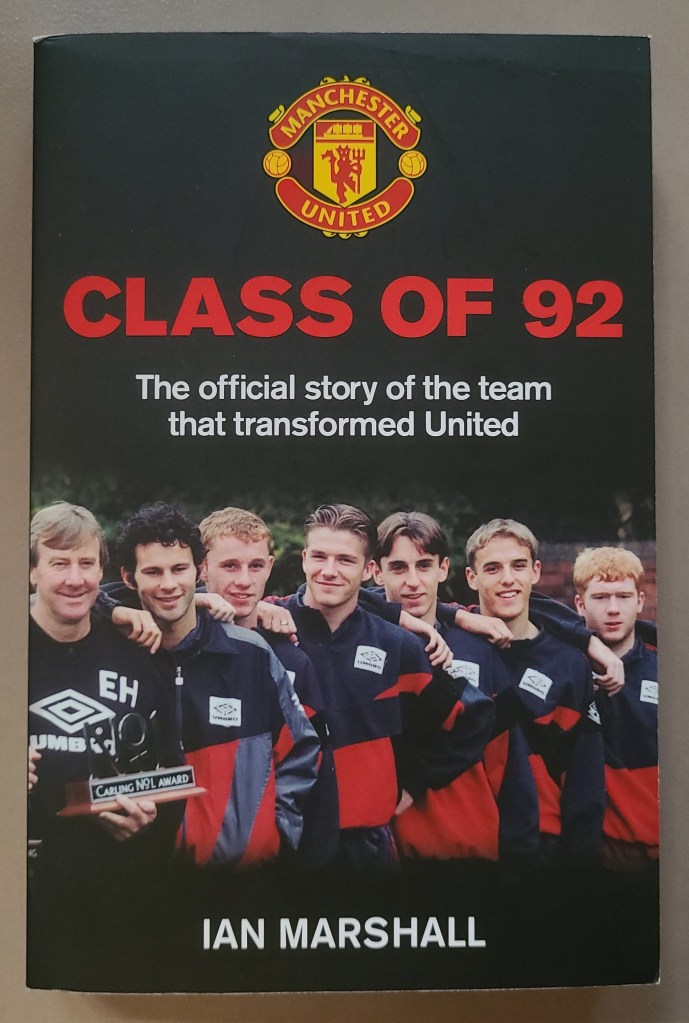
Giggs, Beckham, Scholes, the Nevilles, and Butt. They are part of the ‘Class of 92’: a cohort of Man Utd youth players that achieved enormous collective and individual success in and beyond the game. They require no further introduction. Yet what about Casper, Thornley, McKee, O’Kane, Switzer, or Burke? These names are less familiar, yet they graced the same pitch and teamsheets as their more vaunted fellow members of the Class of 92 in the early-to-mid 1990s. Some may know these latter names by association with Giggs et al., as comparative hard luck stories, or as the answer to a pub trivia question.
In Class of 92, author Ian Marshall tells the collective story of all the indomitable, unsettled, and cruelly curtailed young talents who made up the Class of 92. Through his interviews with the lesser-known members of the team, Marshall spins a fascinating narrative that is very diplomatic to each member, and doesn’t go overboard in throwing plaudits or burnishing the reputations of those selected members who won it all. As such, Class of 92 reads as a dispassionate account of how members of the Class of 92 contemporaneously reacted to, and either adapted or folded to, the extraordinary high demands placed on them by youth team coach Eric Harrison.
“They’ve got to be in love with football…It’s normal for lads of fifteen, sixteen and seventeen to switch off occasionally, but we’re not looking for normal.” Paul McGuinness (pg. 3)
Naturally, GBSNB (for brevity, I’ll shorten the collective presence of Giggs, Beckham, Scholes, the Nevilles, and Butt to this acronym) gets relatively more attention because of their sustained success, and this becomes obvious in the latter chapters as other members of the Class of 92 slew off and away from Man Utd to pastures new for better opportunities.
Yet this focus on GBSNB does not diminish the contributing anecdotes of Colin McKee, Kevin Pilkington, George Switzer, Chris Casper, Ben Thornley, and Raphael Burke among others. All being special players in their own right (Thornley was suggested to be one of the best of the Class of 92), we can see that they do not look back in anger or regret on their relative lack of on-field success or longevity. As Class of 92 was first published in 2012, it looks back at the Class of 92 before they all retired and before some of them took over Salford City in 2014. This serendipitous publication date largely mitigates fawning retrospectives of GBSNB post-retirement and gives more room for the stories of Casper, Thornley, Burke et al. to breathe, settle, and resound.
Nevertheless, Marshall skilfully weaves player biographical snippets throughout each chapter framed by each round of the Class of 92’s successful tilt toward 1991-92 FA Youth Cup glory. These chapters also feature plenty of names of opposition youth outfits from the past that will have you going down a Wikipedia rabbit-hole: Niall Thompson, Adie Mike, and George Ndah, anyone?
“Players must also have a capacity, and even enthusiasm, for hard work…beyond that, apprentices are also gaining in strength as they mature, learning how to perform to a consistently high standard and understanding their role in the team. It is a lot to take on in a short period—the world of professional football is a results-driven business that cannot afford to wait too long. Because of this, some players hit their ceiling very early on, while others have the priceless ability to go on improving. The football careers of Giggs and Burke show how quickly the paths can diverge, even between the ages of 14 and 18.” (pg. 107)
What I particularly like about Class of 92 is its retrospective analysis of the genesis of a youth intake—the Class of 92’s wild success notwithstanding. Watching a young tyro come up through the ranks of our club is a special joy that grows out of personal and in-group identity, geographical pride, and the tribal insularity of us versus them. These qualities are crystallised within the spectre of that young player clocking his or her first professional minutes. One of us, from the ground-up. Their names somehow stay with us, no matter how transitory their presence in the team may have been. We wonder about them, and how they’re getting on.
Of course, we can’t do a retrospective analysis of every youth intake of our club over the years. It would be impracticable. But with the Class of 92, Marshall has hit on a mainline vein of supporter pride that is rarely tapped into in non-fiction long-form despite the minutiae of youth management present in iterations of Football Manager and FIFA games. In having a hand in youngsters’ development, we want to see how players tumble out in the final wash.
Nowadays, the academy transfer market is a shadowy one to many fans due to the likelihood of a club’s top talent being poached by bigger clubs, often without warning and adequate compensation. This stacking of talent is a rich club’s game that many PL clubs—let alone Football League clubs—struggle to retain local and regional talent. This hyper-elite pathway to professionalism virtually guarantees at least a decent football career for youngsters in any of the four English leagues due to the raised standard of individual talent and application honed and shaped by peer competition and youth coaching and support that is beyond anything seen in the 1990s and 2000s.
This is why Class of 92 is an important and worthwhile read for all football fans: it outlines a blueprint of wholesome, on-field sustainability via a talent pipeline that we crave for as it appeals to our local supporter identity. Where many current top academy models exist as a late-capitalist means to identify ‘assets’ to on-sell for profit later, the book would also greatly appeal to supporters of teams further down in the FA pyramid that rely on their youth academies to nurture local talent as a means for existential survival. As such, Class of 92 acts as a manifesto, a retrospective, and a powerful rejoinder to Alan Hansen’s oft-repeated quote of “You can’t win anything with kids.”
“The important thing wasn’t being at United. It was working hard enough to make sure they’d let me stay there.” David Beckham (pg. 29)
STARS: 4/5
UNDER 20: An engrossing retrospective that covers all the angles and unknown corners of the much-celebrated ‘Class of 92’.
FULL-TIME SCORE: The young team, put together only recently, play with a verve and flair beyond their years to romp to a 3-0 win, and in the process, usher in a new spirit of hope for the club’s future fortunes.
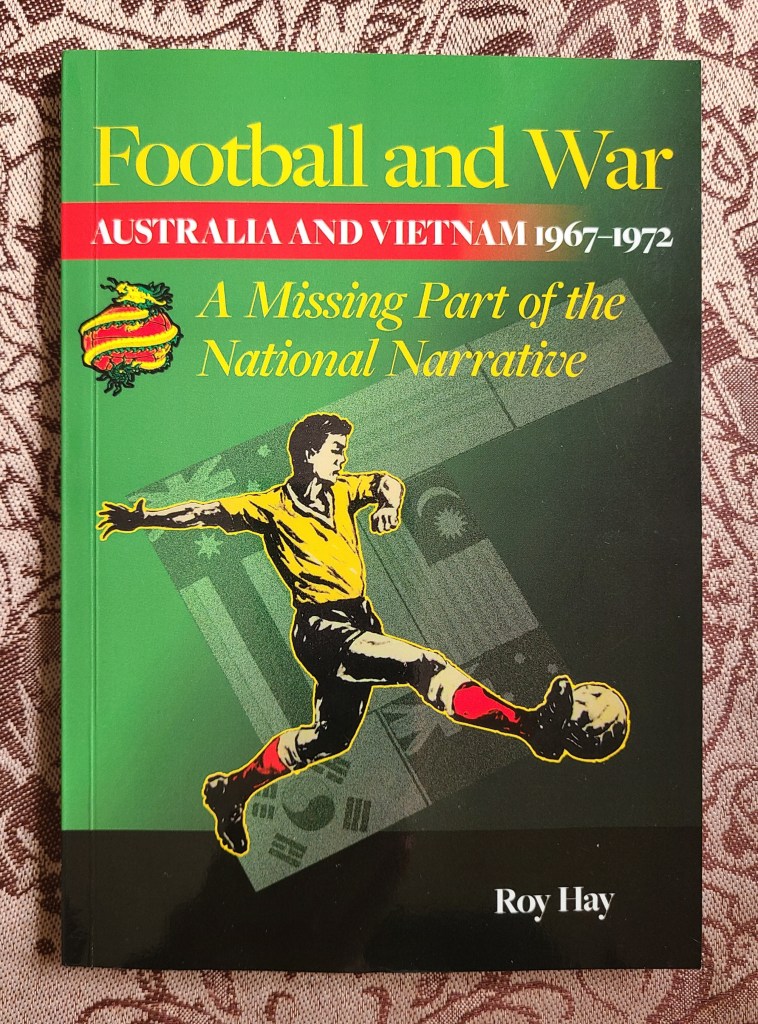
Sometimes I find a very niche football book on a second-hand book shelf. When I do, I wonder if it would make suitable fodder for review. When I saw Football and War: Australia and Vietnam 1967-1972 by Roy Hay nestled tightly between two hardbacks and barely visible in the shadow of the bowing shelf above it, I knew that it deserved to be given the light of day.
The book—its cover coloured with that familiar Australian sport green of Pantone 348C—possesses a frailty suggestive of self-publishing. It’s a wafer of a book that seeks to describe a forgotten part of national lore in a sport that has fought inwards on itself in civil war as much as it has fought outwards on other codes for recognition in Australia. Football and War—now this was niche, and eminently reviewable. It’s time to put on my green and gold anorak.
Football and War by Roy Hay (one of Australia’s most well-respected and eminent footballing and sporting historians, and Football Australia 2025 Hall of Fame inductee alongside Tim Cahill and Sharon Black) is about the Australian national team’s trips to south-east Asia from 1967-1972 during the height of the Vietnam War. The team played a number of Asian confederacy teams in this span of time, and played many of the games in Saigon as a means for the Australian military in Vietnam “to use football as a vehicle to bridge the cultural divide between themselves and the local population”.
Although the veracity of the trips’ diplomatic function and success are under question in Football and War, through Hay’s thorough research, he portrays a portentous nexus of tour success, embedded team camaraderie, and trial by fire across five years that contributed to the team’s qualification for the 1974 World Cup and helped to inch the footballing needle closer into Australian popular consciousness. The 1967-72 period was one of great significance for the national team, and deserving of the lofty appellation of ‘the missing part of the national narrative’.
“The Australian military in Vietnam had begun to use football as a vehicle to bridge the cultural divide between themselves and the local population. So, the Australian involvement in the tournament could build on that. The conditions in Saigon in 1967 were not conducive to soccer diplomacy, however” (pg. 20)
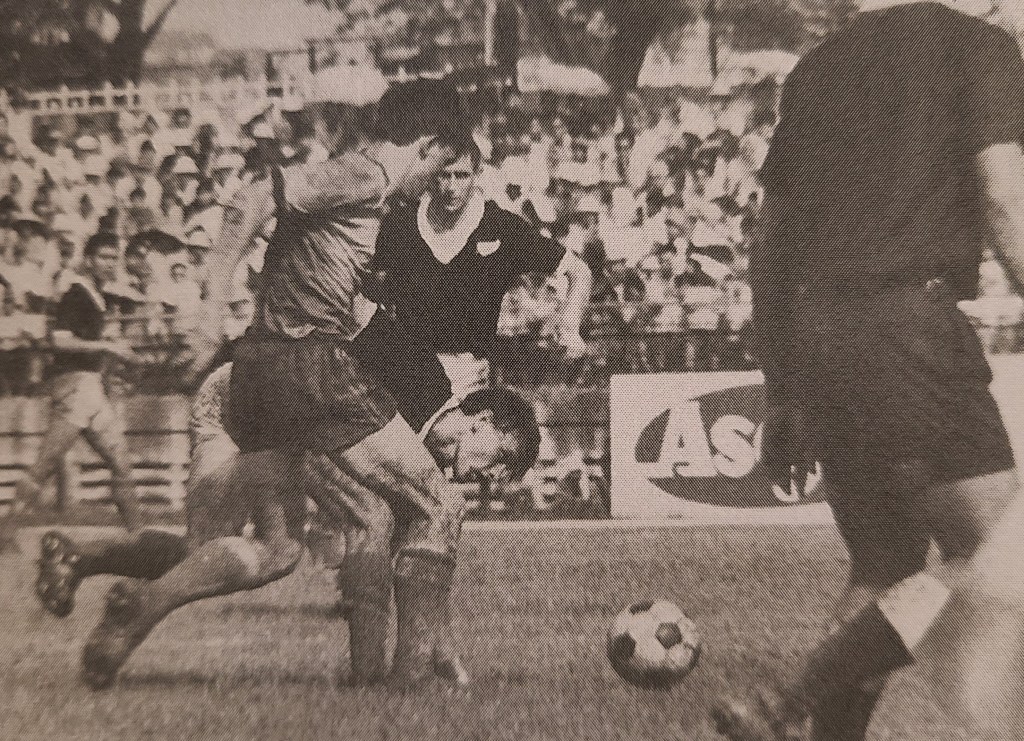
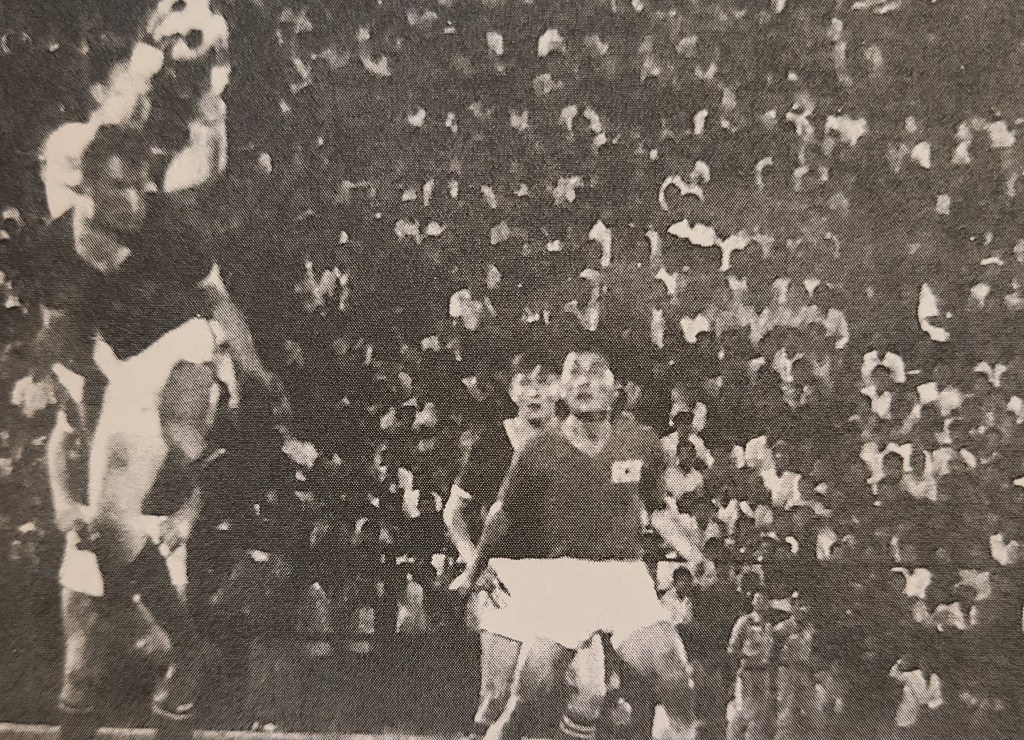
Johnny Warren in action against New Zealand in Saigon.
Hay explores several elements of this now-found, still-unheralded, and long dusted-over missing part in precise detail. Aside from Australia’s glut of wins against other national teams (South Vietnam, South Korea, and Singapore, among others) and local teams (Kowloon Bus Company, anyone?) that led to much fanfare and esprit de corps between players, administrators, and journalists, the players were playing alongside very clear and present dangers on the high-grass pitches of Vietnam. Hay relates anecdotes of partisan local crowds cheering Australia on, and beer-swilling Australian servicemen on-leave cheering the team on even louder; Vietcong intentions of bombing a building where the Australian team was staying; and how amongst the sound of gunfire and artillery in the area, the players were deeply aware of Vietcong match spectators who enjoyed the games enough to lay down their guns for ninety minutes.
“…two Vietcong carrying explosives had been captured half a block from the hotel. Under torture, they said that they intended to blow up the South Koreans who were billeted a floor below the Australian soccer players in the Golden Building” (pg. 22)
Australia versus South Korea.
Hay thoroughly analyses the costs of the tours, from both political and financial standpoints. He draws upon reliable, first-hand sources to add weight to his observations. One of these sources was the former PM, the late Malcolm Fraser, who combed through his personal archives for a diplomatic basis for the 1967-72 trips. The fascinating player and staff anecdotes and political intrigue aside, however, Football and War reads absolutely as dry as chips. There is a cerebral detachment from the topic that is off-putting in places. Hay’s professorial tone reads like an annual report or a Wikipedia entry, rather than a narrative history. The short length of Football and War facilitates an expediency that allows for brief analyses that provide little connective tissue between chapters. As such, the book is an easy read, but not necessarily a read to remember. This is an important point for me.
As a millennial born a full ten years after the Fall of Saigon, my popular consciousness of the Vietnam War has been bounded by Hollywood portrayals, its zeitgeist of protest music, and a brief bus trip through areas of Hội An. Closer to my cultural and national identity, Cold Chisel’s ‘Khe Sanh’, the 1979 film The Odd Angry Shot, and my father’s vague re-telling of his birthday possibly being plucked out for national service, have informed my cultural understanding of Australia’s role in the Vietnam War.I’m probably not alone in knowing more about Australia’s efforts in WWI (Gallipoli) and WW2 (Kokoda Trail) than its role in the Vietnam War. I recognise this as a personal shortcoming—not striving to find out more about events that deeply affected the lives of Baby Boomers; in whose ranks I can count my parents, uncles, and aunts.
This is why I found Football and War to be a bridge for my deeper understanding of the Vietnam War from a cultural identity context. The intersections of conflict, politics, sport, and society that occurred during the Australian national team’s trips to Asia across 1967-1972 offer up a grand opportunity for a longer historical treatment in print. Football and War, in its brevity, perhaps passes up the chance to bring the remarkable story of the 1967-1972 tours to a public that responded so well to Johnny Warren’s Sheilas, Wogs, and Poofters in 2002. Interest certainly exists in the 1967-1972 tours. The Socceroos website has a few articles and interviews about the tours, and articles by Richard Cooke and Les Murray can still be read online. The following extract, from Murray’s article, describes the riot after the Socceroos defeated South Vietnam:
“When the team finally left the stadium, its bus was pelted with rocks. Windows were broken. Young men representing Australia, part-time footballers who worked as tailors, used car salesmen and milkmen, were in fear for their lives. Johnny Warren spoke to me about this event a lot. He was very proud whenever he did. He was proud of ‘the boys’, the sacrifices they made and the spirit they founded. He even suggested that the Socceroos of 1967 had a right to march in the Anzac Day parades, and he had a point.”
From this perspective, the events of Football and War become as much a ‘missing part of the national narrative’ in an Australian historical and cultural context, as in a footballing context. With the 1967-72 tour members yet to receive the right to march in Anzac Day parades, a 2021 article by Chris Curulli sums up how the 1967 tour was consistent with the cultural values that still hold strong today: mateship, persistence, endurance, determination, and sacrifice. Not picking up a weapon should not preclude the members of the 1967-72 tours from reflecting these qualities.
“The Australians played 10 games on that tour and won them all. The camaraderie in the face of adversity was an important element in the mindset that eventually helped the Australians qualify for the World Cup in 1974” (pg. 42)
Describing something as ‘admirable’ can come across as snide. When I call Hay’s work in Football and War here as ‘admirable’, I in no way mean it to be snide. I use admirable here in the sense that Hay has produced a work of merit within the form and length he has confined himself within. But where the brief taste inspires fascination, so it also easily leaves the palate dry. We look to the past to explain the present, and after being so blissfully drunk on the analysis of our drought-breaking 2006 World Cup qualification, similar analysis and extended treatment should be afforded to the pioneering efforts of the 1967-72 tours to instill that teak-like resilience into the latter-day players. Football and War’s brevity hints at a much greater potential left restrained.
In uncovering something that has been ‘missing’ from public attention or inclusion in national sporting lore, Football and War briefly takes the story out of the archives rather than letting it breathe long enough to be well-remembered.
STARS: 3.5/5
UNDER 20: A rigorous retrospective of pioneering Socceroos who brought some cooling footballing diplomacy to the raging heat of the Vietnam War.
FULL-TIME SCORE: The quality of players on the pitch notwithstanding, there is not much to take away from the 0-0 draw that leaves supporters ruing missed opportunities.
RELATED READING:Sheilas, Wogs and Pooftersby Johnny Warren (2002); A History of Football in Australia by Roy Hay and Bill Murray (2016)
You’ve probably seen or heard that Ryan Reynolds’ and Rob McElhenney’s ownership of Wrexham has propelled the club to trophy glory, commercial success, and into American popular consciousness. Welcome to Wrexham, the fly-on-the-wall documentary series and cultural phenomenon that charts Wrexham’s startling rise from National League to Championship over four entertaining seasons, addresses the cynicism of modern-day club ownership by thumbing its nose at PR-massage jobs like All or Nothing.
And if you haven’t seen or heard about it—perhaps that rock that you’ve been living under needs some lifting. For Welcome to Wrexham is stirring viewing, and deserves your attention.
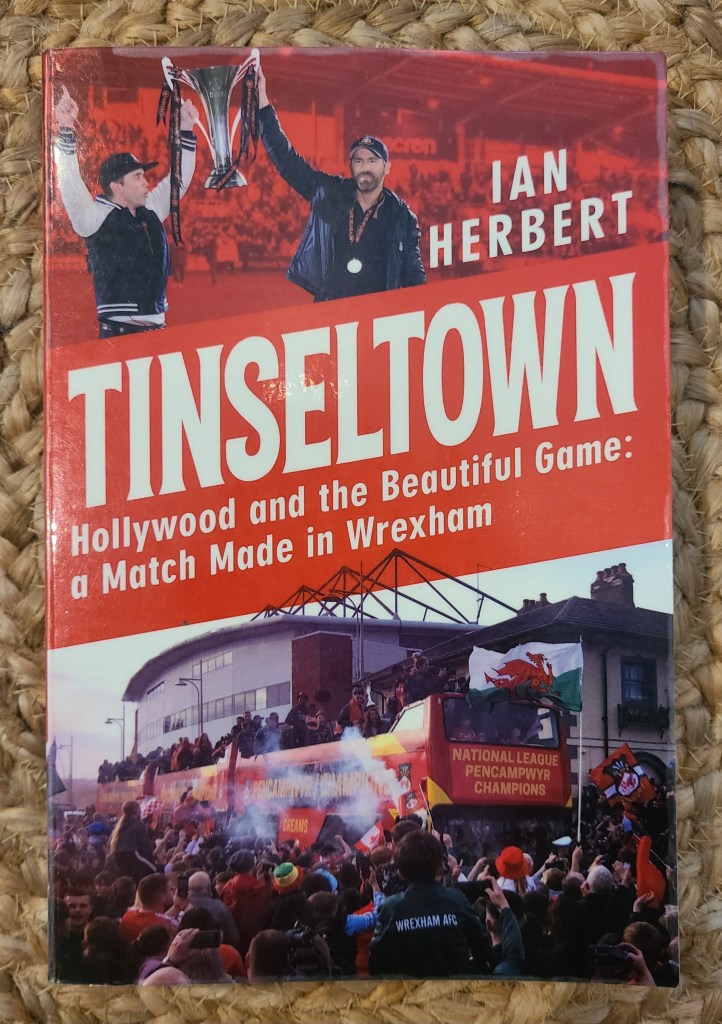
Tinseltown: Hollywood and the Beautiful Game by Ian Herbert is a well-researched and straight-man foil companion piece to Welcome to Wrexham. There is little of the charming snark and wit of the documentary series in Tinseltown, but through Herbert (a Wrexham fan and respected Daily Mail journalist), we can learn more about the club and the city’s history to fully flesh out the angles of anxiety, faded glory, missed chances, and tragedy that haven’t been given the Disney treatment in Welcome to Wrexham.
“Covid’s arrival might have saved Wrexham from relegation but its refusal to go away took what little hope there was left. The turnstile money disappeared, along with the perimeter-board advertisers and the broadcast revenue from occasional live matches on BT Sport. The water and electricity were switched off, the groundsman was paid a retainer to keep out intruders but the turf was no longer cultivated and weeds took over the ground.” (pg. 21)
Herbert writes affectionately about his beloved Wrexham whilst acknowledging the city’s working-class history that is greatly coloured by tragedy. This is a city very obviously under the cosh and living off the fumes of past footballing and industrial glories. Tinseltown’s stories of drug use, juvenile delinquency, and matchday hooliganism underlie the homely football chats over coffee, slow motion redemption shots, and charming stoicism that Welcome to Wrexham routinely serves up.
Tinseltown covers Wrexham’s 2021-23 seasons (which correspond with Season 1 and 2 of Welcome to Wrexham). Familiarity with the documentary series quickly helps us to recognise the knockabout characters around the city (Wayne Jones and Wayne Clarke), the pragmatic heads in the clubrooms (Shaun Harvey, Kevin Mulholland), and the breakout stars (Lili Jones and Rosie Hughes) that are further described in Tinseltown. Herbert also introduces others who don’t appear in the series (for example, club advisor Les Reed, and the shoe repair expert) yet still contribute to the fabric of community and success at the club and around the city.
History features prominently in Tinseltown. Herbert expertly recounts how the Gresford Colliery coal mine disaster of 1934 inflicted multi-generational and shared civic trauma on the city of Wrexham, and how this trauma has infused with the club’s brief snatches of success and its more recent freefall into the depths of the National League. The trauma is palpable as we read that Wrexham’s ignominious survival from relegation from the National League was guaranteed by 0.08 points—a computational reprieve derived from calculating their points-per-game number after Covid lockdown brought an early end to the 2019-20 season. At the lowest ebb of the club’s 156-year history, Ryan Reynolds and Rob McElhenney come in and, well, you probably know the rest of the story (or fairytale).
As an invaluable resource the Wrexham story, Tinseltown shines when providing depth and granular detail to what is only hinted at, or glossed over, in Welcome to Wrexham. Such depth includes:a McElhenney thought bubble is followed up by Humphrey Ker as he scours Transfermarkt and FM for a suitable club for McElhenney to invest in (Wrexham? Macclesfield? Hartlepool?); rumours of a Russell Crowe takeover abound; Les Reed’s incisive spotting of playing talent; the sliding doors moment of Stockport signing Paddy Madden instead of Paul Mullin; and the club being happy to eat fines earned from using the wrong kind of signage for a televised FA Cup game. The nature of these details is darkly humourous considering how the club was run on the thinnest of shoestrings not so long ago—a humour that its owners, as they shoot self-deprecating commercials in the Wrexham dressing room, would readily recognise.
“At a stroke, a decades-old narrative at Wrexham was being rewritten. This was a club which had generally prevailed through managers squeezing value and building quality out of players who cost relatively little, though progress this time (if and when it came) would be inorganic. They were spending for success.” (pg. 133)
Herbert casts his journalistic eye far and wide across Wrexham in weaving Tinseltown’s narrative. He occasionally breaks away to give short, italicised vignettes of various characters around Wrexham. These asides do not always emotionally land, and can feel intrusive and jarring. The methodical pacing of relating Wrexham history and Reynolds’ and McElhenney’s genuineness in conducting due diligence on their ambitious new venture, is blunted by pages of quickfire form and result dispatches from the games in the final run in to the 2021-22 season. These dispatches attempt to set up a thrilling denouement, yet since we already know the ultimate result of it all—having already white-knuckled it through the slick production values in Welcome to Wrexham’s final episodes of Season 2—doesn’t impact as much as Herbert intends.
The quickened pace in the final third of Tinseltown also throws up some avoidable errors, with the most glaring being whirlwind striker for the women’s team and legitimate star of the series, Rosie Hughes, being called ‘Rosie Jones’ across several pages, including a reference to Paul Mullin being “the male Rosie Jones”. These editorial lapses chip away slightly at the credibility that Herbert has worked hard to establish.
One of the most fascinating insights that Tinseltown offers (and is hinted at by the connotation of glittering superficiality of the word itself) come with Herbert’s brief observations of Wrexham becoming a commercial vehicle for advertisers and content creators. Welcome to Wrexham shows replacement goalkeeper Ben Foster coming out of retirement to continue his vlogging of goalmouth scrambles, and using the content for his online channel and podcast. Herbert even writes of how attempts to bring in Hal Robson-Kanu and Gareth Bale to wreak havoc on hapless lower league defences fell through. “Fans didn’t want the club to become a content factory” Herbert writes, “a place where old pros went for a last pay cheque.” As objective viewers of Wrexham’s bankrolled success, we cannot help but feel cynical in an age of contemporary football that gives us more than enough reason to be so. Herbert continues: “…amid the team’s inconsistency, the documentary team began seeing the potential of an episode built around that. It would be called ‘Sack the gaffer’. Again, sensitivities were not spared in the quest for creative output.”
Reading Tinseltown is important because it contextualises and voices our cynicism to Wrexham’s newfound success. What can we make of Reynolds’ and McElhenney’s ownership and social philanthropy in an age when ruthless asset-stripping owners and oligarchs who mobilise the wealth of nation-states to launder reputations, continue to run roughshod over proud club histories? “Why had this story of Rob, Ryan and Wrexham captured the zeitgeist in such an extraordinary way?” Herbert asks. He parses the elements of the Wrexham rags-to-riches story and excels in cutting through the cynicism to give us some answers. These answers help us to cheer Wrexham and Reynolds-McElhenney on, even if only begrudgingly, as the freewheeling counterpoints to the scores of irresponsible owners who have, and continue to, grind proud clubs into dust.
Following Tinseltown’s publication, Welcome to Wrexham has stretched to four seasons, and a fifth (filming Wrexham’s Championship tilt in 2025-26) is forthcoming. Over seasons three and four, we watch as footballing journeymen Steven Fletcher and Jay Rodriguez join Wrexham. These expensive signings are the predictable, banal trappings of bankrolled success; the kind of well-worn names that are somewhat antithetical to the community-focused mandate that Reynolds and McElhenney espouse. Where there’s money to spend, there will be a late-30s, in-from-the-cold big earner to vindicate the realists who know that the price of the relentless push for success in the short-term is long-term unsustainability. When will the fatigue hit? Or even the content fatigue? In Herbert’s Daily Mail article from 4th March, 2025, he writes:
“…it sounds perverse to hope that the club actually don’t win a third successive promotion and make the unprecedented leap from National League to Championship inside three years this spring. I don’t think I’m the only one feeling a sense of unease about that, though. In the cold light of day, I don’t want it to happen… It’s hard to dispel a sneaking suspicion that the breakneck pursuit of Championship football is, to some extent, driven by [Reynolds’s and McElhenney’s] ‘Welcome to Wrexham’ documentary. While the Championship secures more documentary seasons, it’s hard to see a year’s consolidation in League One providing quite the same streaming gold… Wrexham don’t have a training ground. They still only have a temporary stand in place of the old Kop, so the Racecourse will be three-sided when work on a permanent Kop starts… The football journey may have been incredible, but at ground level, little has changed in the five years since McElhenney and Reynolds bought Wrexham.”
Whether Herbert likes it or not, Wrexham currently sit in a respectable 15th place in the 2025-26 Championship season. Tinseltown, in covering up to Wrexham’s promotion to League Two, only tells half of the Wrexham story under Reynolds and McElhenney. And considering Herbert’s recent scepticism, perhaps he has only told half of his story. On the strength and depth of his writing in Tinseltown, a follow-up would undoubtedly be warmly welcomed and similarly fascinating to read.
“We want to become part of your story. We don’t want you to be our story.” (pg. 378)
STARS: 4/5
UNDER 20: A gripping exploration of the Welcome to Wrexham phenomenon that provides a counterpoint to the soullessness of modern club ownership.
FULL-TIME SCORE: Home-grown Herbert, the defensive cover, works tirelessly to ensure that the depth of glittering new talent further up the pitch put in a shift to win the game 3-0.
RELATED READING:My Wrexham Story: The Inspirational Autobiography from the Beloved Football Hero by Paul Mullin (2023); From Hollywood to Wrexham by Peter Read (2023)
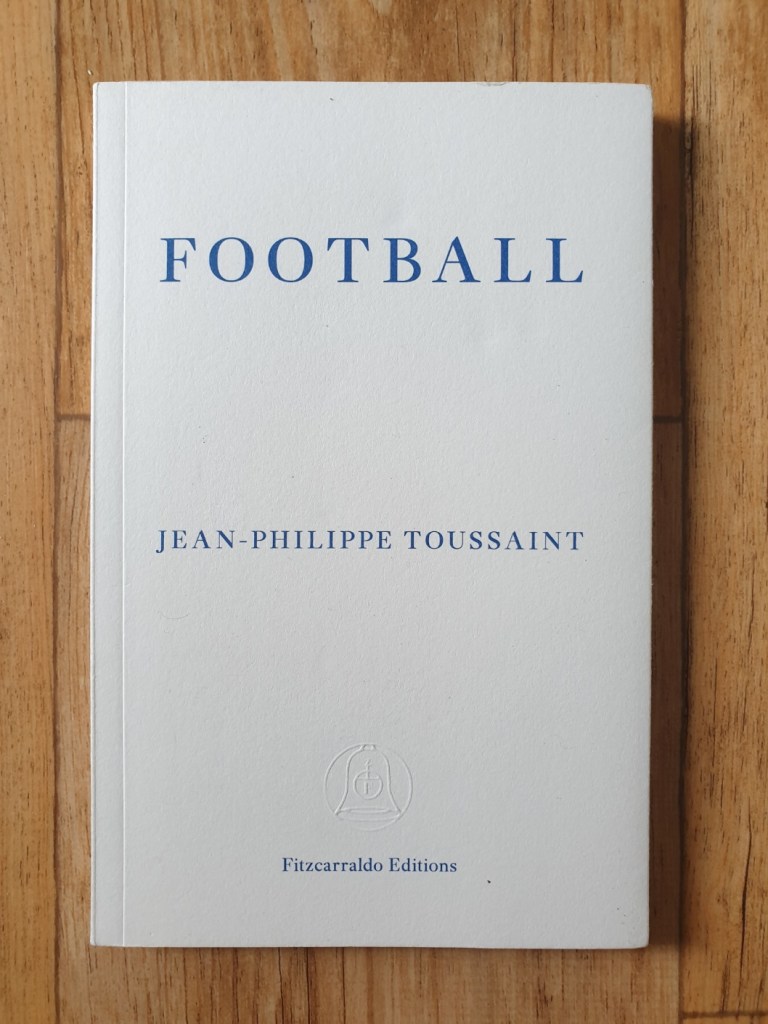
“I cannot dissociate football from dreams and childhood,” Jean-Philippe Toussaint writes in Football. And we, as readers, can be thankful for this. Across eighty-five pages of evocative writing, Toussaint treats us to a selection of lingering vignettes across a life of following football. Framing most of his writing across five World Cups (1998-2014), Toussaint is the aging, harried, and thoughtful everyman who shuffles and scuffs along and against the passing of time.
“This is a book that no one will like, not intellectuals, who aren’t interested in football, or football-lovers, who will find it too intellectual. But I had to write it, I didn’t want to break the fine thread that still connects me to the world.” (pg. 7)
Football begins in 1998, with Toussaint at forty years of age. The year, “though still intimately connected to our lives, to our time, to our flesh and to our history…had accidently sunk its teeth into the edge of the previous century, and inadvertently, found its feet dangling in the past.” In experiencing this transition into middle age, Toussaint recounts early footballing memories. He introduces a recurring motif of the lag and mismatch with time, first in a description of players at the 1970 World Cup, colourised on TV for the first time, leaving their “physical envelope behind and now pursued [their] moves in black and white, leaving behind him the colour of his jersey, which followed him in slight delay.” Despite such vivid memories, he feels a growing detachment with football (realised through his inability to name more than one player of the Belgian national team at the 1998 World Cup). This detachment hints at his general melancholy with life.
“Never have I, as I did in Japan in 2002, sensed such a perfect concordance of times, in which the time of football, reassuring and abstract had, for a month, not substituted but slid, merged into the most enormous gangue of real time, and had made me feel the passing of time like a long protective caress, beneficiary, tutelary, apotropaic.” (pg. 27)
One third of Football is dedicated to Toussaint describing his experiences watching the 2002 World Cup in Japan. Japan is clearly a place that he is comfortable describing in equally rich colour and gloomy substance. Through the neon signs of Shibuya, rain dripping from the ribs of transparent umbrellas, and the convenience culture of 7-Elevens and Family Marts on every other corner, Toussaint effortlessly portrays the buttoned-down culture and colourful, waterlogged kitsch of Japan. The striking scene of a torrential downpour in Yokohama following the end of the World Cup final, where overcautious and polite stewards herd fans with fluorescent truncheons into the Yokohama Metro, is particularly memorable for what it represents: the clashing and melding of cultures at a time when the term ‘globalisation’ was still an unfamiliar concept to many. The 2002 World Cup ushered in an exciting new age for football, represented by Senegal defeating France in the opening match; co-hosts South Korea narrowly missing out on overall third place; European teams flattering to deceive; the raucous partisan Japanese crowds reminding the European and American markets of the UTC+9 time zone…
Like Toussaint does, I must also beg my readers to forgive me for wandering off and dawdling here, for I’m getting to my central point. The 2002 World Cup was a formative footballing moment for many of us, that “perfect concordance of times” that in memory becomes melancholic and slightly discordant. And this is the take-away from Football: thatwhere there was once colour will soon fade and become monotone. As Toussaint tells us plainly, “I am pretending to write about football, but I am writing, as always, about the passing of time.”
Throughout less-than-satisfying experiences attending and watching subsequent World Cups, Toussaint wrestles with his disaffection until difficult times in 2014 force him to face another concordance—that of professional crisis and the absence of existential meaning. The passage where Toussaint struggles with the buffer and lag in a paid stream of the Argentina v Netherlands semi-final in the 2014 World Cup illustrates him as a man also discordant with technology, and with technology being a gauge of progress, he becomes further displaced in modern times. Another storm and downpour frames this closing to Football, providing a form of cleansing and reconciliation to finding some contentment in his existential lag.
“A cycle was coming to an end, leaving me empty and lost. I experienced a crisis, a fleeting moment of doubt, uncertainty and dejection, which lead me to inquire into the meaning of my life and my commitment to literature” (pg. 63)
Toussaint’s claim that everything contained within Football will appeal to nobody is somehow appealing and endearing. The terse title may already put off pontificating intellectuals and raging tribalists (who both think they don’t need to be told about football) who may not commonly seek the middle ground with the each other. Toussaint appeals to those who are fed up, overindulged, and out of time with football, and those who recognise that football isa middle ground, sitting in light and shadow, that we merely dip in and out of as one means to live, rather than an end to live.
Yet don’t misunderstand—Football is a work of philosophic literature from Toussaint, an established literary intellectual of the nouveau nouveau roman (‘new new novel’) school that pushes narrative experimentation and fragmentation in prose writing. As such, Football can be analysed for what underlies the words beyond their surface meaning (and there will be times when Toussaint’s flair for expression will prompt you to consult a dictionary). Toussaint’s writing style of parataxis and cumulative build-up befits his melancholic recollection and a harried search for a place in time (a shoutout is due here to Shaun Whiteside for his sublime translation). Yet despite Football’s intellectual bent, a familiarity with literature isn’t needed for us to understand what Toussaint is telling us.
For although the experiential knowledge gained with the privilege of attending one World Cup, let alone three, is beyond the means of most of us, the spiritual journey of falling in and out with the world game as fortune and time dictates, is familiar. It is above literary pretensions. One of the many things that the COVID-19 pandemic taught us is that sport is inextricably linked with culture and society, and acts as an identity-forming crutch for so many who are marginalised and ignored by society at large. The belaying rope snaps hard against our falling out, but we are inevitably pulled back toward the safety of midweek and weekend fixtures in due time. We keenly know the disenfranchisement of being ‘apart from the main’, and existing in that space where the lack of colour means a lack of meaning. Yet when we do return from that emptiness, we are forever trying to chase back the time lost.
“At every hour of the day, whether I am walking on the beach or strolling up the path through the scrubland to the old tower, whether I’m swimming in the sea or reading in the little garden, when I’m sleeping, a tireless process of ripening is still at work.” (pg. 67)
Toussaint offers this ‘passing of time’ in Football, but in 2025 we can recognise not just the passing of time, but the compression of time with jam-packed fixtures and never-ending content instantly vying for our attention, resulting in the acceleration of time making games, moments, and player careers highly perishable and easily forgettable. Would Toussaint consider his struggles with technology quaint in current times, when we continue to pay top dollar for subscriptions and streams that still buffer and lag despite greater bandwidth to deliver gigabytes of content on-demand? Despite the distortion of our time so that we may more readily consume the increasingly inconsequential, we, like Toussaint, fall into that melancholic middle ground where it takes all of our attention and energy to keep up, only to remain perpetually off the pace.
So, along with Toussaint, we drift back to our memories and to that ‘perfect concordance of times’ to give us spiritual relief. A wisp of Toussaint’s concordance lies in the common denominator between Roberto Carlos, Shinji Ono, Carsten Jancker, and Pierluigi Collina. Such subtle renderings of time and place make Football sparkle. We desire our own “perfect concordance of times” again, like the return of a cleansing storm. Football is Toussaint’s connective tissue with the world. In a football context, what could be more relatable?
“Football does not age well, it is a diamond that only shines brightly today.” (pg. 24)
Football as a means to ‘life sketch’ is an acclaimed substratum of writing, the brilliance of which is shown in works such as Nick Hornby’s Fever Pitch and Gary Imlach’s My Father and Other Working Class Football Heroes. The rich base of reporting and storytelling constantly broadens and deepens. Toussaint’s Football can be added to this. And when ninety minutes seems such a long time to do anything nowadays, you won’t regret the ninety minutes spent reading Football. So, embrace the lag, throw yourself into shadow, silence, and solitude as Toussaint does, and let the time pass without raging against it.
Note: This Fitzcarraldo Editions print of Football also contains Toussaint’s essay ‘Zidane’s Melancholy’, which is not reviewed in this entry.
STARS: 4.5/5
UNDER 20: A hidden work of football literary brilliance that in warning off the wilfully scornful, warms to discerning and disaffected fans.
FULL-TIME SCORE: When the majority of the crowd have left the stadium to beat the traffic before the closing of an uneventful 0-0 draw, the unknown substitute comes on to provide a dazzling cameo, long remembered by those who stayed behind.
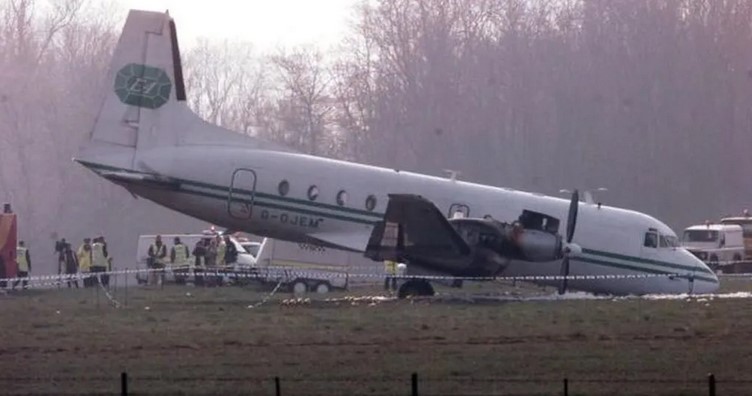
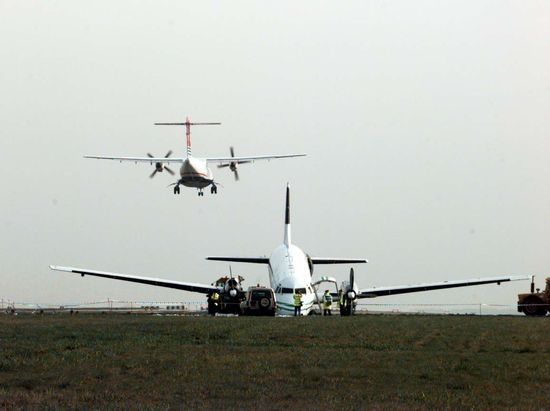
The Hawker Siddeley HS 748 that crashed after takeoff. Photo: PA Images
Catastrophic airplane crashes darkly colour the history of football through the deaths of our heroes past and present. Torino FC at Superga in 1949, Manchester United at Munich in 1958, and Chapecoense over Colombia in 2016 are recent tragic examples of this sad history. In each instance, we mourn the loss of life and lament the joys the lost players had provided and had yet to provide. The passing of time gilds and lionises their lives. And we remember that air travel to fulfill mid-week and weekend fixtures is a necessary part of a team’s pursuit of success; we may remember this, but we take it for granted, just as we do with our own flying experiences. For with the sophistication of modern-day air travel, statistically speaking we will never personally encounter such in-flight danger ourselves in a lifetime of flying.
When a crash occurs—whether or not it results in death—we tend to take notice. On 30th March 1998, the Leeds United team walked away unscathed from a potentially deadly plane crash shortly after taking off at Stansted Airport. A daring act of heroic piloting ensured the survival of all players, passengers, and crew on board. Yet this crash has remained largely forgotten by the footballing world well into the present day, and raises questions about our general perceptions of empathy and gratitude, and how and when we choose to extend those thoughts to survivors, victims, and our own selves.
* * *
So—what on earth happened? Let’s first look at the basic facts:
On the night of 30th March 1998, following a 0-3 loss to West Ham, the Leeds United team (18 players) and an assortment of team staff, fans, and other passengers (26 altogether, including crew) boarded an Emerald Airways flight at Stansted Airport to return to Leeds Bradford Airport. At just after 11:30pm, the Hawker Siddeley HS 748 turboprop aircraft suffered a catastrophic right engine failure seconds after take-off. With the engine on fire, pilot John Hackett decided to immediately land the plane to avoid an in-flight explosion and certain death. Upon landing, the aircraft slid along the runway and overshot into a grassy field where it came to rest, with its nose heavily planted into the ground. All 44 occupants evacuated the aircraft in less than a minute. No significant injuries were reported, and the engine fire was soon extinguished by airport fire crews.
Next, let’s look at the onboard accounts that give some personal insight on the crash:
When the engine failed, some passengers seated on the right side of the plane alerted the crew about shower of sparks and sheets of flame coming from the wing. Upon learning this, pilot John Hackett decided to ditch the plane. Leeds United goalkeeper Nigel Martyn’s game of hearts across the aisle was interrupted. The issuance of emergency procedures led some to confuse the command of ‘fasten seatbelts’ with ‘unfasten seatbelts’, and duly unfastened them when adopting the brace position. Hackett cut the left engine’s power, and the plane dipped down. Leeds United assistant manager David O’Leary said that the plane “came back down like a rollercoaster, and hit the deck.” Bryn Law, the BBC Radio Leeds commentator, said that the plane “bounced along four or five times, for interminable long seconds,” and his co-commentator and Leeds legend Norman Hunter said that they were all simply “waiting for the impact”. Lee Bowyer said, “It’s just gonna blow up. That’s it, we’re dead.” O’Leary continued that “you didn’t know where you were sliding to, were you going to hit a brick wall, or you were going into a house or what…and all of a sudden we slid, and slid, and slid, and stopped, and then it was time to get out of the plane.” According to Martyn, a deathly silence fell over the cabin until midfielder Lee Bowyer got up from his seat to calmly take out his carry-on bag from the overhead bin. Defender Robert Molenaar, anxious of the still-burning engine beside him and striker Jimmy Floyd Hasselbaink, said “Can we hurry up? It’s getting warm here” in an attempt to expedite the evacuation. In the panic, Rod Wallace tried to exit the plane from the right, where the fire was still blazing. O’Leary, seated by the left emergency exit, injured his shoulder by trying to push out the emergency door that would only open when pulled inward. All occupants evacuated the plane; Martyn gave chairman Peter Ridsdale a push when the latter seemed nervous at the prospect of jumping out on to the wing. Martyn walked out of the plane still clutching his hand of hearts. Bryn Law remembers looking back and seeing the plane silhouetted by the orange flames, and bodies dropping down from the emergency exit.
Pilot John Hackett. Photo: Sky Sports
Finally, let’s look at the accident report released by the Air Accidents Investigation Branch in March 2001. The report makes for fascinating reading, and adds a necessary layer of formality to the crash:
The report states that “there was no evidence of any indications, flight deck or otherwise, that could have warned the crew of abnormalities with the engine…There was therefore no reason for the crew to abort the take-off”. An engine failure after take-off would typically involve the pilot to make a ‘go-around’ to account for working through failure check-lists ahead of an emergency landing, but with the devastating fire occurring four seconds after take-off, Hackett feared “for the structural integrity of the aircraft…and aware that a considerable amount of runway remained ahead of the aircraft, he made the decision to re-land…once made, the decision was irrevocable.” Hackett’s decision to ignore protocol and land immediately after the engine failure was vindicated by the report, which stated that “the decision to re-land had to be made rapidly with the information available at that instant. This decision was sensible in the circumstances, as was his decision to take control from the competent but far less experienced First Officer [Gary Lucas]”. Around 27 seconds after take-off, the plane touched down with 448m of runway tarmac remaining ahead of it. The plane slid for another 118m past the end of the tarmac, and finally came to rest on the level grassy field beyond—558m further from where it touched back down. Engine debris was scattered over a distance of 500m, and according to Hackett, there was still 3.5 tonnes of fuel left in the plane, ready to ignite, as passengers evacuated the plane. In the end, Hackett was last off the plane—symbolically putting a cap on the successful emergency that was informed by a quick analysis of danger, swift-decision making, and healthy dose derring-do.
The crash was widely reported upon in the following days and weeks, and eventually became a curious side-note appended to the file of Leeds United’s thrilling rise in the Premier League and Europe in the late 90s and early 2000s, until its devastating fall and eventual relegation in 2003. Yet memory of the incident faded out of the general footballing public’s consciousness over the subsequent 25 years. In 2018, legacy media ran brief stories of acknowledgment of the 1998 crash on its 20th anniversary in 2018. Yet interest in the crash still wasn’t quite piqued until podcasters and online streamers, wanting to take the edge off the pandemic cabin fever, found captivating content by reworking old news for new and fresh angles. Hosts regarded the crash with astonishment and/or novelty, and to enthusiastic questions they received perfunctory answers from ex-Leeds players in interviews. I personally found out about the crash this way whilst listening to an episode of the Let’s Be Having You! The 00s Football Podcastin December 2024. The story immediately intrigued me—I kicked myself for not knowing about it in the first place considering that Leeds was immensely popular in Australia at the turn of the century with its strong contingent of Australian players including Harry Kewell (on board the 1998 flight), Mark Viduka, Jamie McMaster, Jacob Burns, and Shane Cansdell-Sheriff.
The more I read about the crash, the more I wondered how the crash could have been so widely forgotten for so long. I combed through my personal experiences flying for an answer. I’m not a bad flyer. When turbulence hits, or when I feel my stomach drop as the plane passes through an air pocket, I divert the onrushing thoughts of calamity into a warm embrace of rationality. Statistically speaking… I begin to intone. This opening is typically enough for me to dissolve the anxiety that the turbulence, drops, and strange mechanical clunks all induce. The bad thoughts get massaged out. Aspects of the flight that stick in my short-term memory unstick soon after I disembark the plane and pass through immigration and customs at my destination. This cancels out any chance of reflection and learning of what happened. When applied to tens of millions of passengers every day, the cumulative effect of safe air travel lulls us into serene calmness. It makes sense that when there is no threat, there is no remembrance of the conditions that gave rise to that safety and stability. So, we take our safety for granted. It is easy to forget, when we still wake up the next day and continue on.
The collective sense of loss we feel for those killed in disasters from the past (Superga and Munich) and from our living memory (Chapecoense) should behove us to be more empathetic survivors of air crashes, and to be grateful that, despite the utterly overwhelming probability of our in-flight safety, we will arrive at our destination safe and sound. Where we separate from professional footballers in terms of prestige, wealth, and physical prowess, we are one and the same in the act of flying. We ride the same insignificant odds of danger; but if something happens to our heroes in such a space, we know that it can equally happen to us. The ethereal agents of chaos and misfortune are not obliged to bend to our demands and expectations, and when a deadly crash does happen, our emotional proximity to it and its victims gives us a sharp slap to remind us of that reality. Therefore, the act of forgetting is simply denying ourselves the chance to express empathy and gratitude not only to others, but also extending it to ourselves and our own flight experiences.
And so, most of the footballing world at-large forgot about 30th March, 1998.
* * *
Another angle of the crashed plane. Photo: Shutterstock
During my research, I found the Leeds United Crash Memories site. It is a glorious fount of information and visual resources from contemporaneous news reports from 1998 and beyond about the crash, and was created by Carole and Alex Hackett (the daughter and grandson of John Hackett). The site is a commemoration of John Hackett’s and his crew’s actions in ensuring the safety and continued life of the passengers on board. The site has also collected video testimonials from the passengers from that night in 1998. Through these testimonials, the onboard heroics have thankfully been immortalised in football’s historical lore.
Passenger Andy Rafter, in a touching message to Hackett, says that “There ain’t many days that go past and I don’t think about that particular night…after 25 years, it feels like yesterday.” In living his life, Rafter says, “I’ve just tried to be a good person,” and says to Hackett, “You are my hero, a true hero and I wish you good health and happiness for years to come.” I don’t need to recapitulate Hackett’s heroism any longer—the LUACM site does this concisely and expertly. Yet watching the passengers reflect upon the crash, we can see displayed the very human capacity to reflect upon their own mortality and express gratitude for the time given to them.
When we fly, we put our lives in the hands of the pilots and crew. We trust in them to do the proper thing at the right, proper time, and to the right, proper degree. We want every pilot to be a John Hackett, or Sully Sullenberger, or their ilk in experience and wisdom. With this trust in place, we leave the business of flying to the pilots in the cockpit. We are blind to ominous storm clouds ahead, deaf to the squawking of radio chatter, and uncomprehending of an importunately blinking red light. We leave them to their work, much like we leave our surgery to the doctors, and the sausage-making to the butchers. For our comfort, we remain unknowing of what they must know and deal with.
When it comes time to show gratitude for a safe landing, we typically direct a cursory thank you to the cabin crew as we disembark the plane. Our thanks are extended equally to the pilots through the cabin crew. Other shows of gratitude, such as the round of applause that sounds when rubber hits runway tarmac after a bumpy flight is seen by many as old hat, patronising, and obnoxious. Therefore, we limit our own opportunities of reflection. Creating a commemorative website every time a flight touches down safely would of course be hopelessly impracticable. Reserving a space in our mind for more than a moment’s appreciation and gratitude for safe passage across borders and time zones is enough; yet too often our minds are already on to the next thing, the next distraction, in our schedules and lives. This is why the LUACM site is so memorable and striking. The near-tragedy reminds us, but for the grace of God, we may experience such a horrible experience, and if we can extend gratitude and relief that our heroes are safe and can take the field for the next midweek or weekend fixture, surely, we can extend the same emotional courtesy to the wealth of experience and our own personal convictions that brought us back down to terra firma—especially when a brief round of applause is seen as too much.
* * *
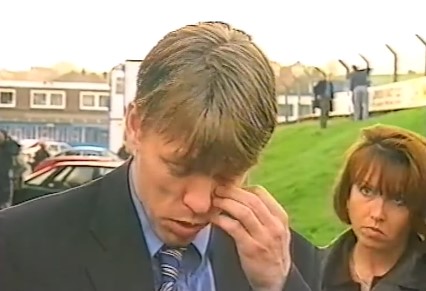
Gunnar Halle interviewed the morning after the crash.
After Jimmy Floyd Hasselbaink had escaped the plane, he was asked by one of the crew if he was OK. “Am I OK? You call that a fucking takeoff?” he said. And we may well have asked the same question to the other passengers then and now. There isn’t a wealth of interviews with players and passengers in the hours following the crash. Leeds defender Gunnar Halle gave a brief interview after stepping off the coach at Elland Road. “It could have gone a lot worse,” he said. Gary Kelly gave an interview eight days after the crash prior to stepping out on the field against Chelsea. Then, of course, there are the calm and surefooted interviews given by David O’Leary. Amongst the players, there is very little to glean about the players’ emotional state from that time. We only get this from the LUACM video testimonials of players 25 years after the crash. We can, fortunately, defer to the opinions and thoughts of others outside the immediate confines of the Leeds United dressing room.
One of the most interesting perspectives is from Frank Taylor, the sole surviving journalist aboard the 1958 Munich air disaster, in TV interviews following the 1998 crash. He advocated for players to adopt a phlegmatic attitude post-crash, citing his own, and the Man Utd players’ he travelled with, long recovery from life-threatening injuries sustained in the 1958 disaster. That colonial, stiff upper lip disposition is reflected in quoting his then-doctor: “You should remember you had a blackout, and you awoke in a hospital. Your friends had a blackout, and they’ve awoken in eternity. It’s anybody’s guess which is the place to be.” Taylor emphasised the need for players to simply get on with their lives.
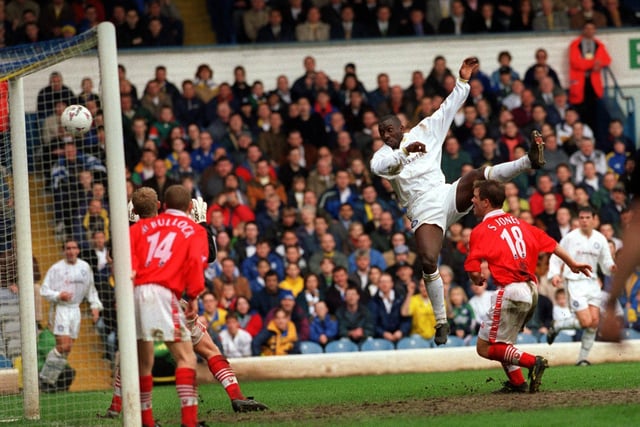
Jimmy Floyd Hasselbaink heads home against Barnsley days after the crash. Photo: Bruce Rollinson
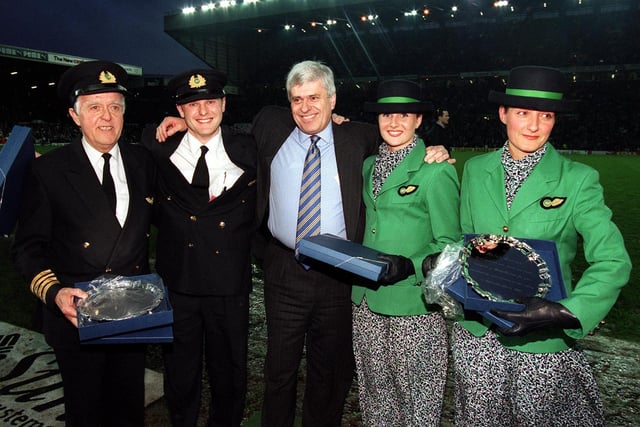
Fortunately, the players and passengers were able to walk away from their crash, forty years after the Munich disaster. They walked back to the Stansted terminal, shaken and stirred, and waited for the coaches to arrive to take them back to Leeds. During the three-hour wait at the terminal, wherein players called family and ate snacks, Peter Ridsdale noted the “strange camaraderie between us all.” Back at Leeds the next morning, players were given the day off to take stock, and to focus on the home matches against Barnsley and Chelsea three and four days later respectively. Apart from Lucas Radebe—who appeared in the Chelsea fixture—the Leeds United players featuring in both matchdays were all aboard the crash. Eight days after the crash, referencing the aforementioned ‘strange camaraderie’, captain Gary Kelly said that the crash “has just brought us all together so much, it’s just unbelievable…we’re rooting for one another now.” On the Chelsea matchday, John Hackett and his flight crew were commemorated on the pitch at Elland Road in front of 37,276 fans, and were given engraved watches and plaques. The James Bond theme even played over the tannoy. “All in a day’s work,” Hackett said in a press conference at the time.
John Hackett, Gary Lucas, Peter Ridsdale, Helen Hammond, and Nicola Lomas being celebrated on the Leeds United v Chelsea matchday, April 1998. Photo: Varley Picture Agency
Everyone got on with their job, phlegmatically so—especially the players. In those eight days following the crash, Leeds United won both their matches. Outwardly, on the pitch, survival seemingly enlivened and galvanised the players. They would continue flying, a necessary part of being a professional footballer—with some taking part in the 1998 World Cup, and from the following season until the end of 2002, Leeds United would fly abroad to play in Europe.
It defies belief that anyone could continue flying so soon after such a traumatic experience. Yet getting back in the air as part of ‘exposure therapy’ is a recommended way to overcome aerophobia and flight anxiety following a crash. Psychotherapy and Cognitive Behavioural Therapy (CBT) are also preferable courses of treatment over straight doses of medication. In an NBC article from 2018, one crash survivor highlighted the importance of simply getting back into the air. This seems to reflect the experiences of some of the passengers on the 1998 crash. Stephen Pygott flew again days after the crash—if he hadn’t, he’d never have flown again. Alan Swift, the Leeds United physiotherapist whose brother was injured in an unrelated plane crash, flew three weeks later with the same airline, on the same make of aircraft. Bryn Law took to flying again, but still experiences those sharp pricks of memory from 1998 when doing so. Lee Bowyer still gets nervy when flying, but continues to do so because he still wants to see family and the world. “If you’re nervous of flying,” Bowyer says, “fly with me. ‘Cause it can’t happen twice, surely.” The necessity of air travel for the sake of their livelihood and family perhaps brute-forced a solution for the passengers, and trauma be damned.
Knowing that many people would simply never board a flight again after experiencing such trauma makes the emotional efforts of the Leeds United players to actually do so a herculean one.
* * *
Peter Ridsdale, in an interview after the crash, said that air travel was “something that [the players are] going to have to confront.” Perhaps he was speaking for himself, too. At the time, players would have had to confront the anxiety, burgeoning phobias, and PTSD that could have gone undetected in the days and weeks after the crash. Trauma is bespoke to the individual, and it can be unrelenting in its unfathomably cruel edges and dark depths. Professional footballers live and perform in the limelight, and must develop a supreme mentality and high standard of physical prowess to succeed in football. Signs of their humanity manifest in mistakes on and off the field; these mistakes can be career-killers when passed through the prism of concentrated public attention and judgment, and the 24-hour news cycle. Purcell et al. in 2019 stated that even into the late 2010s, there was “no comprehensive framework or model of care to support and respond to the mental health needs of elite athletes” and urged the development of an adequate framework that, among other elements, focused on early intervention care and support for athletes who experienced stress levels exceeding their ability to cope. The presence of sports psychologists and therapists within club structure may not be enough to stave off what overcomes an athlete’s much-vaunted, so-called ‘supreme’ mentality. In the end, athletes are affected by the same things that affect us. Disaster and trauma are great levellers. Dennis Bergkamp famously suffered from a fear of flying, and Jesús Navas has suffered from extreme homesickness during his career. Yet players must get over it in double-time for the sake of continued on-field results.
An indication of this expectation of players is reflected in the vox pop interviews of two Leeds United fans on the street on the morning after the crash in 1998. One said, “As long as they’re all right, I don’t care”; whilst the other said, “I hope it doesn’t affect the play on Saturday.” Just get on with it. This perhaps dated catchcry and being ‘phlegmatic’ in the face of disaster and trauma are incompatible with a greater focus on acknowledging, recognising, managing, and treating declining mental health across society. To suggest that we simply ‘get on with it’ is antithetical to, and is a repudiation of, good mental health practice and mindfulness. There is nothing wrong in empathising with someone’s emotional pain and trauma without expecting anything back—this is another truth that the LUACM site tells us. It shouldn’t have to take an air crash to practise it.
In a great show of empathy, Leeds United and Aston Villa observed a moment of silence before the kick off of their December 2016 fixture for the victims of LaMia Flight 2933 over Colombia—a crash that basically wiped out the entire barnstorming Brazilian football club Chapecoense in November 2016. However, there have been instances in recent years where Leeds United fans have chanted about the Munich disaster in a tit-for-tat with Man Utd fans chanting about the two Leeds United fans killed in Istanbul in 2000. Where the capacity exists to show genuine empathy, there exists the snubbing of it in the malicious brinksmanship with opposing fans. Bryn Law commented on this in 1998, drawing upon his own experience of the crash, stating that for anyone to experience such trauma and still continue to chant about Munich would make them “subhuman”. This infers that all fans experience empathy and grief for those that they have emotional attachments to—and clearly, if reports of recent hypocritical chanting are true, then the capacity to remember may not always crossover with the capacity to be empathetic.
* * *
I began this write-up shortly before the tragedy of Jeju Air Flight 2216, wherein 179 of the 181 passengers and crew were killed when the plane crashed upon arrival at Muan International Airport, South Korea, on the morning of December 29th, 2024. This tragedy was simply unfathomable to comprehend by an already-grieving Korean nation still recovering from the sudden political instability caused by then-President Yoon Suk-yeol’s declaration of martial law on December 4th. Having lived in Korea now for many years, my wife and I woke up on the 29th to the news dominated by the crash. When news filtered out into the Korean streets on that wintry Sunday, the usual chirrup of the mid-morning stopped. I opened up the window of my fourth-floor apartment, and was struck dumbfounded by the lack of noise outside. The palpable quiet was disquieting. People inside, safe from the cold, watching the news and mourning for countrymen and women in collective grief. The sky was grey outside, being winter after all, but it felt like that sky was falling.
The causes of the crash, still under investigation at the time of writing, strike sharply at my thoughts. Both crashes—from 1998 and 2024—demand my attention. A couple of days after the Muan crash, the two most visible Korean footballers on the world stage in Son Heung-min (손흥민) and Hwang Hee-chan (황희찬) played against each other in the Tottenham v Wolves fixture. Hwang Hee-chan scored the opening goal for Wolves, celebrated, and then bowed his head in remembrance for the perished in the crash days before. Son Heung-min missed a penalty for Spurs. The match ended 2-2 and heaped more pressure on Spurs’ embattled Australian gaffer Ange “Mate” Postecoglou. Advertisements for ‘Squid Game 2’ on Netflix rounded the digital hoardings at Spurs’ Stadium, reminding everyone of the quality and validity of Korean-language content in the age of streaming. The Korean language uses the expression ‘Leeds Day’ (리즈시절, Lee-jeu si-jeol) as an everyday translation for somebody’s ‘heyday’, in reference to comparing Alan Smith’s shining Leeds United career with his injury-plagued time at Man Utd.
All these connections of my identity, spiritual makeup, interests, passions, and home entangled with each other; and more so than being an ode to noting things down contemporaneously, these connections deepened my received grief for the perished aboard the Muan flight, increased my empathy for Hwang Hee-chan and Son Heung-min for their collective loss, and solidified my desire to write something as a way to process my own thoughts on what was going on in my head. The cure to abhorrent and revolting chanting should not be derived from having to endure the trauma first-, second- or third-hand of a plane crash. And with fewer bastions of empathy, gratitude, and genuine self-reflection in public let alone on the internet, a site such as LUACM should be lauded for its aim in conveying a promise of simple and enduring beauty—a promise to remember, and in promising this, celebrating our capacity to empathise with others and ourselves.
* * *
John Hackett is duly remembered as a hero. And in many hero stories, there are often unheralded victims that act heroically. Just as Hackett and his flight crew kept flying, so did the other passengers aboard the flight. They went on with their lives, despite the external and internal turmoils that sought otherwise. Leeds United director and survivor Alec Hudson helped to build 4,000 council homes in Leeds. Gary Kelly has a cancer support centre named after him, and Norman Hunter’s annual charity event raises funds for cancer research. A wealth of managerial talent teaches the next generation of players. According to the LUACM site, 47 children and 41 grandchildren have been born to the passengers of the 1998 crash to date. One of those born was Erling Haaland, son of passenger Alfie Haaland. Less than eight days after the crash, Leeds United captain Gary Kelly became a father to his first son, and was there to see it. No greater immortalisation of averted disaster can be ascribed to John Hackett’s actions than the preserving of the life and time of those on board, and those that were yet to come.







 Dispatches from Row-Z