
I Think Therefore I Play – Andrea Pirlo

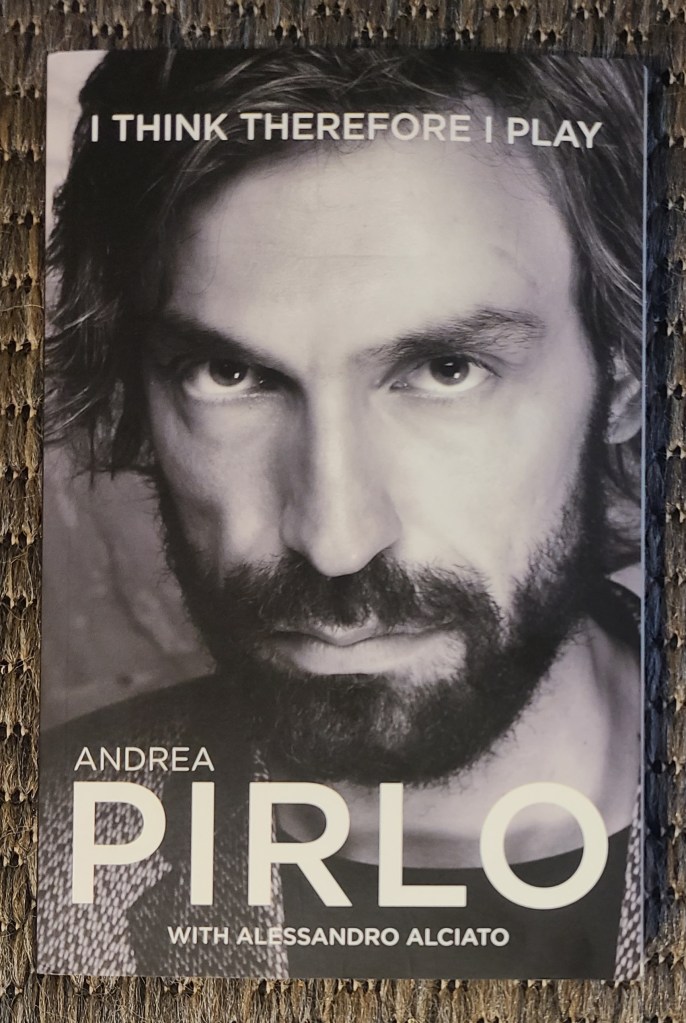
At the end of Andrea Pirlo’s autobiography I Think Therefore I Play, Pirlo writes, “I know how to think.” He asserts this to remind the reader of something that he fears went over our heads: that he writes and reflects with the same creativity, elegance, and vision that he played with. As readers we certainly don’t need reminding. The title itself, coupled with Pirlo’s glowering cover pose that echoes his enduring prestige as a player, sets the reader up well with the expectation that a gloriously wild philosophical ride is ahead.

I Think Therefore I Play is a bonkers book written at a frenetic, whiplashing pace that is best read in a single sitting. It scratches many itches, and although it was first published over ten years ago, it still comes across as mostly fresh with its brashness and diversion from autobiographical convention. It is co-written by Italian journalist Alessandro Alciato and translated into English by Mark Palmer. These added layers of treatment still capture Pirlo’s voice and his reflections on the events that catapulted him to legendary status in Italian and world football.

“…but perhaps they wanted to stick new faces in their Panini album, hear new stories being told. They’d got used to the things I did, my movements, my creations. They weren’t awestruck any more. In their eyes, the extraordinary was in real danger of becoming normal. You can’t be Pirlo any more.” (pg. 4, on leaving AC Milan)

Readers will not be disappointed with Pirlo’s descriptions of: his performance in the 2006 World Cup and that Panenka against England; the perpetual heartache of Istanbul in 2005 despite getting revenge on Liverpool two years later; being marginalised at AC Milan and his sparkling revival at Juventus; being in the running for the Ballon d’Or; and embracing his role as the paragon of elegant technique in the regista role he made his own.

Pirlo is not backward in coming forward. Loyalty and friendship (“Let’s go piss off Gattuso”) are key themes in his book, even when his honouring of Berlusconi and Agnelli come across as overly cloying. He also displays a flair for the lyrical, metaphorical, and cultural. In no other football autobiography will you read a Monica Lewinsky simile or the words ‘equidistant’ and ‘suppository’. You likewise wouldn’t see references to Children of the Corn, Woody Allen films, Pippo Inzaghi’s bowel movements, or a description of pre-match warm ups as “masturbation for conditioning coaches” elsewhere. Pirlo’s philosophical bent is borne from his on-field standing, so his assertion that he knows how to think does much to scaffold the wanderings of his mind that are worthy of inclusion in the book.

“…if the whole Istanbul experience was a suppository, it could find no escape once inside us. Every now and then, I feel it move, letting me know it’s still there, asserting its presence. It calls me by name and it’s a pain in the arse in the truest sense of the word.” (pg. 84, about the 2004-05 Champions League Final loss to Liverpool)

Yet I Think Therefore I Play suffers from the same issue that befalls many autobiographies: the inclusion of token, trite, and age-like-milk stances on the knotty issues on-and-off the field that may never be adequately resolved. Pirlo’s opinion about the introduction of technology to aid referee decision-making would have been shallow back then, and comes across as painfully naïve in current times. His tentative solutions to match-fixing are wishy-washy.

Personally, I found his opinions about tackling racism galling in its timidity. In regards to walking off the pitch in solidarity with the victim, he writes, “…in purely theoretical terms…I don’t think it’s the best way to make a stand against racism: for me, it’s more a surrender than a reaction” and “It’s too delicate a subject to plan your response in advance”.

Elsewhere, in regards to Juventus being stripped of the 2004-05 Serie A title following Calciopoli, Pirlo writes, “a title that’s taken away and then not assigned or handed to another team remains an honour you’ve won” (I wonder if Lance Armstrong thinks the same). And readers can snort at Pirlo’s comment of, “I wouldn’t bet a single cent on me becoming a manager, though. It’s not a job I’m attracted to” knowing that five years after this book was written, he was managing Juventus in the Champions League.

Taken as a whole, the point of I Think Therefore I Play is to invite comment and controversy, and Pirlo’s statement of “I know how to think” is a challenge to readers to see the game in the lines and exquisite curves that only he can see. His philosophical arrogance, coupled with his frenetic, off-beat style, creates an alluring syncopation that is hard to dislike. Over 150 pages of this makes for blistering reading, as long as you can get through the more tedious forced opinions toward the end.

“I can’t abide the cliche “only the team’s success matters–I don’t care about my own.” It’s the tiresome complaint of those who have no personal ambitions, whether for want of class or lack of character. For me, the team counts a huge amount but if I forgot about myself, I’d be doing my teammates a disservice. Many individuals make a team, just as many dreams make a triumph. And if you’re really lucky, they make history as well.” (pg. 119)

Finally, I want to shamefully repurpose one of Pirlo’s comments about technology to attach wider value to I Think Therefore I Play; that comment being,“Truth is the winner.” In his book, Pirlo offers nothing but his truth at the time of writing. That truth may sound discordant with what we know of present-day football, but to me, the passing of time grants his truth fragility. His voice was the most dominant in a new generation of Italian footballers that won the 2006 World Cup, and the passing of that generation has resulted in the tragic decline experienced by the contemporary Gli Azzurri after its failure to qualify for three consecutive World Cups since Pirlo’s international retirement.

However Pirlo’s truth resonates now, it is representative of the fragility of dominance. We remember Pirlo fondly, and grieve his absence on the field similarly to how we grieve Italy’s absence in the World Cup. The loss of elegance and grace may be a form of spiritual death. In this respect, we might demand more of I Think Therefore I Play, and it is a shame that with Pirlo leaning into being brash and bombastic, we don’t get enough of the vulnerability that typically manifests from genius.

Power through I Think Therefore I Play by all means. But regard each chapter as one of his signature passes that, whether you like what the chapter says or not, will never drift too far away from you.


I’d also like to add a few more points that I wanted to keep separate from the review.

The first is that readers may remember that I Think Therefore I Play was published in English a year after Zlatan Ibrahimović’s autobiography I Am Zlatan Ibrahimović was published in English. At the time, Zlatan’s book was both regarded as the vanguard of the new breed of football autobiography and one of the best football autobiographies of all time.

When I Think Therefore I Play was released, I remember that it basked in the radiance of the compelling honesty that made Zlatan’s book so refreshing. Therefore, I admit that I cannot think of Pirlo’s work as entirely separate from Zlatan’s due to both their nature of disclosure and the publishing environment at the time. I don’t think that I Think Therefore I Play is deserving of similar critical acclaim given to I Am Zlatan Ibrahimović, but I don’t want this personal yardstick of mine to dissuade you from enjoying I Think Therefore I Am on its own merits.

Now, for full disclosure: I am an Australian who still feels the disappointment and heartache of the Socceroos’ 0-1 loss to Italy in the Round of 16 of the 2006 World Cup. Italy won it all that year, and Australia was one of the stepping stones that Italy used to reach that ultimate glory. So, when I think about Pirlo, I think about this match above all.

In the match, after Materazzi was sent off in the 51st minute, Australia did its best to make life hard for Buffon and Italy’s defence. With Gattuso and Zambrotta yellow carded, Australia fed off Italy’s frustration. However, no Australian shot seemed to hit the target. Cahill headed over the bar when he would have ordinarily scored, and Aloisi fresh-aired an overhead kick that, had he connected, would have put Buffon in some trouble. At the other end, Toni and Iaquinta were misfiring, despite Pirlo doing his best with his delicately lofted balls into the box. With no goals seemingly forthcoming for both teams in normal time, Australia would have liked its chances in extra time with its numerical advantage.
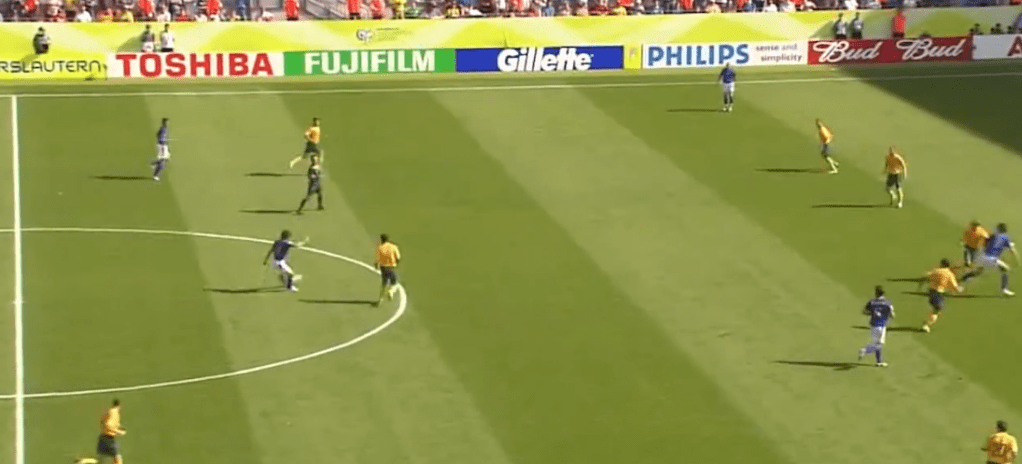
Pirlo, over the ball, about to send in a centimetre-perfect pass to Luca Toni, in the match versus Australia at the 2006 World Cup.

With the last attack of the ninety minutes, Italy’s Grosso skinned Bresciano in the corner, went deep into the box, and enticed Lucas Neill to casually sweep his leg at the ball. Grosso fell, or dived, over the flailing Neill, and the referee pointed to the spot (about this event, I land more on the “Neill, what the bloody hell are you doing!?” rather than the “Grosso, you bloody cheat!” side of the narrative, as it was criminal of Neill to make that kind of tackle in the box at that time). Totti converted the penalty, and Italy went through.
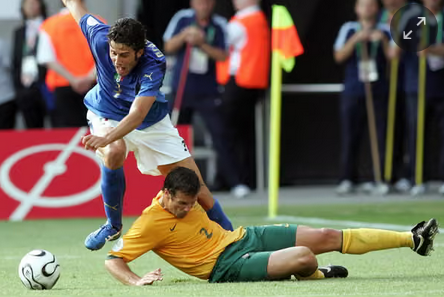
Lucas Neill tackles Fabio Grosso. Photo: Johannes Simon/AFP/Getty Images

The result is both Australia’s high watermark in World Cup finals history, as well as being a big part in Italy’s World Cup lore.

Naturally, I was very interested to read that Pirlo believed it shouldn’t have been a penalty. Even if his admission may come across to some as an empty example of ‘hindsight sportsmanship’ after triumph, it is nevertheless the first admission of its kind that I’ve read from any of the Italian players or staff involved in the match. So, credit where credit is due. However, it is still of little consolation to Australians considering that in an instant Totti’s penalty spelled the end of the Socceroos golden generation that rode the otherworldly groundswell of public support at the time, and robbed Australians of that sweet enchantment for the Socceroos that hasn’t really returned since.

From the pen of Pirlo comes the bittersweet truth.

I am as fascinated by Pirlo’s role in this match as much as I was captivated by Pirlo’s on-pitch role as the greatest regista in football history. As much as I remember Pirlo caressing and protecting the ball with his hypnotic turns and feints out of an opposition press in order to design another visionary pass, I also remember his name in drop caps on the back of a blue jersey, attempting to orchestrate Australia’s downfall under the afternoon sun in Kaiserslautern. The once-ignored kid, playing his own game, and letting others be a part of it.

STARS: 3.5/5

UNDER 20: An attempted balancing act between Pirlo as the player and Pirlo as the writer doesn’t completely hit the mark.

FULL-TIME SCORE: The floating cucchiaio from the penalty spot wins the game for his team 1-0; fans and media laud the goal as representative of his sublime genius or smug arrogance.

RELATED READING: I Am Zlatan Ibrahimović by Zlatan Ibrahimović (2013); Impassibili e maledette: Le invenzioni di Andrea Pirlo by Roberto Ferrucci (2014)
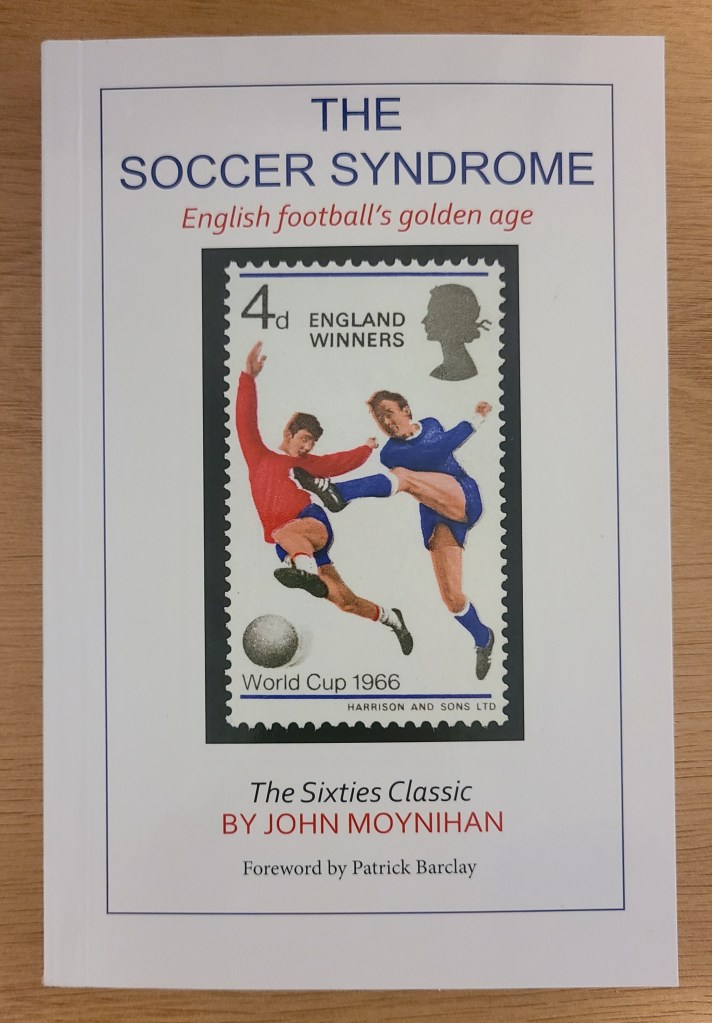

The Soccer Syndrome – John Moynihan

We should be so lucky that the history of football has allowed for a rich and varied literature that can convey the timelessness of several aspects of the game. In terms of genre classics, The Soccer Syndrome by John Moynihan (a respected Sunday Telegraph football journo), originally published in 1966, endures in popularity for its gritty evocation of supporters in their element, whether they be in the stands, in the Sunday league mud, or outside the stadium cadging autographs.

In The Soccer Syndrome, first published in the lead-up to the 1966 World Cup, Moynihan relates his footballing memories from the 1940s and 1950s, and writes contemporaneously about the burning questions facing English football in the years ahead. The Soccer Syndrome reads as particularly portentous considering that the Three Lions ‘brought football home’ in the World Cup that year, and as such Moynihan’s writing conveys a strong sense of nostalgia for wholesome, fan-facing, toiling football of the mid-20th century that those old enough to experience it will cherish. The timelessness of The Soccer Syndrome lies in the fan experience that is difficult to supplant even in the early 21st century: the grittiness, pettiness (“they did not appreciate football, only successful football played by their own side”), hoarse barracking, pitch-side noises and malodours all combine to create a sense of enduring joy that we can all, sixty years after its publication, keenly recognise.

“Alf Ramsey, the former Dagenham grocer’s boy, stands to win a prestige fortune or lose all by July 1966, for England’s performance will be judged by this.” (pg. 41)

The strength of The Soccer Syndrome lies in the chapters where Moynihan is several degrees removed from the stadium. These chapters read almost like short stories in their subjective messaging. And through them all, the line between quaint and risqué is repeatedly blurred (a tea party while watching the ‘Matthews Final’, and a mysterious tryst in a Paris café while the 1958 World Cup final plays on a TV nearby) that distinctly reflects the rise of football celebrity with changing societal values. Moynihan also spends much time writing about his on-pitch heroes (in particular Tommy Lawton, and Sirs Stanley Matthews and Tom Finney), and through this prism he describes the styles of then-contemporary players (Denis Law, “the greatest footballer in Britain today”, for example) and tactics (questioning England’s use of the 4-3-3). Footballing historians will get much out of these opinions from a historiographical standpoint, even if younger readers in their 30s and 40s may read with glazed-over eyes these often long-drawn recitations of British footballing toil before globalisation.

Nevertheless, Moynihan’s perspectives on legendary 20th-century English footballing figures such as Matt Busby, Stan Cullis, Jimmy Greaves and Bobby Moore (the latter two’s potential role in the then-upcoming 1966 World Cup especially) are enlightening and valuable. His lament for Duncan Edwards is moving. All of these serve to fill in anecdotal gaps describing British footballing royalty now shadowed into an incomprehensible past to someone in the present.

“I can still hear [Alfredo Di Stefano’s] staccato commands during a match between Real Madrid and Arsenal at Highbury. They sounded like HA, HA, HA, mere barks as he rolled the ball to colleagues under the floodlight with the authority of a Spanish polo colonel at Deauville, displaying in the same way a gracious ruthlessness.” (pg. 65)

The Soccer Syndrome’s blurb describes Moynihan’s writing as “observant, engaging, wry and perspective”, and Moynihan’s son Leo, writing in the afterword, describes his father’s style as “wonderfully idiosyncratic”. These deserved plaudits notwithstanding, the book is riddled with typos (“…as he gout out one of those marble baths”, “…their scarves growing further and father away”) and continued awkward use of punctuation, especially colons and semi-colons. The former may come from a past era of stylistics, but too often these typos and poor punctuation go beyond idiosyncrasy and into the slipshod and careless proofreading. This criticism seems to be repeated in other reviews I have read of the book. Honestly, there are more errors in The Soccer Syndrome than in any book I’ve ever read—let alone football books. I typically forgive books for minor errors, but repeatedly poor proofreading is a failure by the publisher that unfortunately distracts from the narrative and writer’s voice.

I feel that a reader of The Soccer Syndrome needs to align three internal elements to fully enjoy it (aside from forgiving the aforementioned criticisms): those being historical interest, age demographic, and sentimentality. There are veins of gold for prospective readers who pick this book up, knowing that it was written at a time before “They think it’s all over…it is now!”, total football, Maradona, Hillsborough, the Premier League, oligarch owners, and VAR.

With the 60th anniversaries of the book’s publication and England’s triumph in the 1966 World Cup this year, there is no better time to read The Soccer Syndrome. There is a popular saying that ‘history is cyclical’. British readers, therefore, will identify with Moynihan’s lamentation of England’s dearth of international silverware on the eve of the eventual 1966 triumph, considering that football has been ‘coming home’ for the past 30 years. Readers can do no worse than to dip into the past to pluck out some hope, as well as the realisation that, eventually, all droughts must come to an end.

“Haven’t we waited long enough to win this competition?” (pg. 42)

STARS: 3.5/5

UNDER 20: A fascinating time capsule into the footballing past, the contents of which often reflect the footballing present.

FULL-TIME SCORE: At the press conference, the respected scribe holds court with an evocative filibuster that reminds all that the fans, more so than the players, are at the heart of the game.

RELATED READING: The Story of the World Cup by Brian Glanville (1993)

Football – Jean-Philippe Toussaint

“I cannot dissociate football from dreams and childhood,” Jean-Philippe Toussaint writes in Football. And we, as readers, can be thankful for this. Across eighty-five pages of evocative writing, Toussaint treats us to a selection of lingering vignettes across a life of following football. Framing most of his writing across five World Cups (1998-2014), Toussaint is the aging, harried, and thoughtful everyman who shuffles and scuffs along and against the passing of time.

“This is a book that no one will like, not intellectuals, who aren’t interested in football, or football-lovers, who will find it too intellectual. But I had to write it, I didn’t want to break the fine thread that still connects me to the world.” (pg. 7)

Football begins in 1998, with Toussaint at forty years of age. The year, “though still intimately connected to our lives, to our time, to our flesh and to our history…had accidently sunk its teeth into the edge of the previous century, and inadvertently, found its feet dangling in the past.” In experiencing this transition into middle age, Toussaint recounts early footballing memories. He introduces a recurring motif of the lag and mismatch with time, first in a description of players at the 1970 World Cup, colourised on TV for the first time, leaving their “physical envelope behind and now pursued [their] moves in black and white, leaving behind him the colour of his jersey, which followed him in slight delay.” Despite such vivid memories, he feels a growing detachment with football (realised through his inability to name more than one player of the Belgian national team at the 1998 World Cup). This detachment hints at his general melancholy with life.

“Never have I, as I did in Japan in 2002, sensed such a perfect concordance of times, in which the time of football, reassuring and abstract had, for a month, not substituted but slid, merged into the most enormous gangue of real time, and had made me feel the passing of time like a long protective caress, beneficiary, tutelary, apotropaic.” (pg. 27)

One third of Football is dedicated to Toussaint describing his experiences watching the 2002 World Cup in Japan. Japan is clearly a place that he is comfortable describing in equally rich colour and gloomy substance. Through the neon signs of Shibuya, rain dripping from the ribs of transparent umbrellas, and the convenience culture of 7-Elevens and Family Marts on every other corner, Toussaint effortlessly portrays the buttoned-down culture and colourful, waterlogged kitsch of Japan. The striking scene of a torrential downpour in Yokohama following the end of the World Cup final, where overcautious and polite stewards herd fans with fluorescent truncheons into the Yokohama Metro, is particularly memorable for what it represents: the clashing and melding of cultures at a time when the term ‘globalisation’ was still an unfamiliar concept to many.  The 2002 World Cup ushered in an exciting new age for football, represented by Senegal defeating France in the opening match; co-hosts South Korea narrowly missing out on overall third place; European teams flattering to deceive; the raucous partisan Japanese crowds reminding the European and American markets of the UTC+9 time zone…

Like Toussaint does, I must also beg my readers to forgive me for wandering off and dawdling here, for I’m getting to my central point. The 2002 World Cup was a formative footballing moment for many of us, that “perfect concordance of times” that in memory becomes melancholic and slightly discordant. And this is the take-away from Football: thatwhere there was once colour will soon fade and become monotone. As Toussaint tells us plainly, “I am pretending to write about football, but I am writing, as always, about the passing of time.”

Throughout less-than-satisfying experiences attending and watching subsequent World Cups, Toussaint wrestles with his disaffection until difficult times in 2014 force him to face another concordance—that of professional crisis and the absence of existential meaning. The passage where Toussaint struggles with the buffer and lag in a paid stream of the Argentina v Netherlands semi-final in the 2014 World Cup illustrates him as a man also discordant with technology, and with technology being a gauge of progress, he becomes further displaced in modern times. Another storm and downpour frames this closing to Football, providing a form of cleansing and reconciliation to finding some contentment in his existential lag.

“A cycle was coming to an end, leaving me empty and lost. I experienced a crisis, a fleeting moment of doubt, uncertainty and dejection, which lead me to inquire into the meaning of my life and my commitment to literature” (pg. 63)

Toussaint’s claim that everything contained within Football will appeal to nobody is somehow appealing and endearing. The terse title may already put off pontificating intellectuals and raging tribalists (who both think they don’t need to be told about football) who may not commonly seek the middle ground with the each other. Toussaint appeals to those who are fed up, overindulged, and out of time with football, and those who recognise that football isa middle ground, sitting in light and shadow, that we merely dip in and out of as one means to live, rather than an end to live.

Yet don’t misunderstand—Football is a work of philosophic literature from Toussaint, an established literary intellectual of the nouveau nouveau roman (‘new new novel’) school that pushes narrative experimentation and fragmentation in prose writing. As such, Football can be analysed for what underlies the words beyond their surface meaning (and there will be times when Toussaint’s flair for expression will prompt you to consult a dictionary). Toussaint’s writing style of parataxis and cumulative build-up befits his melancholic recollection and a harried search for a place in time (a shoutout is due here to Shaun Whiteside for his sublime translation). Yet despite Football’s intellectual bent, a familiarity with literature isn’t needed for us to understand what Toussaint is telling us.

For although the experiential knowledge gained with the privilege of attending one World Cup, let alone three, is beyond the means of most of us, the spiritual journey of falling in and out with the world game as fortune and time dictates, is familiar. It is above literary pretensions. One of the many things that the COVID-19 pandemic taught us is that sport is inextricably linked with culture and society, and acts as an identity-forming crutch for so many who are marginalised and ignored by society at large. The belaying rope snaps hard against our falling out, but we are inevitably pulled back toward the safety of midweek and weekend fixtures in due time. We keenly know the disenfranchisement of being ‘apart from the main’, and existing in that space where the lack of colour means a lack of meaning. Yet when we do return from that emptiness, we are forever trying to chase back the time lost.

“At every hour of the day, whether I am walking on the beach or strolling up the path through the scrubland to the old tower, whether I’m swimming in the sea or reading in the little garden, when I’m sleeping, a tireless process of ripening is still at work.” (pg. 67)

Toussaint offers this ‘passing of time’ in Football, but in 2025 we can recognise not just the passing of time, but the compression of time with jam-packed fixtures and never-ending content instantly vying for our attention, resulting in the acceleration of time making games, moments, and player careers highly perishable and easily forgettable. Would Toussaint consider his struggles with technology quaint in current times, when we continue to pay top dollar for subscriptions and streams that still buffer and lag despite greater bandwidth to deliver gigabytes of content on-demand? Despite the distortion of our time so that we may more readily consume the increasingly inconsequential, we, like Toussaint, fall into that melancholic middle ground where it takes all of our attention and energy to keep up, only to remain perpetually off the pace.

So, along with Toussaint, we drift back to our memories and to that ‘perfect concordance of times’ to give us spiritual relief. A wisp of Toussaint’s concordance lies in the common denominator between Roberto Carlos, Shinji Ono, Carsten Jancker, and Pierluigi Collina. Such subtle renderings of time and place make Football sparkle. We desire our own “perfect concordance of times” again, like the return of a cleansing storm. Football is Toussaint’s connective tissue with the world. In a football context, what could be more relatable?

“Football does not age well, it is a diamond that only shines brightly today.” (pg. 24)

Football as a means to ‘life sketch’ is an acclaimed substratum of writing, the brilliance of which is shown in works such as Nick Hornby’s Fever Pitch and Gary Imlach’s My Father and Other Working Class Football Heroes. The rich base of reporting and storytelling constantly broadens and deepens. Toussaint’s Football can be added to this. And when ninety minutes seems such a long time to do anything nowadays, you won’t regret the ninety minutes spent reading Football. So, embrace the lag, throw yourself into shadow, silence, and solitude as Toussaint does, and let the time pass without raging against it.

Note: This Fitzcarraldo Editions print of Football also contains Toussaint’s essay ‘Zidane’s Melancholy’, which is not reviewed in this entry.

STARS: 4.5/5

UNDER 20: A hidden work of football literary brilliance that in warning off the wilfully scornful, warms to discerning and disaffected fans.

FULL-TIME SCORE: When the majority of the crowd have left the stadium to beat the traffic before the closing of an uneventful 0-0 draw, the unknown substitute comes on to provide a dazzling cameo, long remembered by those who stayed behind.

RELATED READING: Fever Pitch by Nick Hornby (1992)

Find Football on Amazon