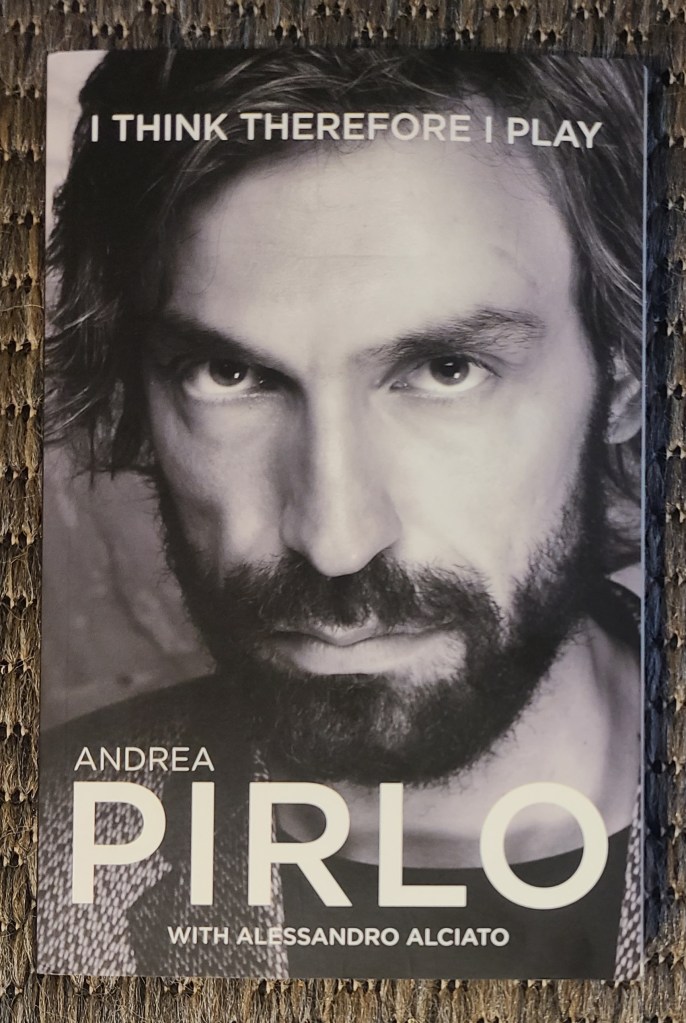

At the end of Andrea Pirlo’s autobiography I Think Therefore I Play, Pirlo writes, “I know how to think.” He asserts this to remind the reader of something that he fears went over our heads: that he writes and reflects with the same creativity, elegance, and vision that he played with. As readers we certainly don’t need reminding. The title itself, coupled with Pirlo’s glowering cover pose that echoes his enduring prestige as a player, sets the reader up well with the expectation that a gloriously wild philosophical ride is ahead.
I Think Therefore I Play is a bonkers book written at a frenetic, whiplashing pace that is best read in a single sitting. It scratches many itches, and although it was first published over ten years ago, it still comes across as mostly fresh with its brashness and diversion from autobiographical convention. It is co-written by Italian journalist Alessandro Alciato and translated into English by Mark Palmer. These added layers of treatment still capture Pirlo’s voice and his reflections on the events that catapulted him to legendary status in Italian and world football.
“…but perhaps they wanted to stick new faces in their Panini album, hear new stories being told. They’d got used to the things I did, my movements, my creations. They weren’t awestruck any more. In their eyes, the extraordinary was in real danger of becoming normal. You can’t be Pirlo any more.” (pg. 4, on leaving AC Milan)
Readers will not be disappointed with Pirlo’s descriptions of: his performance in the 2006 World Cup and that Panenka against England; the perpetual heartache of Istanbul in 2005 despite getting revenge on Liverpool two years later; being marginalised at AC Milan and his sparkling revival at Juventus; being in the running for the Ballon d’Or; and embracing his role as the paragon of elegant technique in the regista role he made his own.
Pirlo is not backward in coming forward. Loyalty and friendship (“Let’s go piss off Gattuso”) are key themes in his book, even when his honouring of Berlusconi and Agnelli come across as overly cloying. He also displays a flair for the lyrical, metaphorical, and cultural. In no other football autobiography will you read a Monica Lewinsky simile or the words ‘equidistant’ and ‘suppository’. You likewise wouldn’t see references to Children of the Corn, Woody Allen films, Pippo Inzaghi’s bowel movements, or a description of pre-match warm ups as “masturbation for conditioning coaches” elsewhere. Pirlo’s philosophical bent is borne from his on-field standing, so his assertion that he knows how to think does much to scaffold the wanderings of his mind that are worthy of inclusion in the book.
“…if the whole Istanbul experience was a suppository, it could find no escape once inside us. Every now and then, I feel it move, letting me know it’s still there, asserting its presence. It calls me by name and it’s a pain in the arse in the truest sense of the word.” (pg. 84, about the 2004-05 Champions League Final loss to Liverpool)
Yet I Think Therefore I Play suffers from the same issue that befalls many autobiographies: the inclusion of token, trite, and age-like-milk stances on the knotty issues on-and-off the field that may never be adequately resolved. Pirlo’s opinion about the introduction of technology to aid referee decision-making would have been shallow back then, and comes across as painfully naïve in current times. His tentative solutions to match-fixing are wishy-washy.
Personally, I found his opinions about tackling racism galling in its timidity. In regards to walking off the pitch in solidarity with the victim, he writes, “…in purely theoretical terms…I don’t think it’s the best way to make a stand against racism: for me, it’s more a surrender than a reaction” and “It’s too delicate a subject to plan your response in advance”.
Elsewhere, in regards to Juventus being stripped of the 2004-05 Serie A title following Calciopoli, Pirlo writes, “a title that’s taken away and then not assigned or handed to another team remains an honour you’ve won” (I wonder if Lance Armstrong thinks the same). And readers can snort at Pirlo’s comment of, “I wouldn’t bet a single cent on me becoming a manager, though. It’s not a job I’m attracted to” knowing that five years after this book was written, he was managing Juventus in the Champions League.
Taken as a whole, the point of I Think Therefore I Play is to invite comment and controversy, and Pirlo’s statement of “I know how to think” is a challenge to readers to see the game in the lines and exquisite curves that only he can see. His philosophical arrogance, coupled with his frenetic, off-beat style, creates an alluring syncopation that is hard to dislike. Over 150 pages of this makes for blistering reading, as long as you can get through the more tedious forced opinions toward the end.
“I can’t abide the cliche “only the team’s success matters–I don’t care about my own.” It’s the tiresome complaint of those who have no personal ambitions, whether for want of class or lack of character. For me, the team counts a huge amount but if I forgot about myself, I’d be doing my teammates a disservice. Many individuals make a team, just as many dreams make a triumph. And if you’re really lucky, they make history as well.” (pg. 119)
Finally, I want to shamefully repurpose one of Pirlo’s comments about technology to attach wider value to I Think Therefore I Play; that comment being,“Truth is the winner.” In his book, Pirlo offers nothing but his truth at the time of writing. That truth may sound discordant with what we know of present-day football, but to me, the passing of time grants his truth fragility. His voice was the most dominant in a new generation of Italian footballers that won the 2006 World Cup, and the passing of that generation has resulted in the tragic decline experienced by the contemporary Gli Azzurri after its failure to qualify for three consecutive World Cups since Pirlo’s international retirement.
However Pirlo’s truth resonates now, it is representative of the fragility of dominance. We remember Pirlo fondly, and grieve his absence on the field similarly to how we grieve Italy’s absence in the World Cup. The loss of elegance and grace may be a form of spiritual death. In this respect, we might demand more of I Think Therefore I Play, and it is a shame that with Pirlo leaning into being brash and bombastic, we don’t get enough of the vulnerability that typically manifests from genius.
Power through I Think Therefore I Play by all means. But regard each chapter as one of his signature passes that, whether you like what the chapter says or not, will never drift too far away from you.
I’d also like to add a few more points that I wanted to keep separate from the review.
The first is that readers may remember that I Think Therefore I Play was published in English a year after Zlatan Ibrahimović’s autobiography I Am Zlatan Ibrahimović was published in English. At the time, Zlatan’s book was both regarded as the vanguard of the new breed of football autobiography and one of the best football autobiographies of all time.
When I Think Therefore I Play was released, I remember that it basked in the radiance of the compelling honesty that made Zlatan’s book so refreshing. Therefore, I admit that I cannot think of Pirlo’s work as entirely separate from Zlatan’s due to both their nature of disclosure and the publishing environment at the time. I don’t think that I Think Therefore I Play is deserving of similar critical acclaim given to I Am Zlatan Ibrahimović, but I don’t want this personal yardstick of mine to dissuade you from enjoying I Think Therefore I Am on its own merits.
Now, for full disclosure: I am an Australian who still feels the disappointment and heartache of the Socceroos’ 0-1 loss to Italy in the Round of 16 of the 2006 World Cup. Italy won it all that year, and Australia was one of the stepping stones that Italy used to reach that ultimate glory. So, when I think about Pirlo, I think about this match above all.
In the match, after Materazzi was sent off in the 51st minute, Australia did its best to make life hard for Buffon and Italy’s defence. With Gattuso and Zambrotta yellow carded, Australia fed off Italy’s frustration. However, no Australian shot seemed to hit the target. Cahill headed over the bar when he would have ordinarily scored, and Aloisi fresh-aired an overhead kick that, had he connected, would have put Buffon in some trouble. At the other end, Toni and Iaquinta were misfiring, despite Pirlo doing his best with his delicately lofted balls into the box. With no goals seemingly forthcoming for both teams in normal time, Australia would have liked its chances in extra time with its numerical advantage.
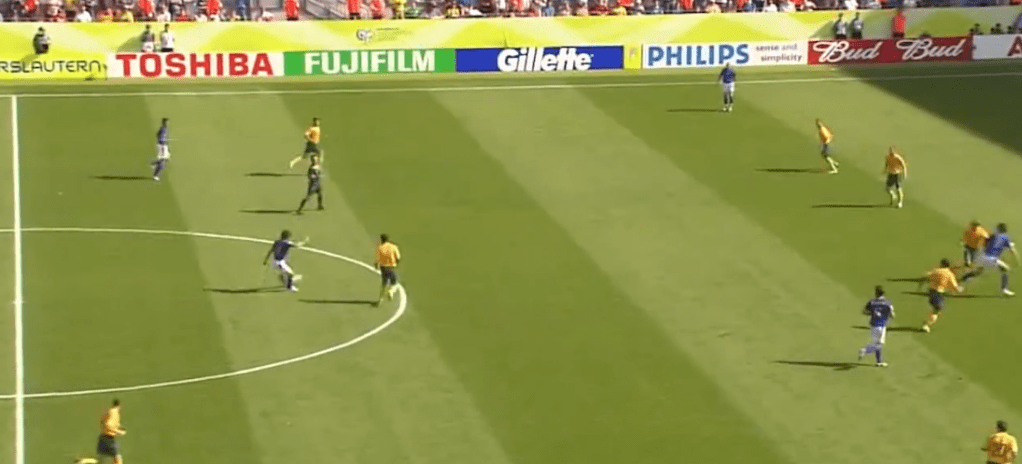
With the last attack of the ninety minutes, Italy’s Grosso skinned Bresciano in the corner, went deep into the box, and enticed Lucas Neill to casually sweep his leg at the ball. Grosso fell, or dived, over the flailing Neill, and the referee pointed to the spot (about this event, I land more on the “Neill, what the bloody hell are you doing!?” rather than the “Grosso, you bloody cheat!” side of the narrative, as it was criminal of Neill to make that kind of tackle in the box at that time). Totti converted the penalty, and Italy went through.
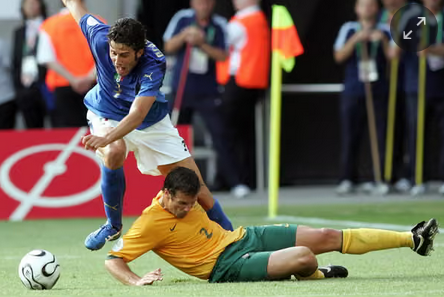
The result is both Australia’s high watermark in World Cup finals history, as well as being a big part in Italy’s World Cup lore.
Naturally, I was very interested to read that Pirlo believed it shouldn’t have been a penalty. Even if his admission may come across to some as an empty example of ‘hindsight sportsmanship’ after triumph, it is nevertheless the first admission of its kind that I’ve read from any of the Italian players or staff involved in the match. So, credit where credit is due. However, it is still of little consolation to Australians considering that in an instant Totti’s penalty spelled the end of the Socceroos golden generation that rode the otherworldly groundswell of public support at the time, and robbed Australians of that sweet enchantment for the Socceroos that hasn’t really returned since.
From the pen of Pirlo comes the bittersweet truth.
I am as fascinated by Pirlo’s role in this match as much as I was captivated by Pirlo’s on-pitch role as the greatest regista in football history. As much as I remember Pirlo caressing and protecting the ball with his hypnotic turns and feints out of an opposition press in order to design another visionary pass, I also remember his name in drop caps on the back of a blue jersey, attempting to orchestrate Australia’s downfall under the afternoon sun in Kaiserslautern. The once-ignored kid, playing his own game, and letting others be a part of it.
STARS: 3.5/5
UNDER 20: An attempted balancing act between Pirlo as the player and Pirlo as the writer doesn’t completely hit the mark.
FULL-TIME SCORE: The floating cucchiaio from the penalty spot wins the game for his team 1-0; fans and media laud the goal as representative of his sublime genius or smug arrogance.
RELATED READING: I Am Zlatan Ibrahimović by Zlatan Ibrahimović (2013); Impassibili e maledette: Le invenzioni di Andrea Pirlo by Roberto Ferrucci (2014)