
It is 2026, and Arsenal are the reigning Premier League champions. The stylish, progressive Gooners (also recently ‘Boring Arsenal’, heroic runners-up, also-rans, squibs resting on their laurels) have ended a twenty-two-year title drought. And they’ve done it amidst the extravagant excess and financial brinksmanship of a certain nation-state club whose form of success may forever be brandished with an asterisk.
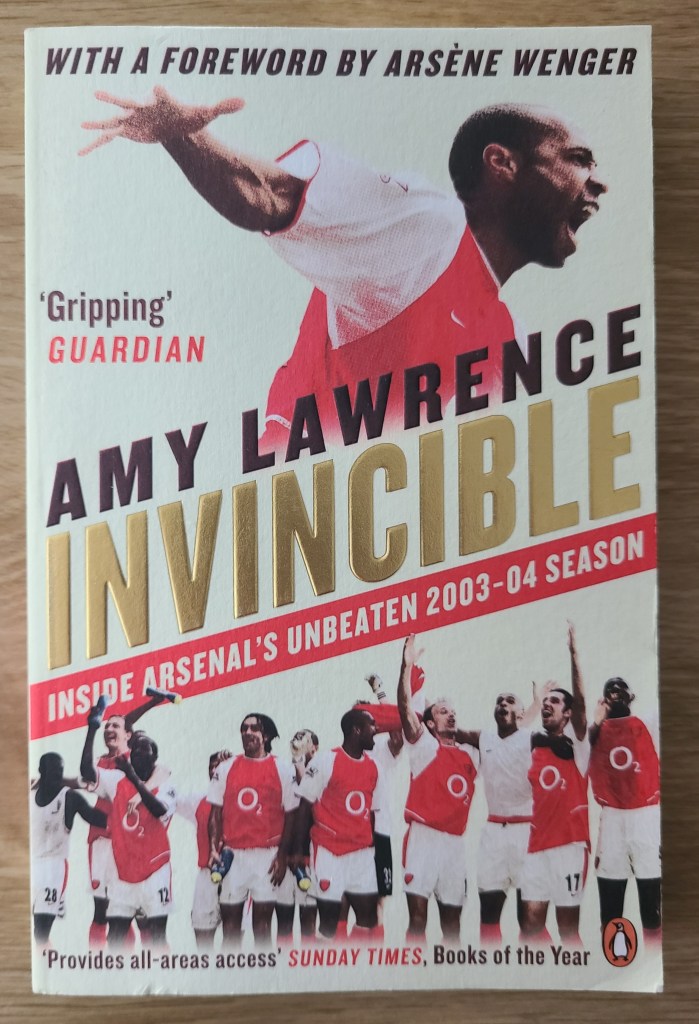
We look for grains of nostalgia in an era of apathy and cynicism to justify our present joy. In Invincible, Amy Lawrence provides us with this warm nostalgia as she confidently recounts Arsenal’s 2003-04 ‘invincible’ when the club romped to the PL title undefeated. In the shake-out, Invincible reminds us of those times when success was earned through grit rather than through exorbitant financial outlays.
As Invincible was first published in 2014, Lawrence writes with a decade’s worth of hindsight on that remarkable 2003-04 season. She relays the personal testimonies of Thierry Henry, Dennis Bergkamp, Patrick Vieira, Robert Pires et al. to describe how on-field success and camaraderie were achieved.
Invincible’s opening chapter depicts Ruud van Nistelrooy’s head-ringing smack of his penalty kick against the crossbar (and him getting a subsequent head-ringing from Martin Keown) during the infamous Battle of Old Trafford in 2003. That glorious crack of ball on wood still evokes the immense stakes that were at play in that particular time and place. Lawrence does well to kick off the Invincible narrative with it, as it was the most natural and thrilling way to show the intense Arsenal-Man Utd rivalry (read, Wenger-Ferguson rivalry) as an ongoing theme.
From there, Lawrence explores the Arsenal years leading up to 2003-04 to find what contributed to the “symphony of that season”. Interviews abound here. David Dein recounts slow-dancing Wenger to Arsenal. There are anecdotes about Wenger introducing better training standards, professionalism, and player nutrition (the well-worn ‘no-ketchup at the table’ yarn gets more play here) to the club to facilitate the PL titles in 1998 and 2002. The Arsenal mise-en-scène is thus established.
There are some anecdotal gems here for all readers. Vieira’s reminiscences of his first days at Arsenal are a highlight, including the suspicious fire at the London Colney training ground, and Remi Garde causing confusion by not translating the key word ‘alcoholic’ to him during Tony Adams’ infamous dressing room speech. Henry’s thoughts are brilliantly self-reflective. Lawrence comes at all angles to define Wenger’s formula that goes beyond simple ‘tactical touch’ and ‘managerial mastery’. Something of the elemental is there, too, elusive but palpable; whatever it was, the players are effusive with it, even if they are still baffled at the glorious final manifestation of their joint efforts: the ‘invincible’ season.
My favourite part of Invincible comes after the PL title was sown up with four games still remaining. Henry talks about the initial confusion the players felt when considering the idea of an unbeaten season, or the motivation after final victory required to reach that nebulous invincible status:
“The goal was abstract. There was no prize. At the end, what are you getting? You are fighting for something you will never see. We didn’t know they were going to make a golden trophy. It hadn’t been done before. We were fighting for a place in history. Something that has never been done before and may never be done again but there was no silverware or medal for it. It was kind of weird. I guess it was something we would look back on and think, Wow, but at the time I don’t think we realized how big a deal it actually was.” (pg. 177)
Followed by:
“I remember Patrick [Vieira] looking at me and saying, “There is no fight. I need to have a fight. I need to know that we need to get some points.” We were not realizing what was happening.” (pg. 177)
Lawrence’s discussion of desire and mentality in uncertain times brings the players to the fans’ level, our level. The cerebral Jens Lehmann is frustrated with the 2-2 draw against Tottenham to clinch the title, and Sol Campbell is equally perturbed. Where Lawrence asks, ‘What does it take to be undefeated?’, she teases out the question, ‘What is to be gained, or lost, by being undefeated?’ That period of uncertainty in confirmed victory still inspires human self-reflection in 2014, and Lawrence capitalises further on this in the short ‘Reflections’ chapter at the end of the book.
Discussion of the Invincibles seems to inevitably circle around Wenger. Invincible occasionally comes across as fawning, and its goal of finding out how Arsenal became invincible is subservient to the question What did Wenger do to make them invincible? Wenger writes the foreword and is interviewed in the epilogue (in that diplomatic and distant Q&A format). He bookends the narrative, letting Lawrence and the players do the talking. It starts and ends with him, that imposing demi-god of Highbury. It is like he is sitting on the patio deckchair, listening to his children’s discussion inside the house, and coming back in to definitively weigh in. This criticism is the trade-off Invincible makes for not featuring Wenger throughout; it is better to be talked about, rather than being there to take the words out of players’ mouths.
Yet I feel that Lawrence misses a trick in Invincible by this player-first approach in not including the full complement of Invincibles. Twenty players are named as Invincibles, yet six of them are conspicuous in their absence in Invincible: Jose Antonio Reyes, Sylvain Wiltord, Pascal Cygan, Gael Clichy, Nwankwo Kanu, and Jeremie Aliadiere. The roles of Reyes and Aliadiere both represent the sacrifices made by some players to buttress the success of the whole. Unfortunately, little else is given in Invincible about the other ‘glue guys’.
To use Lawrence’s symphony metaphor, the symphony is played and driven by the dominant instruments. It sounds authoritative and majestic, but is missing that middle-ground timbre of the viola squashed between the violin and cello heavyweights. In such history-defining season write-ups like Invincible, I seek and appreciate the voices of the in-between or on-the-margin, as much as I do the voices of the household names.
In being the definitive account of Arsenal’s 2003-04 season, Invincible both caters to the Arsenal fans and non-fans alike, and the intersection between the two: that seemingly shrinking middle ground of appreciators of good club football despite the team and the rivalry. Invincible’s broad sweep to cater to all is a strength; as such, things are inevitably left out. In an era where team tribalism has an added dimension of vicious entitlement through billionaire backers, it is beneficial for football fans to remember that an instance of glory is an event that forever culminates in the collective rise and fall of others. Invincible, in conveying the details of that unforgettable 2003-04 season, provides a philosophic element to the act of winning, and how remaining unbeaten for so long masks the existential difficulties players face when there is nothing more to win.
Arsenal crashed out in the semis of both domestic cups and the quarter-final of the Champions League in 2003-04. Lawrence stresses this fact in the book and how it affected player mentality. She elicits the following response first from Vieira:
“Two competitions extinguished in four days. From treble to terrible. The mood was sober, and even years later, lasting regret about the ones that got away is manifested in hard stares and rueful shakes of the head. “We underachieved in the Champions League,” says Vieira.” (pg. 106, on losing to Chelsea in the UCL)
And then Wenger:
“I could see we were jaded [after the Chelsea UCL match]. So I think if I made a mistake that season, that was not to sacrifice the game against Man United. Many times the Champions League conflicts with the FA Cup and you sit there and think, What did I do? [He exhales deeply] That season we could have won everything. I tried to do it. We had the squad to do it. We had sixteen or seventeen players of top, top level.” (Wenger, pg. 212)
I’ve always been interested in the use of the ‘invincible’ adjective in sport. Yet can it truly be used in a footballing context? With the sheer number of games across a season, the importance of the domestic league, and the depth of social and historical significance of cup games, can the ‘invincible’ appellation (with its connotation of otherworldly power and utter dominance) be applied to a team that drew almost half as many games as it won in the 2003-04 Premier League?
As readers, we look for the fallibilities to explain the ‘invincible’. These fragilities are somehow more inspiring. The invincible is boring, it has plot armour, and it always has the rub of the green. Lawrence thinks similarly: by highlighting the flash of a soft underbelly and by amplifying frustrations, she undermines the ‘invincible’ and makes it believable.
What results is a very human story that we can all identify with because, through our varying life experiences and challenges, we want to regard ourselves as ‘unbeaten’, ‘indefatigable’, and ‘unbowed’, despite it all. In football, our clubs experience success in response to the success of other clubs. The current Arsenal side, as incumbent PL champions, achieved success drawing from the Invincible template as much as it did from the Man City template* from recent years. Yet who knows how long before Arsenal finds success again?
This is why Invincible is worth your time. Read it, knowing that Lawrence hits upon that deep well of fragility that exists in all success, including our own.
STARS: 4/5
UNDER 20: This definitive account of the Invincibles relates the inherent fragility that existed at Arsenal during that wondrous season.
FULL-TIME SCORE: The game is won and ultimate success is achieved. The camera crosses to the celebrating players, then to the proud manager, and back again, and then back again, and all the while we know how burdensome it can be, this thing called winning.
RELATED READING: The Unbelievables by David Bevan (2016); Stillness and Speed: My Story by Dennis Bergkamp (2013)

