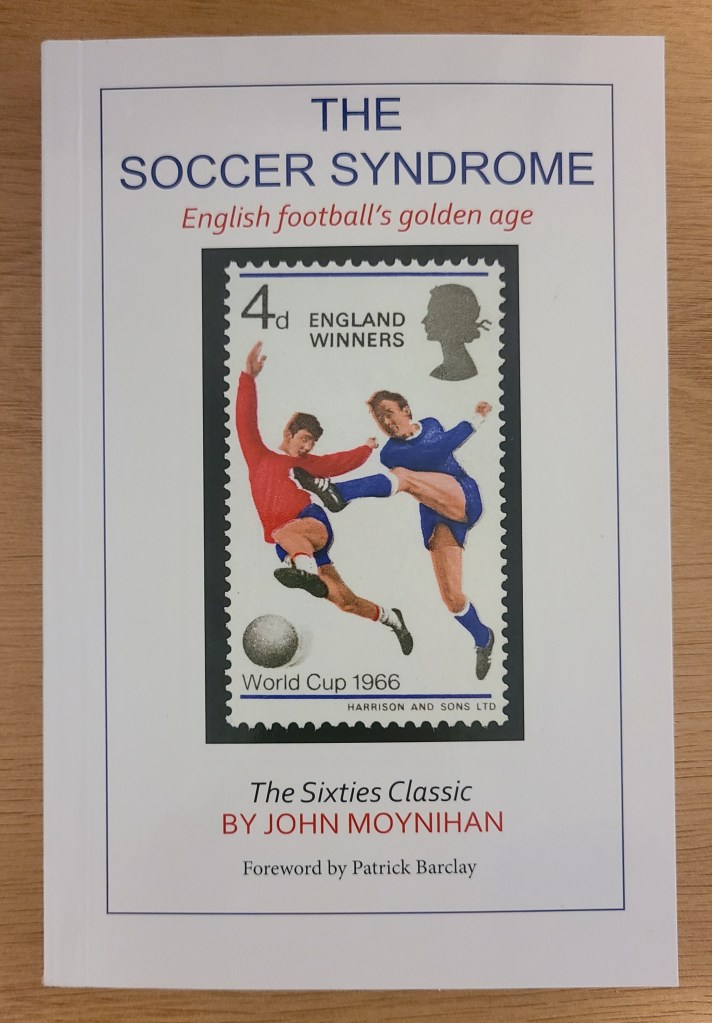

We should be so lucky that the history of football has allowed for a rich and varied literature that can convey the timelessness of several aspects of the game. In terms of genre classics, The Soccer Syndrome by John Moynihan (a respected Sunday Telegraph football journo), originally published in 1966, endures in popularity for its gritty evocation of supporters in their element, whether they be in the stands, in the Sunday league mud, or outside the stadium cadging autographs.
In The Soccer Syndrome, first published in the lead-up to the 1966 World Cup, Moynihan relates his footballing memories from the 1940s and 1950s, and writes contemporaneously about the burning questions facing English football in the years ahead. The Soccer Syndrome reads as particularly portentous considering that the Three Lions ‘brought football home’ in the World Cup that year, and as such Moynihan’s writing conveys a strong sense of nostalgia for wholesome, fan-facing, toiling football of the mid-20th century that those old enough to experience it will cherish. The timelessness of The Soccer Syndrome lies in the fan experience that is difficult to supplant even in the early 21st century: the grittiness, pettiness (“they did not appreciate football, only successful football played by their own side”), hoarse barracking, pitch-side noises and malodours all combine to create a sense of enduring joy that we can all, sixty years after its publication, keenly recognise.
“Alf Ramsey, the former Dagenham grocer’s boy, stands to win a prestige fortune or lose all by July 1966, for England’s performance will be judged by this.” (pg. 41)
The strength of The Soccer Syndrome lies in the chapters where Moynihan is several degrees removed from the stadium. These chapters read almost like short stories in their subjective messaging. And through them all, the line between quaint and risqué is repeatedly blurred (a tea party while watching the ‘Matthews Final’, and a mysterious tryst in a Paris café while the 1958 World Cup final plays on a TV nearby) that distinctly reflects the rise of football celebrity with changing societal values. Moynihan also spends much time writing about his on-pitch heroes (in particular Tommy Lawton, and Sirs Stanley Matthews and Tom Finney), and through this prism he describes the styles of then-contemporary players (Denis Law, “the greatest footballer in Britain today”, for example) and tactics (questioning England’s use of the 4-3-3). Footballing historians will get much out of these opinions from a historiographical standpoint, even if younger readers in their 30s and 40s may read with glazed-over eyes these often long-drawn recitations of British footballing toil before globalisation.
Nevertheless, Moynihan’s perspectives on legendary 20th-century English footballing figures such as Matt Busby, Stan Cullis, Jimmy Greaves and Bobby Moore (the latter two’s potential role in the then-upcoming 1966 World Cup especially) are enlightening and valuable. His lament for Duncan Edwards is moving. All of these serve to fill in anecdotal gaps describing British footballing royalty now shadowed into an incomprehensible past to someone in the present.
“I can still hear [Alfredo Di Stefano’s] staccato commands during a match between Real Madrid and Arsenal at Highbury. They sounded like HA, HA, HA, mere barks as he rolled the ball to colleagues under the floodlight with the authority of a Spanish polo colonel at Deauville, displaying in the same way a gracious ruthlessness.” (pg. 65)
The Soccer Syndrome’s blurb describes Moynihan’s writing as “observant, engaging, wry and perspective”, and Moynihan’s son Leo, writing in the afterword, describes his father’s style as “wonderfully idiosyncratic”. These deserved plaudits notwithstanding, the book is riddled with typos (“…as he gout out one of those marble baths”, “…their scarves growing further and father away”) and continued awkward use of punctuation, especially colons and semi-colons. The former may come from a past era of stylistics, but too often these typos and poor punctuation go beyond idiosyncrasy and into the slipshod and careless proofreading. This criticism seems to be repeated in other reviews I have read of the book. Honestly, there are more errors in The Soccer Syndrome than in any book I’ve ever read—let alone football books. I typically forgive books for minor errors, but repeatedly poor proofreading is a failure shared by writer and publisher that unfortunately distracts from narrative and voice.
I feel that a reader of The Soccer Syndrome needs to align three internal elements to fully enjoy it (aside from forgiving the aforementioned criticisms): those being historical interest, age demographic, and sentimentality.There are veins of gold for prospective readers who pick this book up, knowing that it was written at a time before “They think it’s all over…it is now!”, total football, Maradona, Hillsborough, the Premier League, oligarch owners, and VAR.
With the 60th anniversaries of the book’s publication and England’s triumph in the 1966 World Cup this year, there is no better time to read The Soccer Syndrome. There is a popular saying that ‘history is cyclical’. British readers, therefore, will identify with Moynihan’s lamentation of England’s dearth of international silverware on the eve of the eventual 1966 triumph, considering that football has been ‘coming home’ for the past 30 years. Readers can do no worse than to dip into the past to pluck out some hope, as well as the realisation that, eventually, all droughts must come to an end.
“Haven’t we waited long enough to win this competition?” (pg. 42)
STARS: 3.5/5
UNDER 20: A fascinating time capsule into the footballing past, the contents of which often reflect the footballing present.
FULL-TIME SCORE: At the press conference, the respected scribe holds court with an evocative filibuster that reminds all that the fans, more so than the players, are at the heart of the game.
RELATED READING: The Story of the World Cup by Brian Glanville (1993)
 Dispatches from Row-Z