
Football and War: Australia and Vietnam 1967-1972 – Roy Hay

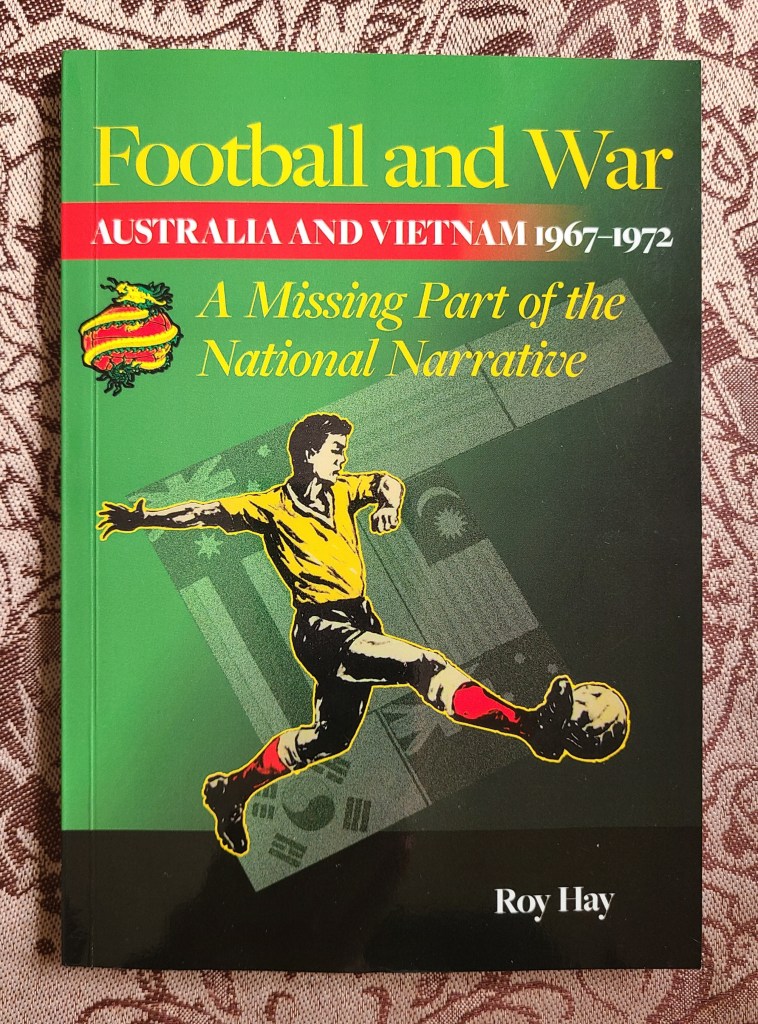
Sometimes I find a very niche football book on a second-hand book shelf. When I do, I wonder if it would make suitable fodder for review. When I saw Football and War: Australia and Vietnam 1967-1972 by Roy Hay nestled tightly between two hardbacks and barely visible in the shadow of the bowing shelf above it, I knew that it deserved to be given the light of day.

The book—its cover coloured with that familiar Australian sport green of Pantone 348C—possesses a frailty suggestive of self-publishing. It’s a wafer of a book that seeks to describe a forgotten part of national lore in a sport that has fought inwards on itself in civil war as much as it has fought outwards on other codes for recognition in Australia. Football and War—now this was niche, and eminently reviewable. It’s time to put on my green and gold anorak.

Football and War by Roy Hay (one of Australia’s most well-respected and eminent footballing and sporting historians, and Football Australia 2025 Hall of Fame inductee alongside Tim Cahill and Sharon Black) is about the Australian national team’s trips to south-east Asia from 1967-1972 during the height of the Vietnam War. The team played a number of Asian confederacy teams in this span of time, and played many of the games in Saigon as a means for the Australian military in Vietnam “to use football as a vehicle to bridge the cultural divide between themselves and the local population”.

Although the veracity of the trips’ diplomatic function and success are under question in Football and War, through Hay’s thorough research, he portrays a portentous nexus of tour success, embedded team camaraderie, and trial by fire across five years that contributed to the team’s qualification for the 1974 World Cup and helped to inch the footballing needle closer into Australian popular consciousness. The 1967-72 period was one of great significance for the national team, and deserving of the lofty appellation of ‘the missing part of the national narrative’.

“The Australian military in Vietnam had begun to use football as a vehicle to bridge the cultural divide between themselves and the local population. So, the Australian involvement in the tournament could build on that. The conditions in Saigon in 1967 were not conducive to soccer diplomacy, however” (pg. 20)

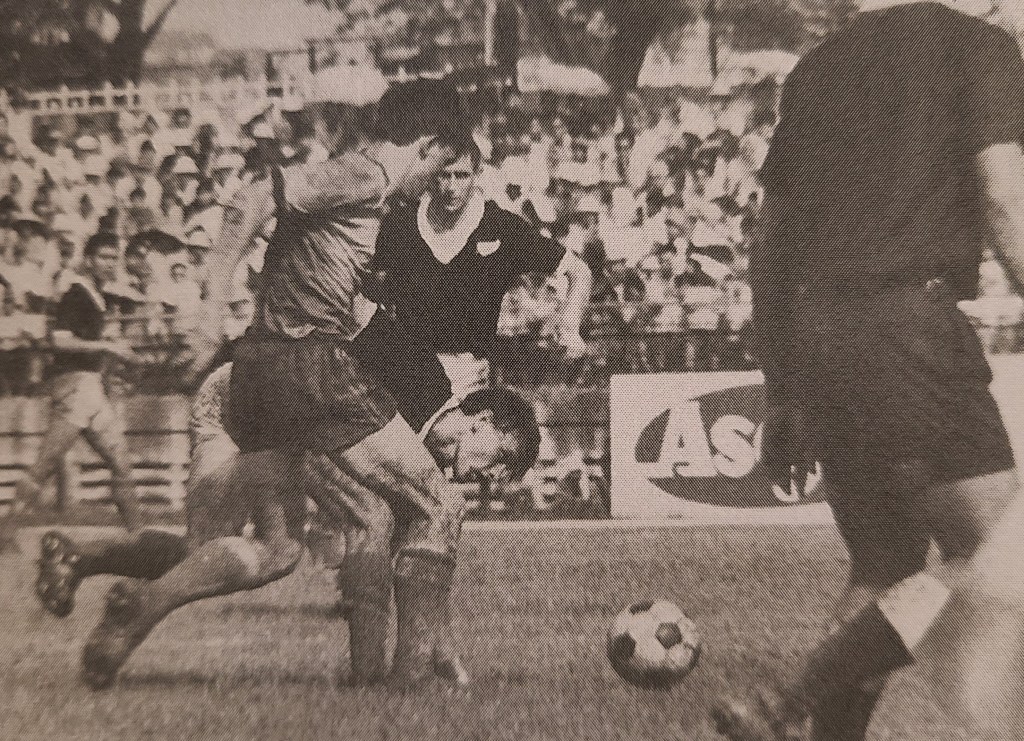
Johnny Warren in action against New Zealand in Saigon.

Hay explores several elements of this now-found, still-unheralded, and long dusted-over missing part in precise detail. Aside from Australia’s glut of wins against other national teams (South Vietnam, South Korea, and Singapore, among others) and local teams (Kowloon Bus Company, anyone?) that led to much fanfare and esprit de corps between players, administrators, and journalists, the players were playing alongside very clear and present dangers on the high-grass pitches of Vietnam. Hay relates anecdotes of partisan local crowds cheering Australia on, and beer-swilling Australian servicemen on-leave cheering the team on even louder; Vietcong intentions of bombing a building where the Australian team was staying; and how amongst the sound of gunfire and artillery in the area, the players were deeply aware of Vietcong match spectators who enjoyed the games enough to lay down their guns for ninety minutes.

“…two Vietcong carrying explosives had been captured half a block from the hotel. Under torture, they said that they intended to blow up the South Koreans who were billeted a floor below the Australian soccer players in the Golden Building” (pg. 22)

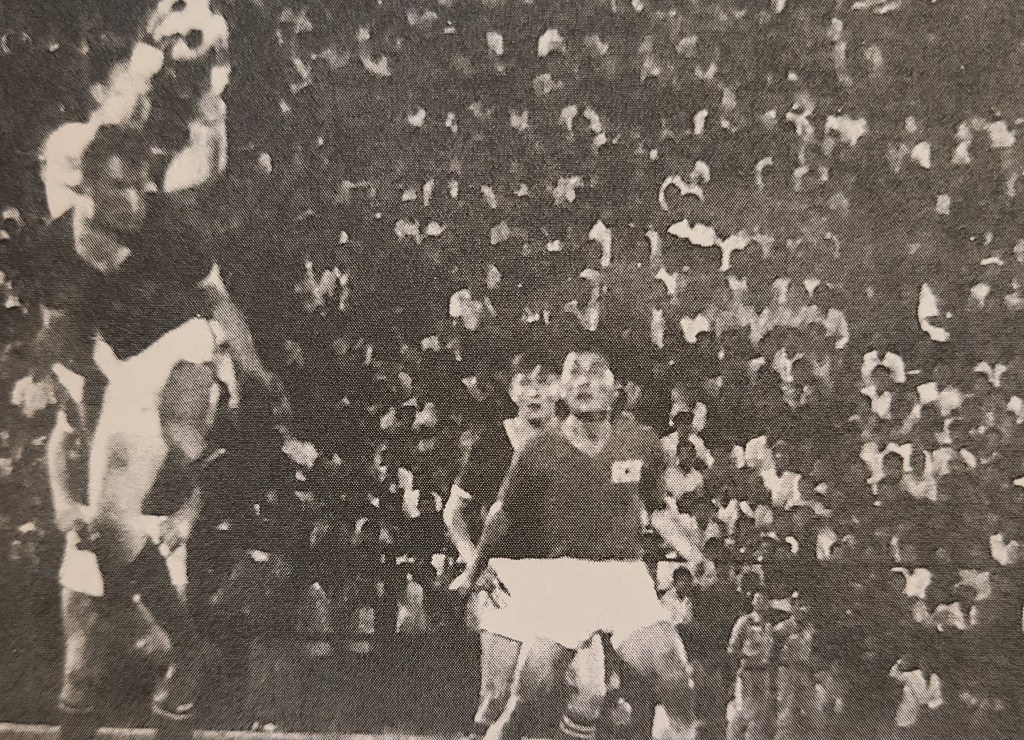
Australia versus South Korea.

Hay thoroughly analyses the costs of the tours, from both political and financial standpoints. He draws upon reliable, first-hand sources to add weight to his observations. One of these sources was the former PM, the late Malcolm Fraser, who combed through his personal archives for a diplomatic basis for the 1967-72 trips. The fascinating player and staff anecdotes and political intrigue aside, however, Football and War reads absolutely as dry as chips. There is a cerebral detachment from the topic that is off-putting in places. Hay’s professorial tone reads like an annual report or a Wikipedia entry, rather than a narrative history. The short length of Football and War facilitates an expediency that allows for brief analyses that provide little connective tissue between chapters. As such, the book is an easy read, but not necessarily a read to remember. This is an important point for me.

As a millennial born a full ten years after the Fall of Saigon, my popular consciousness of the Vietnam War has been bounded by Hollywood portrayals, its zeitgeist of protest music, and a brief bus trip through areas of Hội An. Closer to my cultural and national identity, Cold Chisel’s ‘Khe Sanh’, the 1979 film The Odd Angry Shot, and my father’s vague re-telling of his birthday possibly being plucked out for national service, have informed my cultural understanding of Australia’s role in the Vietnam War.I’m probably not alone in knowing more about Australia’s efforts in WWI (Gallipoli) and WW2 (Kokoda Trail) than its role in the Vietnam War. I recognise this as a personal shortcoming—not striving to find out more about events that deeply affected the lives of Baby Boomers; in whose ranks I can count my parents, uncles, and aunts.

This is why I found Football and War to be a bridge for my deeper understanding of the Vietnam War from a cultural identity context. The intersections of conflict, politics, sport, and society that occurred during the Australian national team’s trips to Asia across 1967-1972 offer up a grand opportunity for a longer historical treatment in print. Football and War, in its brevity, perhaps passes up the chance to bring the remarkable story of the 1967-1972 tours to a public that responded so well to Johnny Warren’s Sheilas, Wogs, and Poofters in 2002. Interest certainly exists in the 1967-1972 tours. The Socceroos website has a few articles and interviews about the tours, and articles by Richard Cooke and Les Murray can still be read online. The following extract, from Murray’s article, describes the riot after the Socceroos defeated South Vietnam:

“When the team finally left the stadium, its bus was pelted with rocks. Windows were broken. Young men representing Australia, part-time footballers who worked as tailors, used car salesmen and milkmen, were in fear for their lives. Johnny Warren spoke to me about this event a lot. He was very proud whenever he did. He was proud of ‘the boys’, the sacrifices they made and the spirit they founded. He even suggested that the Socceroos of 1967 had a right to march in the Anzac Day parades, and he had a point.”

From this perspective, the events of Football and War become as much a ‘missing part of the national narrative’ in an Australian historical and cultural context, as in a footballing context. With the 1967-72 tour members yet to receive the right to march in Anzac Day parades, a 2021 article by Chris Curulli sums up how the 1967 tour was consistent with the cultural values that still hold strong today: mateship, persistence, endurance, determination, and sacrifice. Not picking up a weapon should not preclude the members of the 1967-72 tours from reflecting these qualities.

“The Australians played 10 games on that tour and won them all. The camaraderie in the face of adversity was an important element in the mindset that eventually helped the Australians qualify for the World Cup in 1974” (pg. 42)

Describing something as ‘admirable’ can come across as snide. When I call Hay’s work in Football and War here as ‘admirable’, I in no way mean it to be snide. I use admirable here in the sense that Hay has produced a work of merit within the form and length he has confined himself within. But where the brief taste inspires fascination, so it also easily leaves the palate dry. We look to the past to explain the present, and after being so blissfully drunk on the analysis of our drought-breaking 2006 World Cup qualification, similar analysis and extended treatment should be afforded to the pioneering efforts of the 1967-72 tours to instill that teak-like resilience into the latter-day players. Football and War’s brevity hints at a much greater potential left restrained.

In uncovering something that has been ‘missing’ from public attention or inclusion in national sporting lore, Football and War briefly takes the story out of the archives rather than letting it breathe long enough to be well-remembered.

STARS: 3.5/5

UNDER 20: A rigorous retrospective of pioneering Socceroos who brought some cooling footballing diplomacy to the raging heat of the Vietnam War.

FULL-TIME SCORE: The quality of players on the pitch notwithstanding, there is not much to take away from the 0-0 draw that leaves supporters ruing missed opportunities.  

RELATED READING: Sheilas, Wogs and Poofters by Johnny Warren (2002); A History of Football in Australia by Roy Hay and Bill Murray (2016)

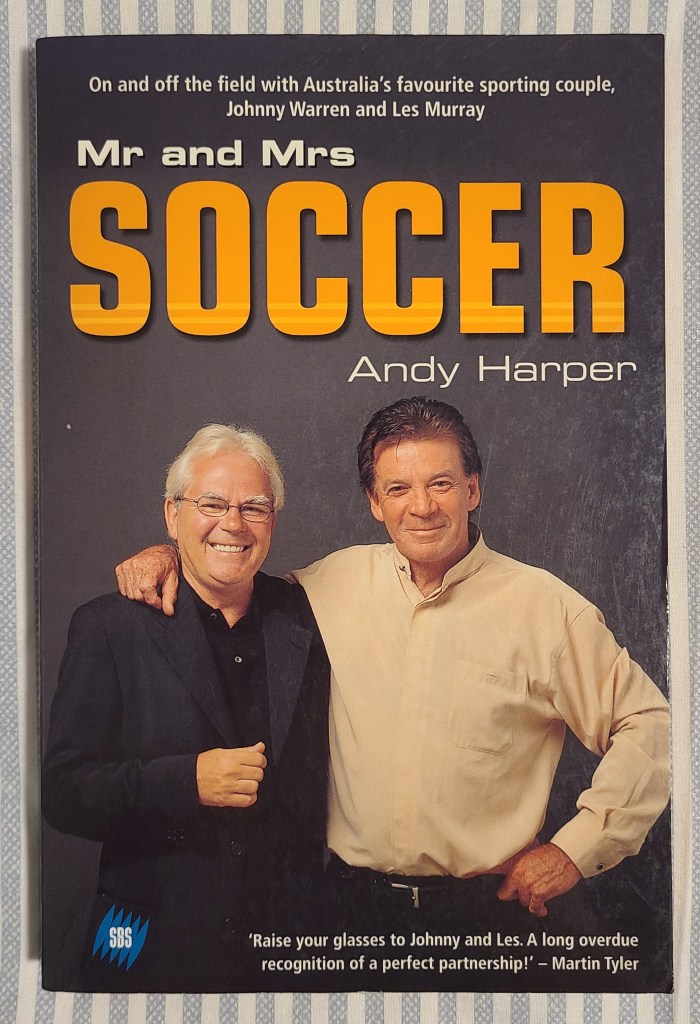
Mr and Mrs Soccer – Andy Harper

I was lucky enough a few weeks ago to find a copy of the out-of-print Mr and Mrs Soccer by Andy Harper at a local op-shop (or charity shop for the non-Australians). After handing over the spare change in my pocket to buy the book, I beamed at having finally secured the missing book in what I think of as a set of three books that make up the early oeuvre of Australian football literature up until the mid-2000s. Along with Mr and Mrs Soccer, this triumvirate also includes Sheilas, Wogs, and Poofters by Johnny Warren, and By the Balls by Les Murray.

So, needless to say, it gave me great pleasure to read Mr and Mrs Soccer. The titular ‘Mr’ and ‘Mrs’ are Johnny Warren and Les Murray (or vice versa), the indefatigable, indomitable, and inimitable broadcasting duo that carried the flame of Australian football from the 1970s until the mid-2000s.  In this book, commentator and writer Andy Harper interviews Johnny and Les as they look over their career on television together, each the yin to the other’s yang, and as surrogate football missionaries to a generation finally opening its eyes to the wonders of the world game.

“Johnny: Seven didn’t show much interest in football at all. I remember when Rex was commentating on a game between England and Australia. Off air, during a break in play or at half time, he turned and said, ‘If this game ever takes over from rugby league you can fuck me in Pitt Street.’ He was flabbergasted. Then he proceeded to call the ball as ‘going into touch’, ‘out on the full’, as well as ‘touch judge has his flag up’ and references to ‘the umpire’. The football media landscape was barren in the extreme” (pg. 36)

Andy Harper, the co-author of Sheilas, Wogs and Poofters with Johnny Warren, goes to the productive well of Australian footballing heartbreak to interview Johnny and Les on the state of football in the country from the 1960s to 2004. Johnny and Les reminisce about growing up amongst the Hungarian diaspora in Sydney, as well as their early forays into football broadcasting that steeled them into the weathered, consummate professionals and doyens of SBS later. They also discuss their anger, driving skills, and the pleasures of smoking. Johnny reflects on his cancer diagnosis and, in gracefully accepting his fate borne from his chain-smoking sins over decades, readers (especially Australian readers) can be forgiven for getting misty-eyed in the present day. There is a bit of room at the end of the book for the duo to opine on Australian identity through the prism of football, and the future of the world game generally; but these asides are like sipping on sweet coffee after already devouring the filling meal.

Of particular interest is the change in cadence when Johnny and Les talk about their chief analyst and SBS Head of Sport roles respectively during the coverage of the 2002 World Cup. The power dynamics between the two, with Johnny, offended for his viewers after chief match commentator Martin Tyler was allowed to jump to Channel 9 for the World Cup Final, while Les defended his decision-making in dealing with a combustible Johnny, is fascinating to read about. This account serves up some humility and regret in a remarkable friendship that allows for this kind of reflection without any lingering animosity, reflected by the various ‘on the balls’ (vigorous, spirited debates on football) and ‘Tre collis’ (their bursts of anger and frustration in dealing with the pressures of travel) that they mention.

“Les: Johnny’s contract came up for renewal and there were further discussions. That was probably the most uncomfortable time I have ever had with Johnny; discussing Johnny’s performance and his future, arguing SBS’s position to Johnny’s lawyer, with Johnny sitting next to him. It was a rare occasion when we were on opposite sides, and it was pretty unpleasant.” (pg 146)

Stylistically, Mr and Mrs Soccer is an appropriate representation of Murray and Warren’s friendship and working relationship. Reading the alternating passages between the two, you can picture them both sitting at angles to each other behind that desk on The World Game, as the television screen places them at such a distance apart that you can’t figure out if it’s out of deference or annoyance with each other. Writer Andy Harper must be given credit for marshalling the experience, knowledge, and cachet of the duo to give such a warts-and-all account of their experiences. In doing so, Harper uses Mr and Mrs Soccer as a bridge between the before (Australia’s footballing oblivion) and the after (achieving the seemingly mythical in qualifying for the World Cup) for a new generation of Australian footballing fans that must be humbled to remember that the relative success of Australian football is underpinned by ignominy and adversity, yet was foretold and beckoned with the unrelenting support of this rare breed of men.

Even if some of their hopes and suggestions in Mr and Mrs Soccer come off as naff (reducing the number of players to 10-a-side) and quixotic (Australia to win the World Cup someday) twenty years later, we have to remember that such ideas were borne out of the bloody-minded idealism that all mavericks possess. Their ideas, as challenging and provocative now as they were before, have a great timbre and lustre. The prescience is there, too. Johnny must be spinning in his grave with the “vested interests of [more than] a small number of money-hungry European clubs” in modern times; and Les must be fuming with the introduction of video technology to deliberate on far more than whether a ball crossed a line or not.

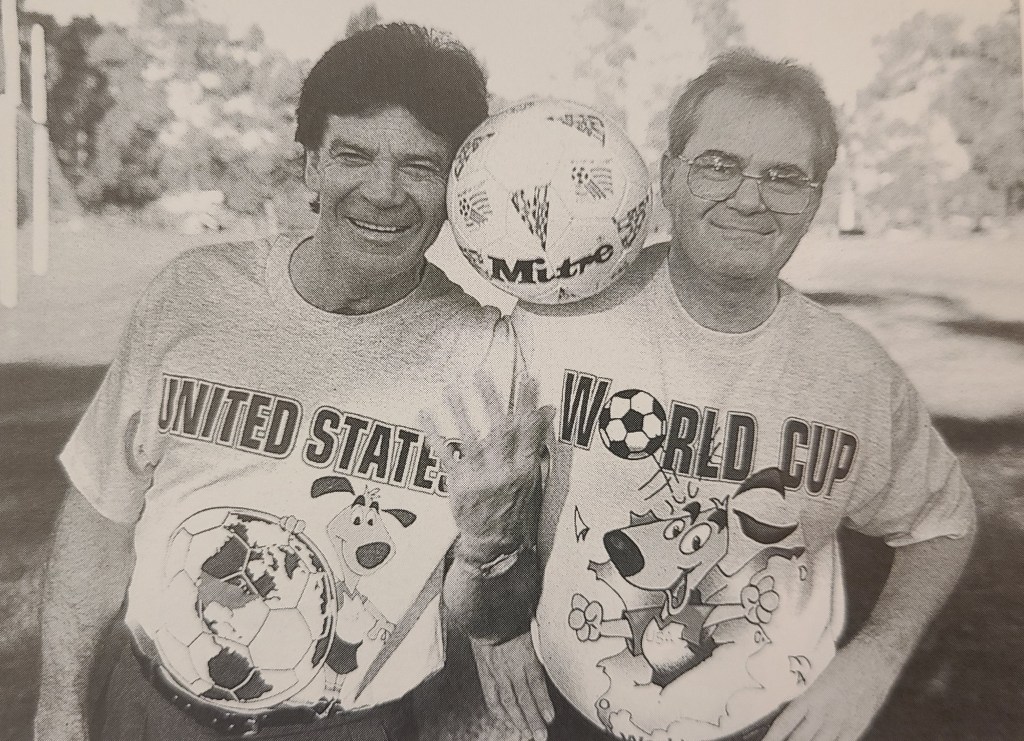
Johnny and Les at USA 1994 in San Francisco. (Courtesy SBS Television)

Quite rightly, the Warren-Murray partnership, in all its forthright, pioneering, and ornery vicissitudes, is the focus of Mr and Mrs Soccer. The book was published before the Australian footballing renaissance in the mid-2000s. They lived, worked (and Johnny played) through the highs, lows, and intolerable doldrums of the Australian football domestic and international scene. Although Australian football suffered the crushing blows of the 1997 loss to Iran in the World Cup Playoff match and the Uruguay defeat in 2002, Warren and Murray had long before rallied an apathetic nation to finally feel something—even if it was soul-crushing defeat—by unfailingly appearing on our screens and replanting the football flag. It mattered because it hurt, and badly.

It is bittersweet to be able to refer to Johnny and Les in the present tense in parts of this review, for although they passed away in 2004 and 2017 respectively, such has been their legacy on football in Australia that I still think of them as alive and kicking, spreading the football gospel on SBS every Sunday morning on The World Game. While reading Mr and Mrs Soccer, I could hear Les’ sophisticated, Euro-inflected English and Johnny’s forthright erudition in every sentence attributed to them.

“Johnny: …the politics and administration of the game in this country have been a disgrace. There have been some very strong anti-soccer forces that have enjoyed this and used it for their own ends but the things that soccer administrators have been able to control have been mismanaged by organisational incompetence and political skullduggery.” (pg. 155)

Mr and Mrs Soccer is Andy Harper’s second book publication behind Sheilas, Wogs, and Poofters. After his professional football career in the National Soccer League (NSL) ended in 2001, he embarked on a productive career in journalism and commentating. Along the way he has gained many fans (and detractors). Clearly, he has contributed much to the domestic football media and literature scenes, and even published a doctoral thesis titled ‘Australia’s Power Structures and the Legitimisation of Soccer (2003-2015)’ in 2020. In a way, he belongs to the second-generation vanguard of Australian football broadcasting talent that was given wings by Johnny and Les.

So, it is quite fitting that Harper, in Mr and Mrs Soccer, plays the role of convener, editor, and witness to this venerable duo; and in doing so, he imparts some of that fiery wisdom to a generation that now knows what it feels like to feel something about football. Johnny and Les’ journey together needed to be told. Read this book, and live again amidst the hopes of the times when things would get better—all the while knowing, full well, that they did.

“Johnny: When we start talking about winning the World Cup, we’ll know the mission is complete. It’s a big task, but it is doable.” (pg. 156)

STARS: 4.5/5

UNDER 20: A fantastic look back on a dynamic duo that contributed so, so much to the development of football in Australia.

FULL-TIME SCORE: Like a 3-0 win remembered from long ago, the layers of affection and nostalgia added over the years burnish the legend and mythos of that victory.

RELATED READING: Sheilas, Wogs and Poofters by Johnny Warren (2002); By the Balls by Les Murray (2006)

Find Mr and Mrs Soccer on Amazon