
Class of 92 – Ian Marshall

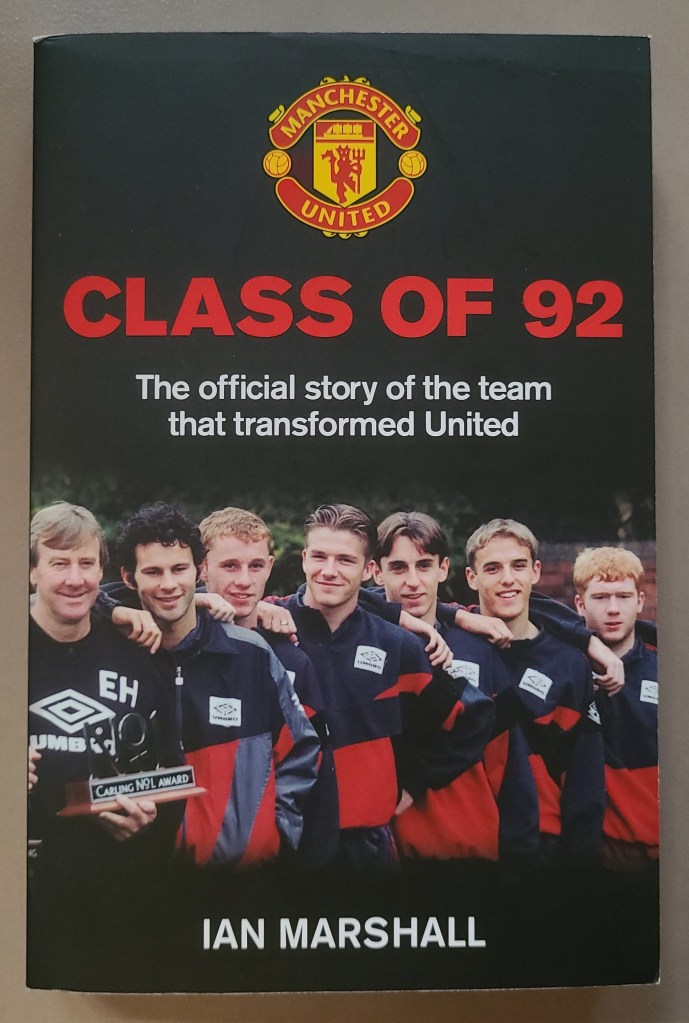
Giggs, Beckham, Scholes, the Nevilles, and Butt. They are part of the ‘Class of 92’: a cohort of Man Utd youth players that achieved enormous collective and individual success in and beyond the game. They require no further introduction. Yet what about Casper, Thornley, McKee, O’Kane, Switzer, or Burke? These names are less familiar, yet they graced the same pitch and teamsheets as their more vaunted fellow members of the Class of 92 in the early-to-mid 1990s. Some may know these latter names by association with Giggs et al., as comparative hard luck stories, or as the answer to a pub trivia question.

In Class of 92, author Ian Marshall tells the collective story of all the indomitable, unsettled, and cruelly curtailed young talents who made up the Class of 92. Through his interviews with the lesser-known members of the team, Marshall spins a fascinating narrative that is very diplomatic to each member, and doesn’t go overboard in throwing plaudits or burnishing the reputations of those selected members who won it all. As such, Class of 92 reads as a dispassionate account of how members of the Class of 92 contemporaneously reacted to, and either adapted or folded to, the extraordinary high demands placed on them by youth team coach Eric Harrison.

“They’ve got to be in love with football…It’s normal for lads of fifteen, sixteen and seventeen to switch off occasionally, but we’re not looking for normal.” Paul McGuinness (pg. 3)

Naturally, GBSNB (for brevity, I’ll shorten the collective presence of Giggs, Beckham, Scholes, the Nevilles, and Butt to this acronym) gets relatively more attention because of their sustained success, and this becomes obvious in the latter chapters as other members of the Class of 92 slew off and away from Man Utd to pastures new for better opportunities.

Yet this focus on GBSNB does not diminish the contributing anecdotes of Colin McKee, Kevin Pilkington, George Switzer, Chris Casper, Ben Thornley, and Raphael Burke among others. All being special players in their own right (Thornley was suggested to be one of the best of the Class of 92), we can see that they do not look back in anger or regret on their relative lack of on-field success or longevity. As Class of 92 was first published in 2012, it looks back at the Class of 92 before they all retired and before some of them took over Salford City in 2014. This serendipitous publication date largely mitigates fawning retrospectives of GBSNB post-retirement and gives more room for the stories of Casper, Thornley, Burke et al. to breathe, settle, and resound.

Nevertheless, Marshall skilfully weaves player biographical snippets throughout each chapter framed by each round of the Class of 92’s successful tilt toward 1991-92 FA Youth Cup glory. These chapters also feature plenty of names of opposition youth outfits from the past that will have you going down a Wikipedia rabbit-hole: Niall Thompson, Adie Mike, and George Ndah, anyone?

“Players must also have a capacity, and even enthusiasm, for hard work…beyond that, apprentices are also gaining in strength as they mature, learning how to perform to a consistently high standard and understanding their role in the team. It is a lot to take on in a short period—the world of professional football is a results-driven business that cannot afford to wait too long. Because of this, some players hit their ceiling very early on, while others have the priceless ability to go on improving. The football careers of Giggs and Burke show how quickly the paths can diverge, even between the ages of 14 and 18.” (pg. 107)

What I particularly like about Class of 92 is its retrospective analysis of the genesis of a youth intake—the Class of 92’s wild success notwithstanding. Watching a young tyro come up through the ranks of our club is a special joy that grows out of personal and in-group identity, geographical pride, and the tribal insularity of us versus them. These qualities are crystallised within the spectre of that young player clocking his or her first professional minutes. One of us, from the ground-up. Their names somehow stay with us, no matter how transitory their presence in the team may have been. We wonder about them, and how they’re getting on.

Of course, we can’t do a retrospective analysis of every youth intake of our club over the years. It would be impracticable. But with the Class of 92, Marshall has hit on a mainline vein of supporter pride that is rarely tapped into in non-fiction long-form despite the minutiae of youth management present in iterations of Football Manager and FIFA games. In having a hand in youngsters’ development, we want to see how players tumble out in the final wash.

Nowadays, the academy transfer market is a shadowy one to many fans due to the likelihood of a club’s top talent being poached by bigger clubs, often without warning and adequate compensation. This stacking of talent is a rich club’s game that many PL clubs—let alone Football League clubs—struggle to retain local and regional talent. This hyper-elite pathway to professionalism virtually guarantees at least a decent football career for youngsters in any of the four English leagues due to the raised standard of individual talent and application honed and shaped by peer competition and youth coaching and support that is beyond anything seen in the 1990s and 2000s.

This is why Class of 92 is an important and worthwhile read for all football fans: it outlines a blueprint of wholesome, on-field sustainability via a talent pipeline that we crave for as it appeals to our local supporter identity. Where many current top academy models exist as a late-capitalist means to identify ‘assets’ to on-sell for profit later, the book would also greatly appeal to supporters of teams further down in the FA pyramid that rely on their youth academies to nurture local talent as a means for existential survival. As such, Class of 92 acts as a manifesto, a retrospective, and a powerful rejoinder to Alan Hansen’s oft-repeated quote of “You can’t win anything with kids.”

“The important thing wasn’t being at United. It was working hard enough to make sure they’d let me stay there.” David Beckham (pg. 29)

STARS: 4/5

UNDER 20: An engrossing retrospective that covers all the angles and unknown corners of the much-celebrated ‘Class of 92’.

FULL-TIME SCORE: The young team, put together only recently, play with a verve and flair beyond their years to romp to a 3-0 win, and in the process, usher in a new spirit of hope for the club’s future fortunes.

RELATED READING: Tackled: The Class of 92 Star Who Never Got to Graduate by Ben Thornley (2018); How Not to be a Football Millionaire by Keith Gillespie (2013)

Bobby Robson: More Than A Manager

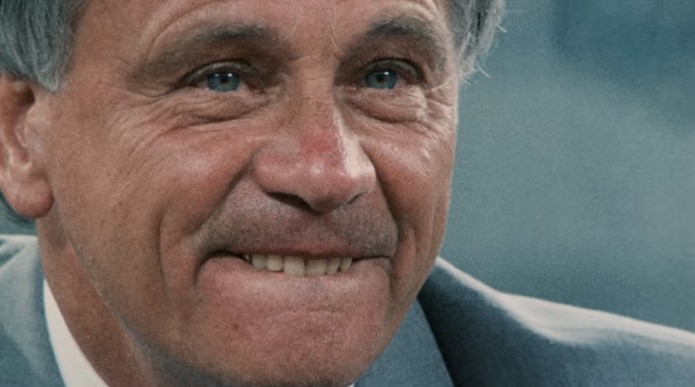
Sir Bobby Robson watches on as England capitulate to West Germany in 1990

The football documentary has of late received a makeover. It was inevitable that the modern-day football documentary would outgrow its gritty, made-for-television docudrama form of the 2000s, to evolve into a more elegant form that melds minimalistic storytelling and raw footage to create a compelling documentary. The masterful F1 documentary Senna has driven this change, and its influence has been seen in recent football documentaries such as Maradona and here with Bobby Robson: More Than A Manager. This documentary outlines Sir Bobby Robson’s various managerial achievements and falls from grace, and crafts a fine portrait of an often cruelly denigrated and misunderstood football man with a worldly bent. Even though Robson passed away from lung cancer in 2009, his legacy positively resounds into the present day. Interviews with figures from Robson’s life showed him to be a caring mentor to his players but a distant father, a successful and daring coach punished for his success, and a man who always looked like he was chasing up ‘unfinished business’.

When he got on the train at Durham to go to Fulham, and he was looking out the window and he was waving, well, I just broke down to think that, was he going to make the grade? Was he going to be alright?

Sir Bobby’s father Philip Robson on his son’s start to his playing career

The opening words of Robson, narrated by the man himself, sets the tone of an uncertain adventure already longed played out. “In my early days,” he says, “I always knew what I wanted to do. It was in my blood. I never knew where it would lead me.” Robson continues in a non-linear fashion, beginning with him taking on the Barcelona coaching job nine months after recovering from an operation to remove a malignant melanoma in his head. The mid-to-late 90s is the anchoring point for Robson, and despite the timeline jumping to his salad days as Ipswich manager and to his infamous stint as England manager through the 80s, we always return to his managerial glory days in continental Europe. This period, highlighted by his Barcelona days, acts as the conflict that drives the narrative forward.

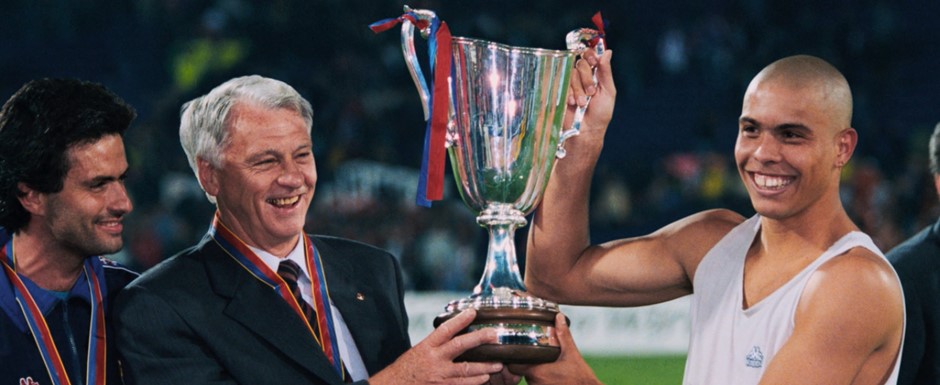
Jose Mourinho, Sir Bobby, and Ronaldo taste victory

The magic of Robson inevitably lies with his days as England head coach and as the successor to Johan Cruyff at Barcelona. The touchstone moments within these periods are covered with invaluable raw footage. An irate Robson fronts a press pack disputing Maradona’s first goal in England’s 1986 World Cup quarter final against England (“Maradona handled the ball into the goal, didn’t he? Didn’t he?”). We watch a nervous Robson fold a paper cup from the touchline as he sees England bow out to West Germany in the 1990 World Cup semi-final. We chuckle at his valiant attempts to speak Spanish in press conferences (“Figo, problem, fora. Stoichkov, problem, fora.”), and stand and salute his glorious last stand against the opposing forces within his own club to lead Barca to three trophies in a season before being unceremoniously dumped from his position as manager. No bit of footage is wasted in Robson, and through the lens of hindsight, we learn that Robson, despite his individual brilliance and his legitimate success, was always on a hiding to nothing from internal and external forces in the football world. Like myself, younger football fans will primarily remember Robson from his time as manager of Newcastle United in the early 2000s. Robson’s stint at Newcastle—his last—was a bittersweet one. The toxic situation at the club before Robson’s departure is palpably conveyed through Robson.

He said it was the hand of God. I said it was the hand of a rascal. And I’m right.”

Sir Bobby on Maradona’s infamous goal in the 1986 World Cup

The interviews carry legitimacy with endorsements of Robson by figures such as Jose Mourinho, Alan Shearer, Ronaldo, Sir Alex Ferguson, Gary Lineker, and Pep Guardiola. Robson clearly had a great influence on Mourinho’s career. Mourinho’s default pose of ‘resting belligerence’ is occasionally broken by misty-eyed recollections (“Without feeling [Robson’s] trust, I couldn’t jump so fast to be working with the best players in the world. Our relationship was phenomenal”). Pep Guardiola recounts how he offered to join Robson at Newcastle United following Robson’s departure from Barcelona (a real sliding-doors moment). Paul Gascoigne, perpetually on the verge of tears, tells of the deep, father-son relationship he had with Robson and how he would receive two calls a week from Robson following Robson’s sacking from Newcastle (“Under Sir Bobby, I knew I was safe. I was safe”; [Robson] could have done anything…to spend most of this time worrying about me was so, so, so unbelievable”). However, Robson’s dedication to his players is reflected with the distance he kept from his family, with his son Mark Robson lamenting that his father spent relatively little time with him. Robson, on a sombre, final note in Robson, seems to acknowledge this.

Paul Gascoigne on Sir Bobby

They were spot-on when they chose Mr. Robson to be the next one. Spot on.

Jose Mourinho on Robson’s appointment as Barcelona manager.

Where there is sentimentality, there is also a sense of despondency and feeling of betrayal in the interviews. In regards to Robson’s sacking from Newcastle United, his wife states that “[Robson] was very heartbroken when he was guillotined”, and his son claims that “His world fell apart. We can’t believe it still. Brutal.” Most tellingly was former Newcastle chairman Freddie Shepherd’s assertion that sacking Robson “was like shooting Bambi”. The undercurrent of sadness that flows through Robson is allowed to flow here in its latter parts, especially when Robson, stricken with terminal cancer, shows up to greet the players before the charity match for his foundation, and specifically gives Paul Gascoigne one final word of encouragement.

Devoted disciples to Robson may find the documentary lacking substance in terms of his initial forays into management on the European continent (PSV Eindhoven and Porto) in the 1990s, and a more complete picture of Robson’s life is best served in his autobiographies and biography. Despite this, Robson, as a documentary, almost bursts at its seams with the amount of territory covered. As a lovingly-curated account of Robson’s managerial life, Robson never overstates itself, and as a result is a simple, eminently watchable appraisal of an unforgettable figure in football history. The renaissance of the football documentary is well and truly in swing, and Robson is a prime example of it.

I remember everything. How long have you got?

Bobby Robson on his life
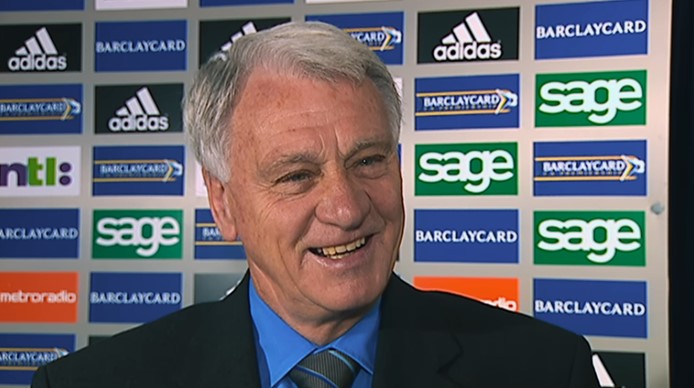
Sir Bobby at Newcastle United

STARS: 4.5/5

UNDER 20: A lovingly compiled and elegant recounting of Sir Bobby Robson’s managerial career.

Find Bobby Robson: More That A Manager on IMDB