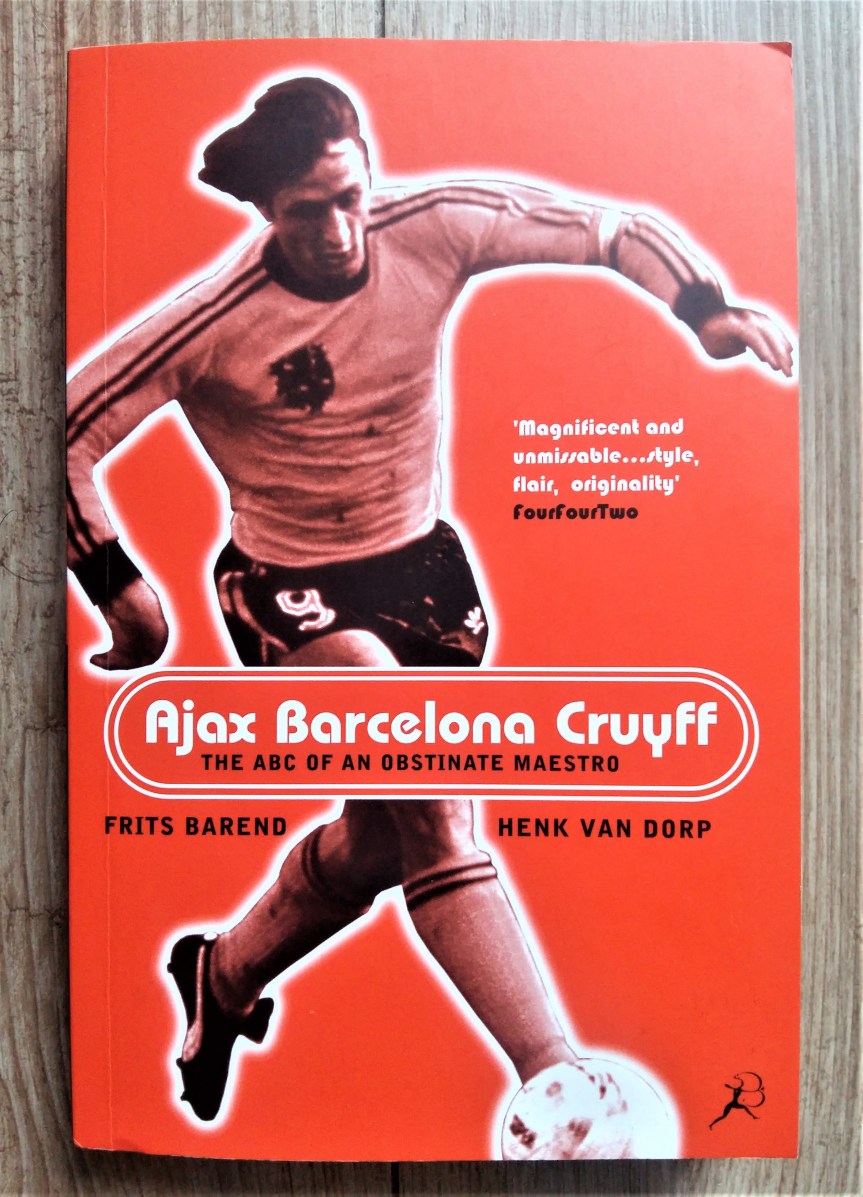

Ajax, Barcelona, Cruyff – Frits Barend & Henk van Dorp

“You don’t have to understand. If I’d wanted you to understand I would have explained it better.” This well-known phrase of Cruyff’s, originally spoken in relation to contract negotiations to become Holland’s national coach before the 1994 World Cup, is often wheeled out to remind everyone how obstinate and single-minded Johan Cruyff was when it came to his principles. This phrase showed Cruyff—the visionary, the sublime tactician, and purveyor of beautiful football—at his indomitable best.

However, this phrase also reflects how intensely private Cruyff was of his personal affairs, and how unwilling he was to offer up a softer side of himself to journalists. Cruyff’s sad passing in 2016 ensured that little was left in the way of an autobiography (aside from the disappointing My Turn published posthumously in 2016), leaving the best accounts of his life’s work to the journalists who followed him closely. The best of these is undoubtedly Ajax, Barcelona, Cruyff by Dutch journalists Frits Barend and Henk van Dorp. In this book, the many sides of Cruyff are laid bare in a series of fascinating interviews with the two journalists over a period of 25 years. The end result is not only a compelling, finely layered, and insightful character study, but also a ground-breaking piece of footballing long-form that straddled the line between traditional biography and cultured essay.

“I’ve been called a tactical genius. I’ve trained the first team, the C-team and also the youth teams. And practice has convinced me you don’t need a diploma for that. I only talk about technique and tactics. If Ajax has to train for physical condition, I just don’t join in. When I was young, I also hated running in the woods.” (pg. 35)

Cruyff speaking to ‘Vrij Nederland’ in March 1981 (pg. 35)

The interviews and articles follow Cruyff as player through his salad days at Ajax and Barcelona in the 1970s, and finishes with the end of his coaching stint at Barcelona in the mid-1990s. The content of specific interviews is wide-ranging, and rarely static. The dialogue between Barend, van Dorp, and Cruyff makes for stirring reading, and Cruyff’s Barcelona interviews (as coach) help to pin down many facets of Cruyff’s character. Gold dust lies between the footballing matters—Cruyff is often prompted on family life, religion and philosophy, and he mostly replies candidly. Elsewhere he shows his tempestuousness and exasperation, resulting in stand-offs between him and the journalists. Cruyff truly flows and rages like a river moving through rapids. His answers are often incomprehensible (even to the journalists) and evasive, but herein lies the humour and tension.

Ajax, Barcelona, Cruyff is not a typical football biography. In format alone, it demands of the reader a basic knowledge of both Dutch footballing dominance in the 1970s and Cruyff’s footballing and coaching exploits. In the interests of providing context, the translators for this English edition (David Winner and Lex van Dam) include magazine and newspaper articles that did not feature in the Dutch edition. These additions are indispensable in painting a picture of Cruyff in the 1960s and 1970s. The very specific nature of the interviews especially caters to the football fan look wistfully at football in the 1980s and 1990s. As Barcelona coach, Cruyff waxes lyrical on the future of young Dutch tyros Aron Winter and Richard Witschge; he laments at the loss of Ronald Koeman and the laziness of Hristo Stoickhov; and he reflects upon his foreign contingent at Barcelona of Popescu, Kodro, Luis Figo, and Hagi post-Romario. The nostalgia trip is real.

“When you are 4-0 ahead with 10 minutes to go, it’s better to hit the post a couple of times so the crowd can go “oooh” and “aaaah” because if it’s 5-0 nil, it’s only for the score, it doesn’t affect the result.”

Cruyff on ‘Barend and Van Dorp’ in April 1997 on how football should be played beautifully (pg. 218)

Although Ajax, Barcelona, Cruyff was first published in 1997, readers will appreciate this portrait of Cruyff more so than his recent autobiography My Turn. The transcripts in Ajax, Barcelona, Cruyff show a dedicated family man (“I’m my daughter’s father”) who picks up the children from school; a philosopher who discusses social affairs and the existence of God; a man who sticks by his footballing principles even in the face of greater opportunity (“I could never work for AS Roma. They have a running track around their pitch. That’s the worst thing there is”); a maverick who never admits he is wrong (“If there was [a time I was wrong], I would never talk about it, never. I would put it away. That’s part of my character”); and a retired player-cum-coach who loves to get stuck in on the training pitch (“There are obviously a thousand and one problems a day here. My only distraction is the one and a half hours I’m on the pitch”). Ajax, Barcelona, Cruyff is a warts and all depiction of Cruyff—it is far-removed from the self-serving and arrogant language of My Turn.

“Last Friday, Cruyff was given an ultimatum. ‘Why an ultimatum when we’re still in the middle of negotiations?’ Cruyff thought. How was he supposed to react to the combination of faxes from the KNVB lawyer Mr Utermark and from Staatsen, bearing in mind that it’s impossible to insult Cruyff more than by giving him an ultimatum. Cruyff might not be arrogant, but he happens to be the Sinatra of football trainers and it remains very Dutch to say that Cruyff shouldn’t think he is Cruyff. Think about it!”

On Cruyff’s contract negotiations with the KNVB, in ‘Nieuwe Revu’ in December 1993 (pg. 164)

The translation is seemingly faithful to the turn of phrase used by Cruyff and the interviewers. Some readers my find the translation jarring and inaccurate, yet knowing that Cruyff had a very distinctive speaking style (“Cruyff can be enigmatic and elliptical to the point of incomprehensibility”) it seems hardly fair to criticise the translation. As previously stated, the articles are very selective in time frame and context, and some may be disappointed that there is almost zero mention of his career in the United States to claw back his fortune following his disastrous decision to invest in a pig farming venture. This may be due to the journalists’ overt criticism of football in the US (“in the United States, where football or ‘soccer’, never was and never will be anything, Cruyff can walk the streets without being disturbed”). Where Cruyff describes his US experience as a defining time for his career and life in My Turn, Barend and van Dorp completely overlook this in Ajax, Barcelona, Cruyff. Cruyff’s experience in the US deserves greater coverage, especially in long form. It is therefore a disappointing omission from an otherwise great book.

There will never be a character in the football world as enigmatic and forward-thinking as Johan Cruyff. Although much is written about his footballing ‘vision’, his tactics, and his immense contribution to the game that still resonates in the present day, there is less written about his life in sum—especially when Cruyff himself famously refused to dwell on his past. Ajax, Barcelona, Cruyff is therefore an invaluable treasure for the footballing community. Despite its unorthodox style and it being twenty years since it was first published, this book is still the most objective and rounded impression of this football revolutionary and bona fide legend.

HIGHLIGHTED PASSAGE

“We’ve listened to a lot of tapes of you. There’s a lot of verbal battles, because you always want to talk rubbish and then we say, Johan, be clear. And then you say: Let me talk, let me explain. As seen through out interviews, your life is one big war. You’ve been active for about 35 years in professional football, and for almost 35 years it’s been a war. Why is that?” Cruyff: “War? Arguments!”

Cruyff on his so-called ‘war’, on ‘Barend and Van Dorp’ in April 1997 (pg. 248)

STARS: 4.5/5

UNDER 20: A series of revealing articles and interviews with Johan Cruyff contribute to a stunning character study of the legend.

FULL-TIME SCORE: The indomitable coach adopts his trademark fluid, attacking display to great effect in a fully-fledged team performance resulting in a 4-0 win (with a last-minute shot against the bar to make the crowd go oooh and aaaah).

RELATED READING: Brilliant Orange: The Neurotic Genius of Dutch Football by David Winner (2000); My Turn by Johan Cruyff (2016)

Find Ajax, Barcelona, Cruyff on Amazon

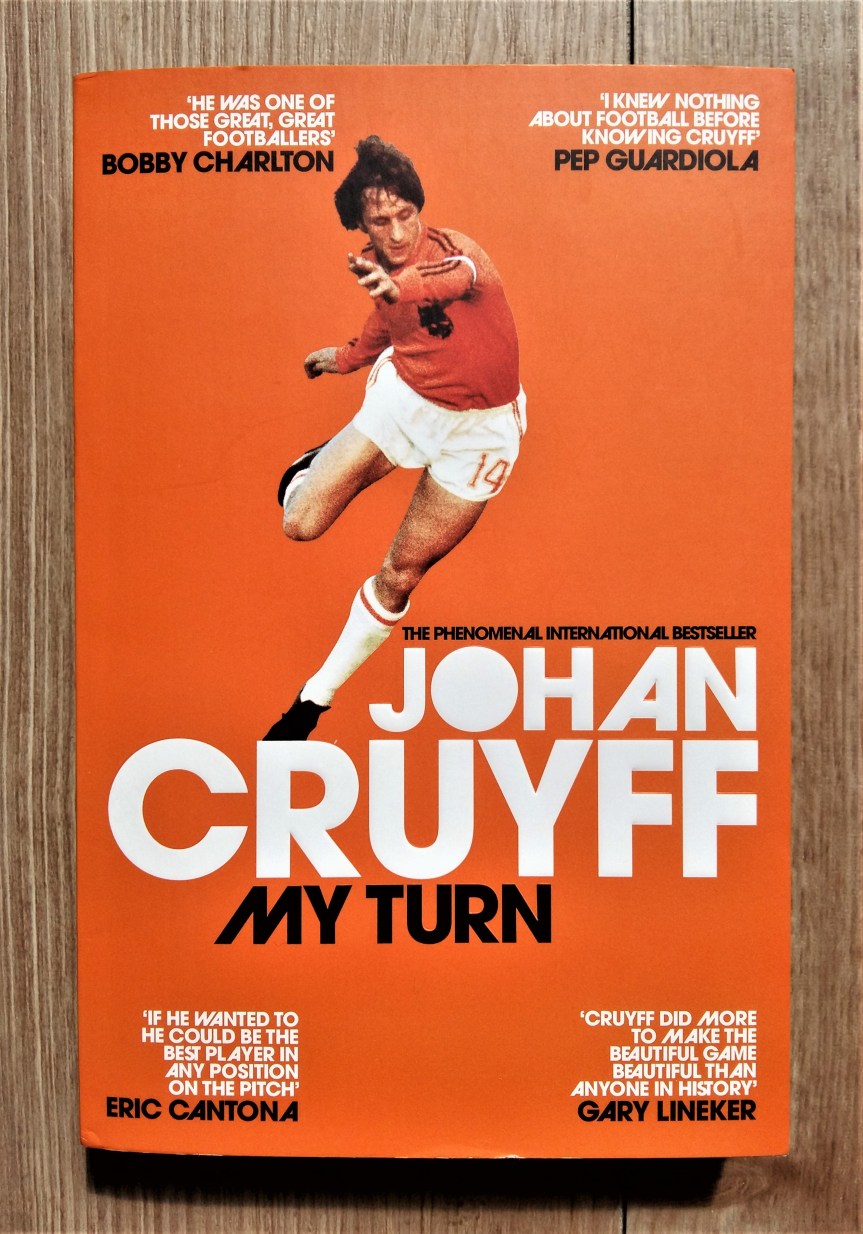
My Turn – Johan Cruyff

Johan Cruyff is regarded as one of the greatest footballers of all time, yet he was also incredibly successful in his post-playing career. In addition to his many honours and accolades, he contributed immensely to the tactical side of football, so much so that the modern game is heavily rooted in the ideas that Cruyff espoused. As such, the European patron saint of ‘beautiful football’ may well go down as football’s single-most influential figure.

Cruyff’s autobiography My Turn, finished shortly before his death at the age of 68, is a typically Cruyffian and frank account of his body of work. Like any man who has truly earned the right to own the soapbox, he writes without filter and without humility. His writing is often illuminating, prophetic, divisive, idealistic, and rooted in that wonderful arrogance that made him such an iconoclast. This is by no means a by-the-numbers autobiography—it is rather a manifest, a thesis defence, and a rallying cry. It is truly his turn.

“The good player is the player who touches the ball just once and knows where to run; that is what Dutch football is about. I have always said that football should be played beautifully, and in an attacking way. It must be a spectacle.”

Cruyff on how football should be played (pg. 29)

My Turn also reads like a mournful eulogy. Cruyff wrote My Turn whilst battling lung cancer, and although there is one mention of this in his book, his health is a subject that he was always highly conscious of. He remarks upon his previous heart problems with a certain casualness, having realised at a young age that his health problems would eventuate. Cruyff’s quiet acceptance of this flows through his writing, and read posthumously My Turn is an incredibly personal recounting of a man who lived and died for football. Even his often-disengaged style is somewhat endearing and displays that brilliant single-mindedness endemic in genius.

Fervent adherents to Cruyff’s philosophy will undoubtedly gain a great insight into his thoughts on Total Football and his turbulent relationship with the Ajax board in his later years. His honesty ranges from brutal, particularly in reference to his failed personal relationships (“That’s happened to me often if my life—people I had a special bond with suddenly letting me down. Like with Michels, but also with Piet Keizer, Carles Rexach and later Marco van Basten…When I think about it, I’ve learned a lot from them all, but they’ve never been willing to learn from me. I think that’s a very telling difference.”); to the tragic, encapsulated by his reasons for refusing to be part of the Dutch national team for the 1978 World Cup and in his description of son Jordi’s injury-plagued career. My Turn is the work of an idealist with unshakeable principles who refuses to be caught up with the material and transient—he merely regards medals and honours as things to put in his “grandchildren’s toy box” and he writes that the past is “not something that I think too much about”.

“In the end, the time will surely come when the club [Ajax] realizes things need to change…At any rate, it’ll happen when the right people start being listened to. People who hold the club in their hearts and who know what Ajax represents. If that happens, our struggle will not have been in vain.”

Lamenting the situation at Ajax (pg. 239)

However, his self-serving style of writing and what he chooses to focus on (and omit) will invite criticism and polarise readers. It may be a great loss to football history that he glosses over his magnificent playing career, and his dismissal of the greatest of the great losses—the 1974 World Cup Final loss—is infuriating in its blitheness (“That said, I got over it quickly enough. In fact it wasn’t much of a blow. Much more important was the vast amount of positivity and admiration for our play that our performances had generated all over the world.” (pg. 60)). He defends himself from the many criticisms levelled at him, including the standing-over of then-Ajax coach Leo Beenhakker and his insensitive remarks to Edgar Davids by claiming that what he did was for Ajax’s betterment. He writes his disdain for the ‘gutter press’, yet used his column to kickstart a war of attrition against the Ajax board. His frequent use of imperatives (“we must”, “we have to”) and arrogant language (“I’ve never been driven by rancour”; “I’m a very idealistic person who knows what he’s talking about”; “I looked in the mirror and came to the conclusion that I should be the model for this”) can make for some difficult reading.

Yet this is what made Cruyff essentially Cruyff—an unshakeable belief in his own ideology, and his determination to make the game ‘beautiful’ to watch, where winning is merely derived from spectacle. Therefore, My Turn cannot possibly encapsulate the depth of Cruyff’s ideology, and it reads much like an unpolished draft. As such, there are some grating contradictions. He writes “You can’t be a top sportsman unless you are intelligent” and later writes that “information is more important than intelligence”. He claimed to have an affinity with numbers and numerology, yet flexes that he doesn’t know how much money he has (“I wouldn’t be able to tell you. Not a clue. Let me know if there are any problems. I don’t live in that world. It’s not my thing.”) It all comes across as conceited, and to a fan who struggles to pay for a ticket to watch a game—let alone the beautiful game—such remarks are insulting and out of touch. Several chapters, especially his meandering descriptions about his battles with the Ajax powers-that-be, are heavily unedited and may have been an effort by the publisher to maintain Cruyff’s ‘voice’.

My Turn ends with a touch of lament. Cruyff bemoans the state of his beloved Ajax, writing that “It’s incredibly sad that, at the age of sixteen, I was there for the beginning of the ascendancy, and now, at nearly seventy, I have to witness the decline. No one wants to listen. Or rather, hardly anyone wants to listen. Everyone has his own agenda.” It would have been unlike Cruyff to question his own relevancy at any time, but to admit his sadness shows a man taking stock near the end of his life. Readers may even pick up some regret in his refusal to even acknowledge the ’74 World Cup loss as a failure in his footballing life, despite bemoaning the circumstances involving his self-exclusion from the ’78 World Cup tilt (that they may have won had he played) and his dejection in not being able to coach the Dutch national team in the 1990 World Cup (Michels “cocked it up”).

Perhaps the charm of My Turn lies in the obstinacy, the inconsistencies, and the unanswered questions. Cruyff set himself high standards, and expected the same of others. His autobiography is written in the same vein—he writes assuming that the reader already understands. In a way, My Turn is engaging in its combativeness and self-importance, for Cruyff certainly earned the right to be unashamedly forthright. However, My Turn is a tragic missed opportunity by Cruyff and his publisher to leave behind a final, unforgettable testimony of one of football’s greatest personalities. We, as football fans, are worse off for what has been omitted, ignored, or downplayed.

HIGHLIGHTED PASSAGE

“The World Cup [1974] turned us into cult figures around the globe. People warmed to our image of gritty bravura. Our strength lay in our honesty. We weren’t acting; that was really how we were. Dutchmen by birth, and definitely Amsterdammers by nature.”

Remarks upon the 1974 World Cup (pg. 62)

STARS: 2.5/5

UNDER 20: A disappointing and uneven autobiography by a bona fide footballing legend at the end of his wonderful life.

FULL-TIME SCORE: The undoubted star of the team dictates play, but his end product is unusually lacking in a bore 1-1 draw against a more pragmatic team.

RELATED READING: Brilliant Orange: The Neurotic Genius of Dutch Football by David Winner (2000)

Find My Turn on Amazon

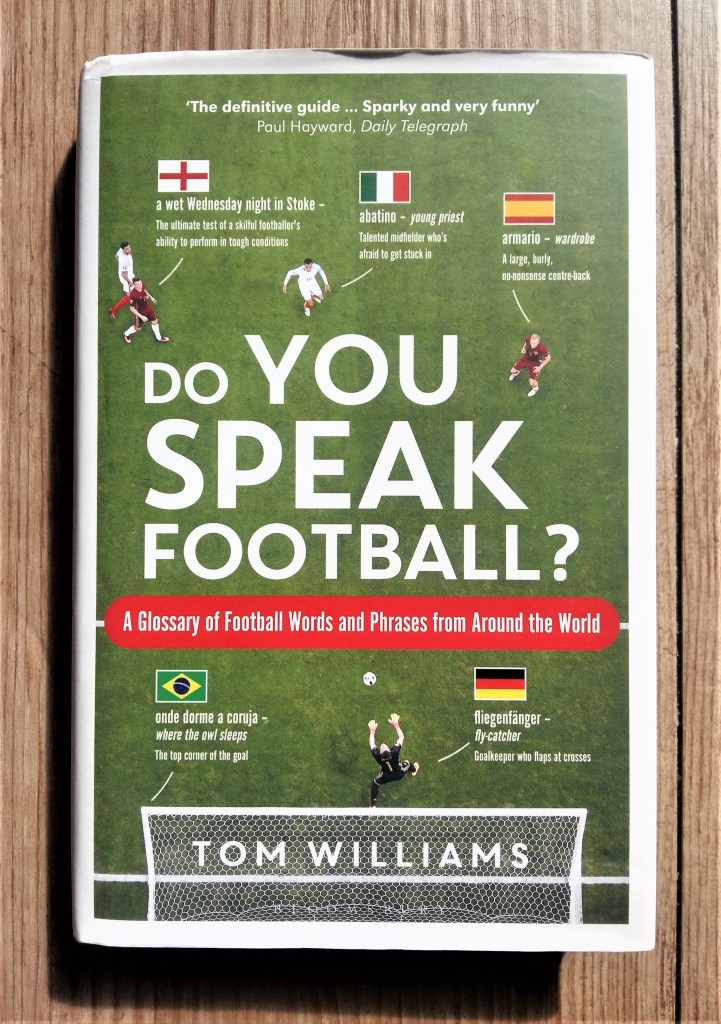
Do You Speak Football? – Tom Williams

The lexicon of football is indeed richly varied. Words and expressions are routinely coined and rarely arbitrary. Each coinage is reflective of the culture from which it originates, and carried a collective feeling, a shared history, a regrettable moment, or a glorious victory. Well known terms such as joga bonito, diski, and morbo all evoke certain ideas about football, and how it should be played. Each part of the football lexicon is personal, subjective, and shifting in meaning over time—therefore, any attempt to categorise such a lexicon would prove to be a difficult task.

Tom Williams has, however, tackled this task meritoriously in his extensive glossary Do You Speak Football? In this book, the respective lexicon of eighty-nine footballing nations over seven regions is detailed in varying degrees, with ‘heavyweight’ nations commanding the most entries. Amidst this eclectic compendium—where there are at least twenty ways to describe a nutmeg and no less than fourteen creative ways to say in the top corner—Williams also cannily delves into the history of more specific expressions and teases out some glorious, seldom-told anecdotes from footballing history that even the most knowledgeable football anorak may be unaware of.

“One of the most evocative words in World Cup History, Maracanazo was the name given to Brazil’s sensational defeat by Uruguay in the deciding match of the 1950 tournament…Nelson Rodrigues, Brazil’s greatest playwright, described it as ‘our Hiroshima’. The calamity was evoked again during the 2014 World Cup when Brazil, again the hosts, collapsed to an unbelievable 7-1 loss to Germany in the semi-finals at Belo Horizonte’s Estádio Mineirão. It was quickly dubbed the Mineirazo.

The meaning of Maracanazo (pg. 28)

The entries are brilliant and conjure up vivid mental images. Onde dorme a coruja (‘where the owl sleeps’), fare la gavetta (‘to do the mess tin’), and pihkatappi (‘faecal plug’) are good examples of this. Panenka, timsaha yatmak (‘doing a crocodile’), and poteaux carrés (‘square posts’) all reflect moments in football history that still ripple in the present; and tuya, Héctor (‘yours, Hector’) and en rigtig Jesper Olsen (a real Jesper Olsen) are footballing expressions that have entered everyday life. There are hundreds of equally fascinating entries each accompanied by Williams’ punchy and clever explanations.

Do You Speak Football? does not have to be linearly read. Readers can dip in and out at will, though it is certainly worth reading from front to back to get full value. A concise appendix of each entry is lacking, making the book difficult to reference quickly. Where there are crossover entries—nutmeg and in the top corner, for example—there are no specific page references for similar entries. Although no entry is forced, some countries are overrepresented, while others are underrepresented.

“When a bear hibernates, a large mass of hardened matter called a faecal plug forms in its colon… In football terms, [pihkatappi] is used to describe a defensive midfielder who plugs the gap in front of his team’s defence. And you thought left-back was an unglamorous position.”

The meaning of pihkatappi (pg. 92)

Do You Speak Football? can also be compared to Adam Hurrey’s 2014 book Football Clichés. Both are glossaries of footballing parlance, but are very different in tone. Football Clichés is a humorous and light stocking stuffer, whereas Do You Speak Football? eschews the pithy humour to take a more erudite and meaningful look at footballing language. As such, it reflects upon how culture affects language.

The success of Do You Speak Football? is a testament to Williams’ research, and his ability to compose a fascinating anecdote. His work will appeal to all football fans, and will especially please those who appreciate esoteric football trivia. Readers of Do You Speak Football? will also gain a clearer insight into the beauty of a lexicon that is often watered down by clichés and platitudes.

HIGHLIGHTED PASSAGE

“Unimpressed by the performances of 18-year-old playmaker Gianni Rivera at the 1962 World Cup in Chile, [Gianni] Brera dubbed him l’Abatino, meaning ‘the Young Priest’, in mocking reference to Rivera’s slight physique and lack of defensive endeavour. The term became used to describe any thoughtful, willowy midfielder whose excellent vision and passing ability were not matched by his work-rate. Another term was euclideo (‘Euclidean’), after the Ancient Greek mathematician Euclid, which he used to describe a player who read the game well and moved in logical patterns.” (pg. 122-123).

A couple of Gianni Brera’s classic coinages (pg. 122-123)

STARS: 4/5

UNDER 20: A fascinating study of football lexicon and culture that is punctuated with wonderful asides, historical anecdotes and trivia.

FULL-TIME SCORE: The l’Abatino plays a Streltsov pass to the ponta de lança, who puts some chanfle to put the la bendita into the jep’s nest for a glorious final mark on a colourful and creative 3-1 win.  

RELATED READING: Football Clichés by Adam Hurrey (2014).

Find Do You Speak Football? on Amazon

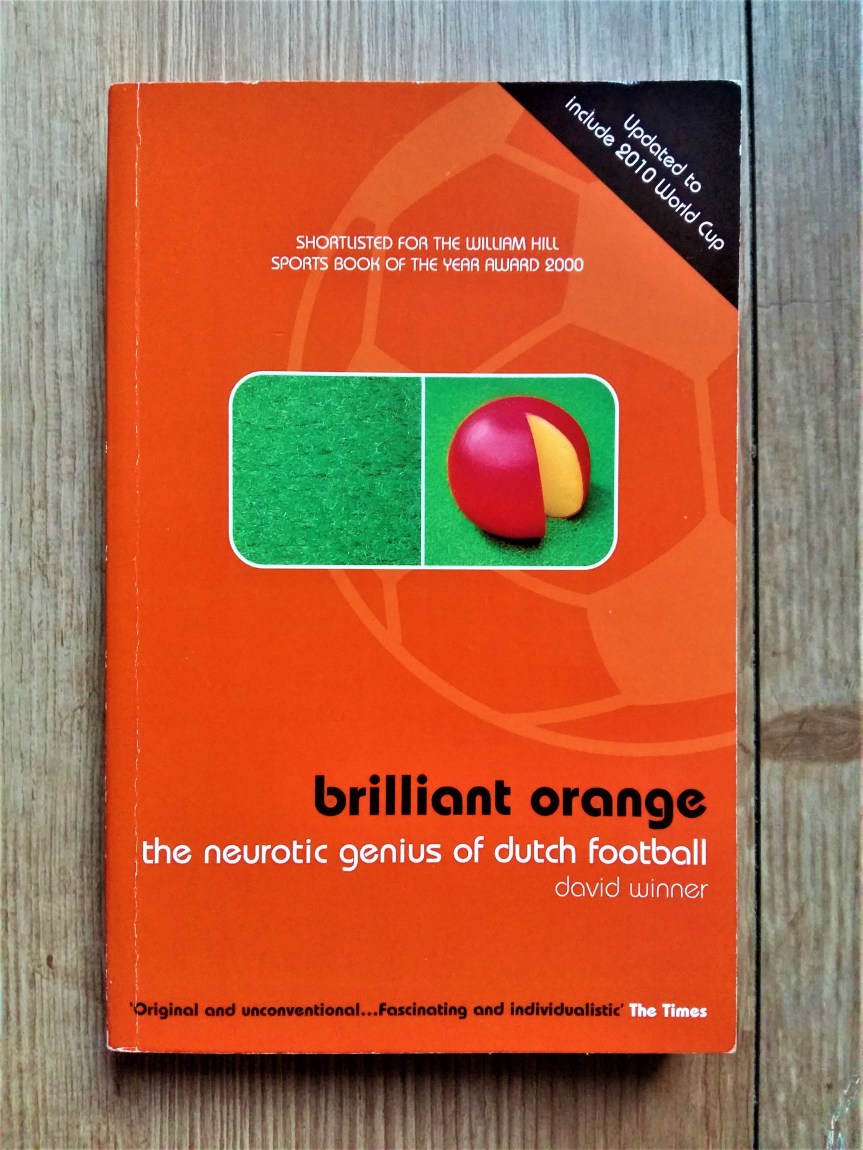
Brilliant Orange: The Neurotic Genius of Dutch Football – David Winner

The Dutch style of football, typically characterised by Ajax and Dutch national teams playing ‘Total Football’ in the 1960s and 1970s, is more complicated than the sum of its parts. Any book investigating the roots of the Dutch style needs an author who can tease out elements of history, society, culture, and politics that went into the making of the Dutch style. David Winner, in his masterpiece Brilliant Orange, succeeds in picking apart the Dutch style and analyses it with an expert and loving eye. So successful is his quest that Brilliant Orange can be read as a love letter to, eulogy to, or debriefing of the great enigma that was—and arguably still is—the Dutch style of football.

So, what is the Dutch style? Perhaps it can be popularly summed up through three elements: the tactics of ‘Total Football’; the late and great Johan Cruyff; and the 1974 World Cup Final. David Winner, however, takes a deep dive into the Dutch psyche and resurfaces with anecdotes from multiple spheres, sources, and spectrums to explain the Dutch brand of football. The Dutch style, Winner argues, is not just a product of Rinus Michels’ disciplinarian and manipulative tactics on and off the pitch. It is influenced by the progressive politics of the 60s, flexibility in architecture, the Dutch penchant for making open space from crawlspace, and collective trauma. By no means is this a definitive list—Brilliant Orange is far too storied to adequately describe it in bullet points.

“Barry Hulshoff explains the principle: ‘Total Football means that a player in attack can play in defence—only that he can do this, that is all. Everything starts simply. The defender must first think defensively, but he must also think offensively. For an attacker it is the other way around. Somewhere they meet.’”

Barry Hulshoff on ‘Total Football’ (pg. 26)

The usual malaises of the Dutch style are skilfully covered, including the heartbreaks of the 1974 and 1978 World Cup Finals, and continued underperformance and failure at national level. As well as drawing upon anecdotes from wide-ranging sources, Winner also interviews players, managers, journalists, psychologists, and artists to bring together a narrative. Every poke and prod he makes pushes out a further question. We read a thrilling interview with the enigma and former glamour boy Johnny Rep which reads like a tug-of-war between him and Winner. Where Rep is unforthcoming and cheekily evasive, Gerrie Muhren is serene, open and engaging. The pragmatic coach Leo Beenhakker talks about how he both “hates” and “loves” the Dutch style of the end-to-end excitement of attacking play. We learn about the man who played in Johan Cruyff’s shadow (and was possibly on par with him skill-wise), and how a captain’s ballot and swimming pool party helped bring down Camelot. Or, according to one source, how West Germany “murdered innocence.”

Although Winner and the reader may not be any close to an answer on why the Dutch style—perhaps the most stylistically revolutionary of all styles—fell to bits where it mattered, the poetry, as Jan Mulder implies, lies in the failure of the enterprise.

“But we are talking about the great team that lost because they lost. If they’d won, it would be less interesting, much less romantic. So we are in the same room as Puskas and the great Hungarians—we are together with the best team in the history of football. Second but imperial! Unforgettable seconds! Better seconds!”

Jan Mulder on being second (pg. 115)

Some of the, well, more brilliant parts of Brilliant Orange lie in the historical, societal, and artistic insights. Winner bookmarks these insights in the first- and final-thirds of the book. Everything in between is equally illuminating and a treat to read. The structure and chapters of Brilliant Orange can be seen as representative of the theory of total football, in fact—it is total in its scope and content, forever intertwined, and more than the sum of its parts. David Winner, in writing Brilliant Orange, is like an engineer devotedly describing each part of a finely-tuned engine. Such is the quality of writing, and such is the quality of product. And although Brilliant Orange was originally published in 2000, it retains a timelessness and whimsical yearning. The updated version also covers the infamous 2010 World Cup Final.

The best football books come from a longing from within, a need to explain oneself through the content. This comes out through well-known and touching autobiographies, most notably Paul McGrath’s Back from the Brink. However, the gold standard of football long-form also contains that ephemeral delight that can only come from an author’s hobbyhorse. Nick Hornby’s Fever Pitch is perfectly representative of this, and in turn shows what great football writing is. David Winner’s Brilliant Orange comes from the same streets, and is rightfully regarded as one of the greatest football books ever written. Brilliant Orange is a must-read for every football fan.

HIGHLIGHTED PASSAGE

“When we lose, it’s always because of “brutal force”. We never think we lose because of the elegance or creativity of another team. No, it’s because they used brutal force, which is simply not relevant to us because we are playing a different, better, higher game, which the referee also happens not to understand. We won’t lower ourselves to your level, but if it makes you happy to destroy our elegance, then go ahead!”

Political scientist Paul Scheffer on elegance vs brutal force (pg. 203)

STARS: 5/5

UNDER 20: A mesmeric and thrilling investigation into one of the most glorious football movements and set of players in history.

FULL-TIME SCORE: A glorious 4-0 win that enchants with bold, attacking, and fearsome play. It is very rare to see a team play this cohesively, this magically, and this memorably.

Find Brilliant Orange on Amazon

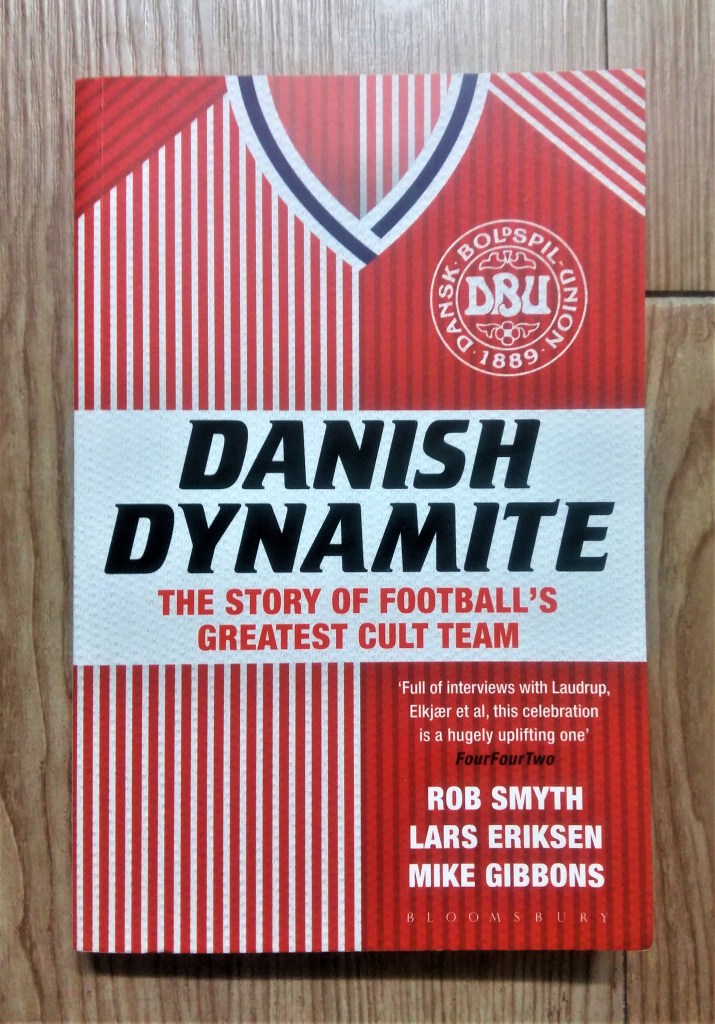
Danish Dynamite – Rob Smyth, Lars Eriksen, Mike Gibbons

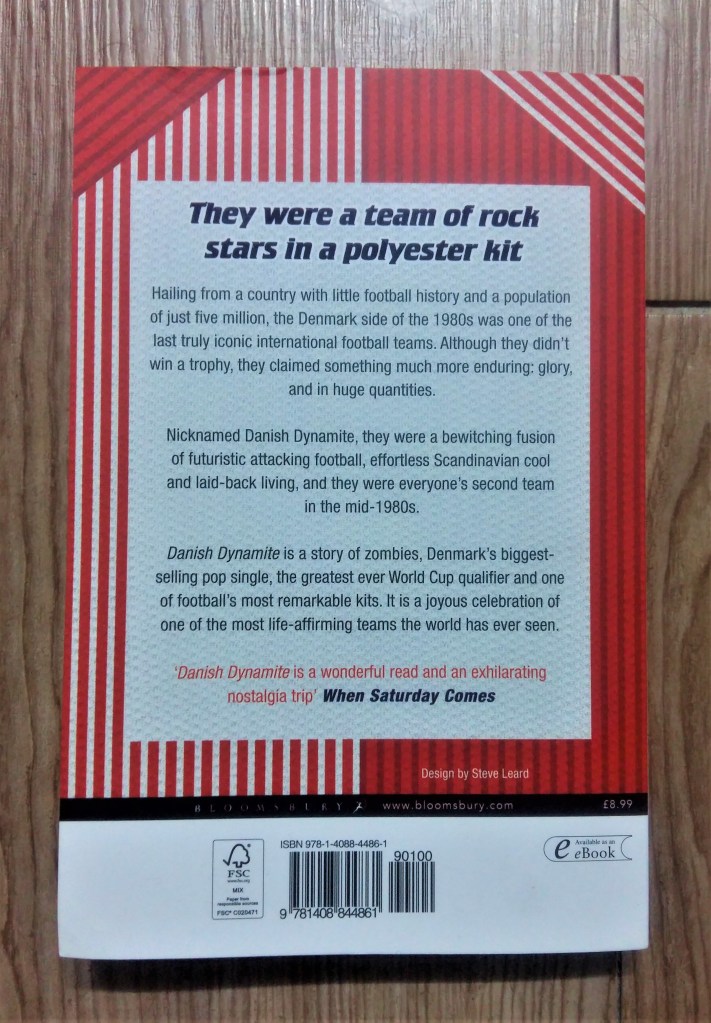
Denmark’s national team in the 1980s was one to behold. Names such as Laudrup, Elkjær, and Olsen became synonymous with an attractive, attacking brand of football that was in full flow at the Euros and 1986 World Cup in Mexico. Coach Sepp Piontek laid the foundations for not so much a team, but a movement for an entire nation that would ultimately culminate in Euro glory in the early 90s. In Danish Dynamite, authors Rob Smyth, Lars Eriksen, and Mike Gibbons capture this Danish zeitgeist in a thoroughly engaging and spirited read that will leave fans of 80s football reminiscing on one of the best-assembled national teams in football history.

Danish Dynamite is a lovingly-curated time capsule that focuses primarily on the ‘golden generation’ which represented Denmark at major tournaments in the 1980s. The book draws upon a multitude of resources that gives weight and depth to the narrative, and the descriptions (particularly of the matches) are lavish and vivid. From the national team’s amateur days wherein a session in a pub or bar was more highly regarded than the performance on the pitch beforehand; to the inspirational wins borne from the attack at-all-costs mentality and the soul-crushing losses at the latter stages of major tournaments, the reader rises and falls with the team.

“For the Italian and Germans an international match was business; for the Danish players it was a beano. They were an international team in name and a pub team in nature, steeped in a quagmire of amateurism in both approach and structure.”

Denmark’s amateur setup at national level (pg. 16)

Elkjær, Simonsen, Laudrup, Arnesen, Berggreen, Olsen, Lerby—these are not just players, but instantly likeable ‘men of the people’ who enchanted the football world, and who were equally as comfortable on the ball as they were drinking with the fanatic traveling band of Danish roligans. Although this generation of Danish footballers may in some quarters be best-known for that game against Spain at Mexico 86, the authors treatment of this game and other memorable ties (the win against Platini and France, and the grudge match against Belgium in particular) is respectful, insightful, and the benchmark of excellent football reportage.

“…after a particularly brutal opening the game morphed into one of the greatest in the history of the European Championship. A genuinely brilliant football match and a stripped-to-the-waist set-to were gloriously entwined. As the saying goes, in the middle of it all a football match broke out. And what a match.”

Denmark v Belgium at the 1984 European Championships (pg. 90)

‘Danish Dynamite’, as the Danish team’s way became known as, was the house that coach Sepp Piontek built, and Danish Dynamite can perhaps be seen as a tribute to his outstanding work. From his beginning as the coach of Haiti, to harnessing the tremendous individual talent he assembled into a glorious Danish national team, Piontek’s influence and character is finely weaved into the narrative. Piontek is a man certainly worthy of mention in football history—he led Denmark to its first World Cup in 1986, and even provided Bobby Robson with his worst memory of management when England capitulated to Denmark in 1983. Thankfully, Danish Dynamite lays out Piontek’s achievements in English-language long-form to a generation of football enthusiasts who may have been too young to remember the Danish team in its pomp.

Some readers may wonder why Denmark’s crowning achievement (champions of Euro 92) gets scant attention in Danish Dynamite, with one chapter at the end devoted to it. Indeed, the glory that escaped the ‘classic’ Danish team of the 80s is seen as an afterthought. However, the main strength of this book is that it poeticises not just the highs but also the lows, and in so gives the missteps, the fateful injuries and red cards, and the painful losses meaning. Danish Dynamite is about the journey, not the destination, of that comet that streaks across the sky and dazzles onlookers. As such, Danish Dynamite is an instant classic of football non-fiction, and is a highly recommended read.

HIGHLIGHTED PASSAGE

“It was football’s saddest, maddest thrashing. ‘It annoys me tremendously still today, because it’s ridiculous,’ says Elkjaer. ‘We were the better team, but we lost our heads and that’s crazy.’ Yet in a sense it was also in the spirit of Danish Dynamite. This was a team who could win 6-1 one week and lose 5-1 the next—and at Mexico 86 they became the only team since the 1950s to score and concede at least five at the same World Cup.”

Summing up the era of ‘Danish Dynamite’ (pg. 190)

STARS: 5/5
UNDER 20:Danish Dynamite is a classic and eminently re-readable account of the 80s Danish team that enchanted supporters and rivals alike.
FULL-TIME SCORE: A barnstorming 6-1 win, reflective of that memorable win against Uruguay in the 1986 World Cup.

Find Danish Dynamite on Amazon

Thirty-One Nil – James Montague

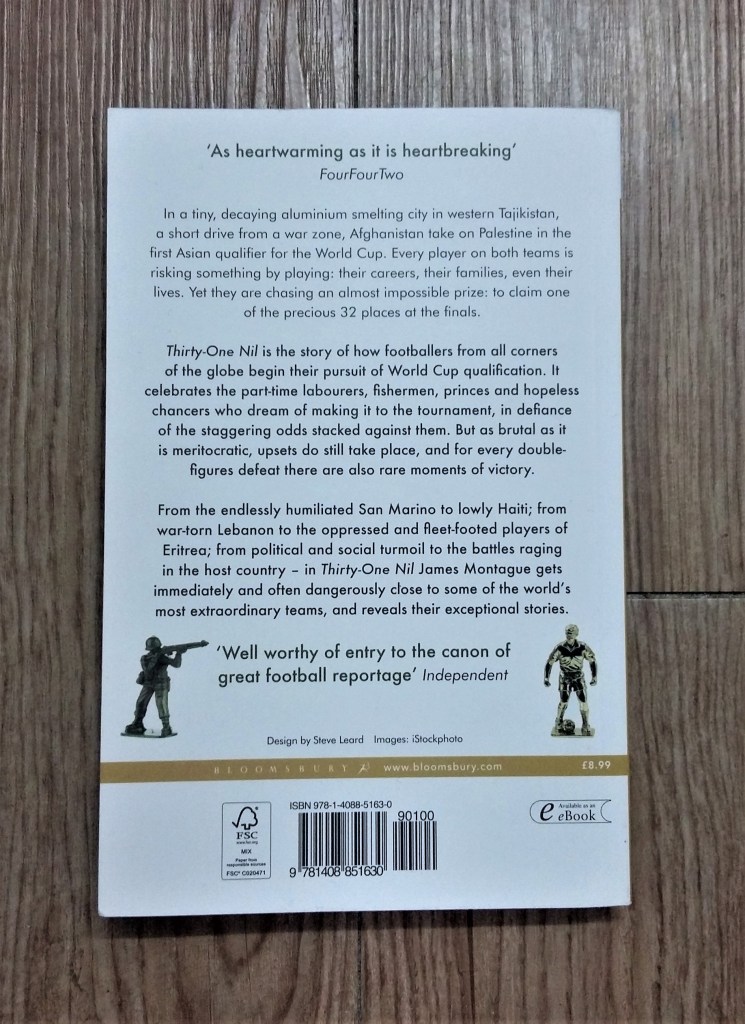
James Montague’s Thirty-One Nil is a sweeping travelogue detailing the fortunes of a number of national teams as they battle through qualifiers in the lead up to the 2014 World Cup. These teams all share ‘outsider’ status in some respect, whether it be for political reasons or because of their lowly status. Author James Montague teases out the difficulties national teams such as—but not restricted to—Haiti, Egypt, Lebanon, American Samoa, and Eritrea faced in putting a team on the park.

Travelogue, geopolitical essay, adventure story—Thirty-One Nil can be described as all of these. Montague covers riots in Egypt and Brazil; questions Sepp Blatter about Kosovo; goes fishing with players of the Antigua and Barbuda national team; gets drunk in a seedy Curacao bar; and even gets tear gassed and shocked out of sense by a stun grenade. Montague writes from the edge of his seat, and has duly earned the plaudit of ‘The Indiana Jones of soccer writing’ from Sports Illustrated’s Grant Wahl.

Montague’s writing shines when he narrows his focus on minnows such as American Samoa, the Caribbean nations, and (the then-lowly) Iceland. The stories of Nicky Salapu (the goalkeeper on the losing end of the 31-0 scoreline to Australia in 2001) and Jaiyah Saelua make for great reading, and Iceland’s goalkeeper-cum-filmmaker Hannes Halldórsson is given a platform in Thirty-One Nil long before he made a name for himself in the 2018 World Cup.

“I feel like I’ve been let out of prison. I want my son to grow up and don’t want kids chasing him around saying your dad lost 31-0…but if we win this tournament, we will get to Brazil no doubt! Even if we qualify for Brazil, and I don’t make it there, I would die a happy person.”

Nicky Salapu on qualification (pg. 100)

Antigua and Barbuda’s search for descendent talent in England is also worth mentioning, as well as Bob Bradley’s challenges in guiding Egypt (which features a young Mohamed Salah, and national icon Mohamed Aboutrika) through the qualifiers. Although the state of the national setups in 2014 are not reflective of the setups at the time of reading (2019), Thirty-One Nil nevertheless echoes the problems that face national teams in the present day due to complex political and social issues.

Montague has certainly chalked up the air miles in Thirty-One Nil. The book has a ‘written on the fly’ feel to it, and as such the writing often lacks cohesion and the chapters read like despatches from a coldly-observing foreign correspondent. The political exposition has a place in the book, but could have done with some pruning to break up overly-long paragraphs.

Back cover.

Some passages come across as insensitive and flippant, such as Montague comparing Haiti’s airport to ground zero of a “zombie apocalypse”, and the use of “bloodbath”, “sacrificial meat”, and “mauling” to describe unflattering score lines alongside chapters covering the Rwandan genocide and the Port Said Stadium riot.

Montague is a daring writer and intrepid traveller, and he has a talent for throwing himself into the moment. However, in travelling all over the world to gather his stories, he has perhaps spread himself too thin. As such, he doesn’t do full justice to one singular format, whether it be travelogue, geopolitical essay, or adventure story. There is undoubted quality in the pages of Thirty-One Nil, however a narrower focus that eschews historical and political exposition would have better served the main characters in this book, and their footballing lives as ‘outsiders’.

HIGHLIGHTED PASSAGE

When it is time for the ‘extreme underdogs’ of the US Virgin Islands to begin training, they start by running the length of the pitch, back and forth, back and forth. They take shooting practice next. No one manages to hit the target. Balls balloon over the goal, or end up near the corner flag. The maintenance men go about their work, painting and repainting the terrace steps in red, yellow, and blue, only stopping to retrieve any balls that land close to them.

On the US Virgin Islands’ upcoming qualifier against Haiti (pg. 50)

STARS: 2.5/5
UNDER 20: A gritty footballing travelogue, geopolitical essay, and adventure story rolled into one—yet lacking a unifying flavour.
FULL-TIME SCORE: A 2-1 loss away from home. Away attacks were fully-fledged and brave, yet sporadic.

Find Thirty-One Nil on Amazon

Football Clichés – Adam Hurrey

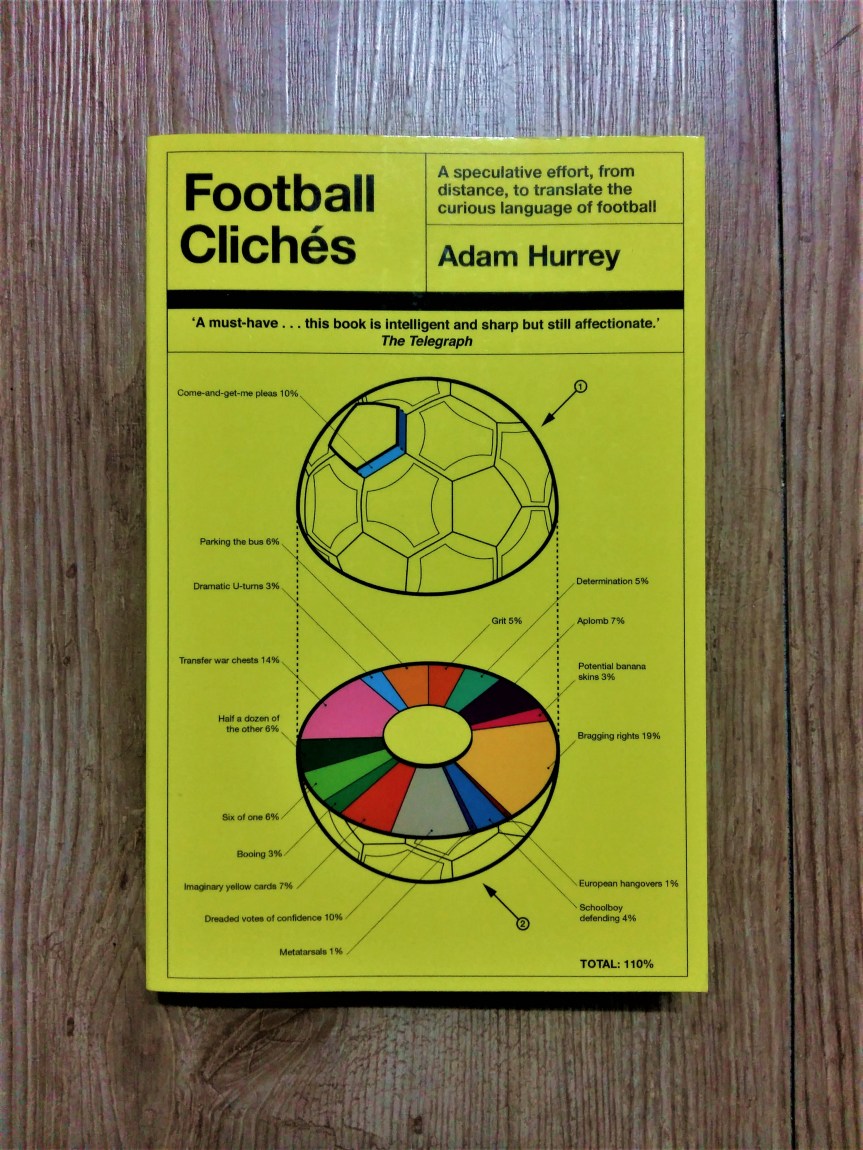
Football Cliches by Adam Hurrey, simply, is a compendium of clichés upon which the modern-day football world dances. The book hums along in a sprightly pace, and is a breezy read. You will laugh and you will smile wryly at the wordplay at work here, and anyone familiar with Hurrey’s work will get a kick out of it, as I did.

“Hammered – So evocative a term for powerful long-range efforts that it even extends to players’ nicknames, such as German midfielders Jorg ‘The Hammer’ Albertz and Thomas ‘Der Hammer’ Hitzlsperger, neither of whom needed a second invitation to shoot during their time in British football.” (pg. 16)

On describing the term ‘hammered’ (pg. 16).

Over fourteen chapters, Hurrey puts the spotlight on hundreds of clichés that are pervasive in football media and weaves them into his prose. From those heard on the field to those heard in the commentary box and everywhere in between, each cliché is keenly and humorously described. Clever diagrams are also featured, and although they are mostly irrelevant, they serve to further solidify Hurrey’s patented sense of football humour (the graph of ‘Minutes of Stoppage Time v Incredulity’ is typical of this humour).

“They may find, however, that their adversary is no slouch and he himself may need no invitation to bomb on. The historically undersung full-back has gradually been liberated by the era of relative gung ho-ism that the backpass rule ushered in. They are not free to buccaneer or maraud to their lungs’ content, provided they are just as good going the other way.”

On the modern-day full-back (pg. 40).

The writing does drag in the latter stages when the novelty of the writing form wears off. A book made up of lists is likely to do that, no matter how good the writing is. So, to sum up, Football Cliches does exactly what it says on the packet, and does it well.

Back cover.

HIGHLIGHTED PASSAGE

“Welcome to the Premier League – The standard English top-flight welcome pack for few foreign signings consists of three items: a pair of oversized headphones, a designer washbag and an agricultural challenge from an old-fashioned centre-half.”

The Premier League ‘welcome pack’ (pg. 94).

STARS: 3.5/5
FULL TIME SCORE: 2-1 win. An entertaining first half with the three goals scored, though the game gently falls away as players run out of legs.

Find Football Clichés on Amazon

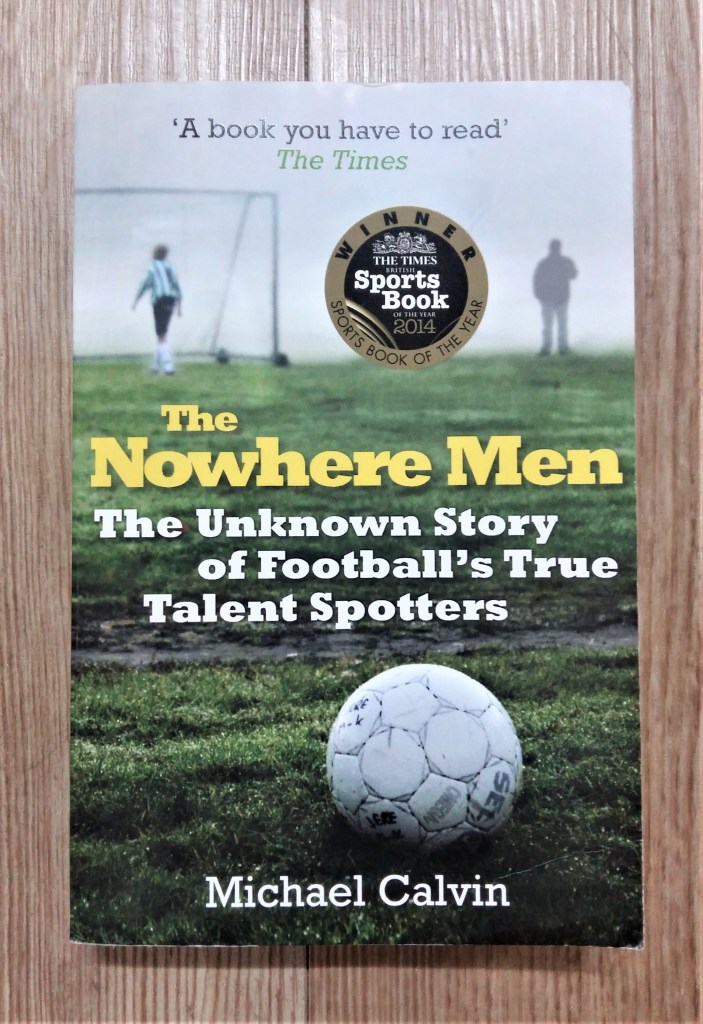
The Nowhere Men – Michael Calvin

The Nowhere Men by Michael Calvin is a deep dive into the world of football scouting. Calvin casts a sincere eye on to that slowly contracting world wherein the attrition is high and the payoffs are rare. Calvin’s polished and insightful writing takes us right smack-bang into the world of the beleaguered scout, who is increasingly becoming marginalised in the modern game.

The highlights of The Nowhere Men are certainly the conversations Calvin has with the scouts who have ‘put the miles in’ over decades in the business. Mel Johnson, Steve Jones, and especially John Griffin are warmly given the soapbox to give their take on their trade and reminisce on old glories. Of particular note is the conversation between Barry Lloyd, Allan Gemmell, and Pat Holland (the transcript of which is an entire chapter); Steve Jones’ scouting report on a Colchester side; and John Griffin’s catharsis at the end. These men are in their twilight, fighting against the technology that will eventually supplant them. Their stories alone could justify a spin-off series.

“Whether it is watching a park game on a Sunday morning, or Bromley, or Dartford, or Manchester United or Liverpool, you’ve got to be there. You’ve got to put the miles in. You’ve got to be there, because if you ain’t wearing those tyres out, you ain’t going to find that one.”

Allan Gemmell on scouting (pg. 147)

The final third of the book gets a bit ragged as Calvin spreads himself too thin and loses focus. The usual references to sabermetrics and Moneyball feature here, as well as the pervasive influence of statistics and video scouting. There are tenuous asides to American sport, too. Clearly the focus of the book is on the ‘nowhere men’ and their struggle to stay in the game. In this section, Calvin neither does justice to the scouts, nor the complex world of sabermetrics in sport.

There is no doubt about Calvin’s writing—it is refined, street-smart, and eminently readable. There are some memorable flourishes that may draw a smile or ire from the reader, some examples being:

You can’t create a love letter out of numbers, or express beauty in an algorithm. There’s no sensuality in a sine curve, or warmth in a heat map. The neuron boogie, which causes tiny hairs to elevate on the back of a scout’s neck, is a timeless tune.

The art of scouting (pg. 371)

The Nowhere Men was first published in 2013, and the references to then-tyros and youth-level starlets have naturally dated. Raheem Sterling, John Swift, Jeremie Boga, and Brandon Ormonde-Ottewill have all had varied levels of success, yet readers will undoubtedly enjoy the anecdotes and predictions laid down by the scouts about the above players and others. The Nowhere Men is sprinkled liberally with these little gems.

Modern football is an unforgiving shouting match wherein the little voices are drowned out. However, upon reading The Nowhere Men, the reader may come to realise that within the din lies the roar of the ‘mileage men’ as they rage against the dying of their profession. It is important to listen to that roar.

HIGHLIGHTED PASSAGE

“Whether it is watching a park game on a Sunday morning, or Bromley, or Dartford, or Manchester United or Liverpool, you’ve got to be there. You’ve got to put the miles in. You’ve got to be there, because if you ain’t wearing those tyres out, you ain’t going to find that one.” (pg. 147) (Allan Gemmell)

“The Nowhere Men were an increasingly endangered species, but no one had found the magic bullet, the ultimate statistic which proved, beyond doubt, a player’s worth from a spread sheet rather than a stream of consciousness, scrawled on the back of an envelope by a scout who felt football in his bones.” (pg. 172)

STARS: 4/5

FULL TIME SCORE: 3-1 winners. The scout—who brought two of the game’s debutants to the club—is halfway across the country watching another game.

Find The Nowhere Men on Amazon

The Stupid Footballer is Dead – Paul McVeigh

Paul McVeigh’s curiously named The Stupid Footballer Is Dead outlines some important lessons potential footballers must learn in the modern age of footballing. With great focus nowadays on sports science, the days of when a footballer could sink pints down at the pub following a game are well and truly over. McVeigh, however, insists that understanding sports psychology—a fascinating yet underappreciated frontier—is just as important in a footballer’s quest to succeed at the professional level and beyond.

Chapters titled ‘Create a Helpful Self-Image’, ‘Think About Thinking’, ‘Focus on Success’, and ‘Take Preparation and Recovery Seriously’ aren’t exactly new and edifying topics for a footballer already initiated at any professional level. Such advice is straight out of an instructional training session of an honest pro made good in the world beyond football. However, McVeigh very often hits the right tone when doling out his wisdom that is based on his experience mentoring young footballers and aiding in their psychological development. Paul McVeigh is a rare breed—a former pro at the highest level who is also an authority on footballing psychology. He provides case studies of footballers embodying the psychological tenets he describes—examples include James Milner typifying ‘Preparation and Recovery’, and Robert Green typifying ‘Meet Adversity with Strength’.

The anecdotes from McVeigh’s playing days are there too, and serve to flesh out his points. You’ll get snippets of what happened to Rory Allen, McVeigh’s fellow professional at Tottenham; how McVeigh got a gig with Sky Sports; and his on-field tussle with Tim Cahill. He touches on tragedy too, particularly with a car accident following a win in the Championship playoff semi-final.

Here is where The Stupid Footballer is Dead seems to be caught between self-help and autobiography. Autobiographies of players of McVeigh’s ilk are gold dust in a burgeoning market for football literature. Content here, however, is often abridged so as not to override a point. From his Belfast boyhood to sharing a dressing room with the likes of Craig Bellamy, Dean Ashton, and Robert Green (“never fully integrated with the team”), the kernel of an entertaining autobiography is here, yet never fully explored.

Some of McVeigh’s assertions are perhaps a little wide of the mark, also. With the wealth of excellent footballing journalism and long-form nowadays, his criticism of journalists who have never played the game is needlessly dismissive, churlish and straight out of the Robbie Savage book of punditry.

Despite the above shortcomings, The Stupid Footballer is Dead certainly also holds value for the typical footballing fan. McVeigh is a success story in retirement from football, and is a product of the discipline and open-mindedness that he practiced during his playing career. Many of the lessons McVeigh describes can be applied to high-performance tasks or everyday life, and will attract the more reluctant reader of self-help books. He introduces the wonderful mantra to live by, “There is no such thing as failure, only feedback” which should inspire many readers.

HIGHLIGHTED PASSAGE
From McVeigh’s mentor, Gavin Drake:

“Gavin had explained to me that when we ‘focus’ we should be channelling our energy into what we want to happen with an expectation of achieving that aim. The brain works ‘teleologically’, which means that it will lock on to and help you achieve whatever you focus on, and quite naturally, you will gravitate in that direction.” (pg. 52)

STARS: 3/5

FULL TIME SCORE: An inspiring 2-0 win led by the red-faced veteran at the heart of defence, willing his young charges on until the final whistle.

Retired – Alan Gernon

Retired is a thorough write-up of the numerous troubles faced by football players upon leaving professional football. The footballing public is often unsympathetic and critical of highly-paid stars who have fallen on hard times, however Retired provides some much-needed perspective on the personal and health issues ex-footballers are consumed by when the game leaves the players behind.

Retirement for ex-footballers is indeed a scary premise. Over nine chapters, author Alan Gernon remains sympathetic of ex-footballers in navigating the retirement ‘minefield’. His description of issues such as divorce, bankruptcy, drug use, gambling, physical and mental health, and crime are well-researched and underpinned with relevant and often shocking statistics. For example, the author states that: 80% of retired players will suffer from osteoarthritis; 75% will get divorced within three years of retirement; and 35% will suffer from some form of depression. In a book replete with such statistics, Niall Quinn’s insistence that Retired is “the most important football book in a long time” is certainly given credence. The anecdotes from and of ex-players also give depth to the sobering and often dry reading. As such, the stories of Lee Hendrie, Peter Storey, and Michael Branch among others are drawn upon.

Jeff Astle’s sad passing from CTE frames Retired’s damning assessment of the football industry’s handling of the mental health of ex-professionals; an assessment that also touches upon male bravado in the dressing room as a mask for depression and anxiety (remember what John Gregory said to Stan Collymore all those years ago?).

The tone of Retired is hard-edged and softens in its treatise of players voluntarily giving the game away completely, or staying in the game as a pundit or coach. Who’d ever thought David Bentley would be now running restaurants in Spain, or Lee Bowyer would be clearing the brush away from his own fishing lake in France? You may not be familiar with names such as Richard Leadbeater or Shane Supple, but their stories are fascinating. Such anecdotes serve to show that players fall out of love with the game, and the decision to quit can be a slow-burning one or even a sudden one—as in the case of Espen Baardsen’s decision to give it away just as he was about to tuck into a Tesco sandwich. This softer side of Retired acts as a counterpoint to the first half of the book.

Of particular highlight is the interview with BBC pundit and seeming Renaissance Man, Pat Nevin. He comes across as erudite and well-informed, and throws in his two cents about the desperate hordes of ex-professionals thinking that punditry is a given upon retirement.

Retired hits hard like an expose aimed more so toward footballing authorities, rather than the failures of footballers failing to recognise the pitfalls of a cutthroat profession. A sense of entitlement pervades but is rarely touched upon, and player failings in avoiding issues such as bankruptcy, divorce, and gambling and not covered in Retired. Although these failings are not the only causes for an ex-player’s downward spiral in retirement, the blinkered attitudes of professional players at the highest level prior to retirement was not adequately covered in Retired. A pro career may finish in an instant, or it can be a dramatic fall from grace. The author, in this respect, was prescient with his description of a World Cup 2018 England squad featuring Joe Hart.

Nevertheless, Retired is indeed an important book for football fans that will add broad shades of understanding to complex issues facing ex-professionals, and will add much-needed perspective to often one-sided pub arguments.

HIGHLIGHTED PASSAGES
On the attrition rate of young professionals:

“A young player, groomed by their club since childhood, has solely focused on a career in the game. They generally have no education to fall back on, so when they’re one of the 98 per cent to be jettisoned between the ages of 16 and 21 panic sets in—remember you are only two per cent on 16-year-olds on a club’s books that are still playing professionally by the age of 21. For the 22 players on the pitch in the next match you watch, consider that there are another 1,100 who were churned out and discarded by professional football before getting the proverbial key of the door.” (pg. 103)

In an interview with Gordon Watson:

“Watson had been gambling during his career but the free time afforded by retirement exacerbated his problems. ‘I think that it took hold all the way through my career. Time, place and money are the triangle of disaster. But I didn’t have the time when I was a player. I was training or travelling or preparing for a match. But as soon as the lines of the triangle align, then it’s just like a runaway train.” (pg. 237)

STARS: 3.5/5

FULL TIME SCORE: An end-of-season 2-2 away draw upon which the long-serving veteran stands tearfully contemplates his retirement before the travelling support.